


What Is Product-Market Fit?
Product-Market Fit (PMF) occurs when a product effectively meets the real needs of a specific audience, resulting in customers using it regularly, finding genuine value, and recommending it to others. It is the stage at which the product begins to drive natural demand and sustainable growth.
For example, Dropbox achieved product-market fit by offering a simple and reliable way for users to store and share files across multiple devices, a solution that quickly resonated with both individuals and businesses, leading to rapid organic growth.
Table of Contents
- Meaning
- Importance
- Key Elements
- How to Achieve It?
- Indicators
- Common Mistakes
- Examples
- How to Measure?
- Evolving Over Time
Key Takeaways
- Product-market fit occurs when your product genuinely meets the needs of a specific audience and drives consistent demand.
- Deep customer understanding, a strong value proposition, and continuous iteration are crucial to achieving PMF.
- Measuring key metrics, such as retention rate, NPS, and user engagement, helps track progress toward achieving PMF.
- Avoid scaling too early, and validate demand before expanding to ensure sustainable growth.
- Product-market fit is an ongoing journey that evolves in response to changing customer preferences and market dynamics.
Why Product-Market Fit Matters?
Product-market fit serves as the foundation for sustainable business growth. Without it, even the most innovative marketing campaigns or advanced technologies fail to create lasting success.
When companies achieve product-market fit, they experience several powerful benefits:
- Faster Customer Growth: Demand rises naturally as satisfied users spread the word and refer others.
- Lower Marketing Costs: Loyal customers become brand advocates, reducing the need for heavy promotion.
- Improved Retention Rates: Users continue using the product because it consistently delivers value.
- Stronger Investor Confidence: Investors view product-market fit as a sign of scalability and long-term potential.
Ultimately, it transforms a company’s focus from pushing sales to fulfilling genuine customer needs, reaching a stage where the product stands out on its own and the market responds enthusiastically.
Key Elements of Product-Market Fit
To achieve product-market fit, businesses must thoroughly understand their customers, offer a compelling value proposition, and remain committed to ongoing improvement and refinement. The following elements form the foundation of a strong PMF strategy:
1. Target Market Understanding
Businesses must clearly identify their ideal customer segments, understand their pain points, and analyze their buying behaviors. Effective market research, surveys, and user interviews provide valuable insights that guide product development and positioning.
2. Value Proposition
A strong value proposition communicates exactly how the product solves the customer’s problem better, faster, or more cost-effectively than competing solutions. The clearer the value, the easier it becomes for customers to connect with and trust the product.
3. Product Experience
A seamless, intuitive, and reliable user experience builds satisfaction and loyalty. Companies that focus on usability testing and maintain active feedback loops reach product-market fit more quickly.
4. Customer Feedback and Iteration
Successful businesses treat customer feedback as an ongoing process, not a one-time task. Continuous iteration based on real-world insights ensures that the product evolves in tandem with changing customer expectations and market conditions.
5. Performance Metrics
Data-driven decisions are crucial for evaluating progress toward achieving product-market fit. Organizations use metrics, including Net Promoter Score, churn rates, retention rates, and engagement rates, to measure satisfaction levels and pinpoint areas for improvement.
The Product-Market Fit Pyramid
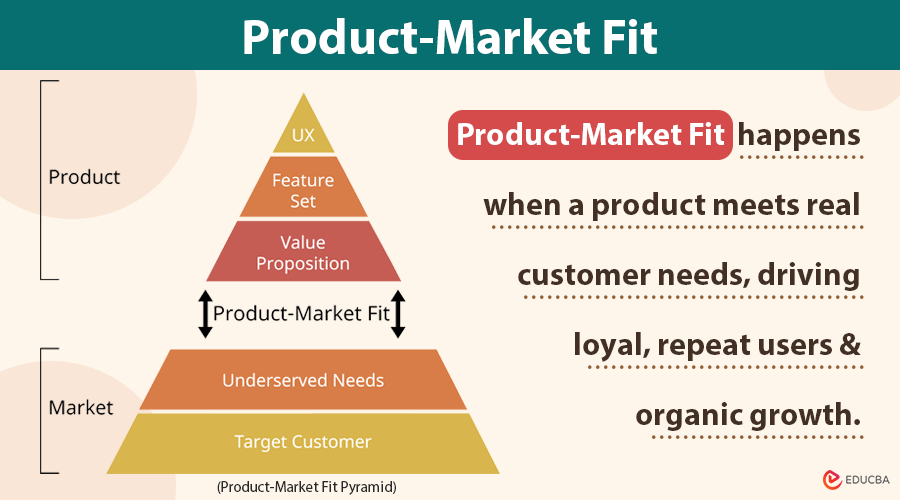
Achieving PMF can be simplified using the Product-Market Fit Pyramid, a framework introduced by Dan Olsen. This model breaks down the PMF into five interconnected layers, helping businesses move from understanding their customers to delivering a product that truly resonates with their audience.
1. Target Customer
Identify and define your ideal users. Understand their demographics, pain points, motivations, and what they value most in a solution.
2. Underserved Needs
Identify specific problems or gaps in the market that current solutions overlook or fail to address. These unmet needs form the foundation of your product strategy.
3. Value Proposition
Clearly articulate how your product uniquely solves customer problems faster, better, or more affordably than existing alternatives.
4. Feature Set
Design and prioritize the core features that deliver on your value proposition. Focus on functionality that directly addresses customer pain points.
5. User Experience (UX)
Create an intuitive, enjoyable experience that enhances usability and satisfaction. A seamless UX ensures users not only try your product but also continue to use and recommend it.
The Product-Market Fit Pyramid illustrates that PMF is not achieved solely by features; it is built layer by layer, beginning with a profound understanding of customers and culminating in a product that fulfills their genuine needs.
How to Achieve Product-Market Fit?
Reaching product-market fit requires a strategic blend of research, testing, and adaptation. Businesses that follow a structured approach can validate their ideas faster and minimize wasted effort.
1. Identify a Market Problem
Start by researching market gaps and understanding the challenges your target customers face. Identify problems that lack effective solutions. A deep understanding of these pain points ensures your product idea remains relevant and valuable.
2. Develop a Minimum Viable Product (MVP)
Develop a basic version of your product that focuses on solving the main problem. This MVP helps you test ideas, collect feedback, and confirm the concept before committing to full development.
3. Test with Real Users
Present your MVP to a select group of real users and analyze their interactions. Collect honest feedback on usability, functionality, and value. These insights reveal whether your product truly meets the needs of your customers.
4. Refine the Product Continuously
Use the feedback you gather to improve the product. Address usability issues, remove unnecessary features, and refine elements that customers value most. Continuous iteration bridges the gap between your initial vision and actual market expectations.
5. Measure Product-Market Fit
Track key indicators, including customer satisfaction scores, retention rates, and organic referrals. If users actively engage with your product and express disappointment at the thought of losing it, you are close to achieving product-market fit.
6. Scale After Validation
Once you confirm product-market fit, invest confidently in marketing, sales, and operations. Scaling after validation ensures your resources support a product the market already values, preventing costly missteps and wasted efforts.
Indicators of Product-Market Fit
Recognizing when you have achieved product-market fit is essential for deciding when to scale your business. The following signs indicate that your product strongly resonates with your target market:
- Frequent Usage and High Satisfaction: Customers use your product regularly and express genuine satisfaction with its value and performance.
- Organic Growth and Referrals: Word-of-mouth and organic traffic outpace paid marketing efforts as happy users share their experiences.
- Lower Churn, Higher Retention: Customers stay longer, renew subscriptions, or repurchase consistently, signaling deep trust in your product.
- Daily Integration: The product becomes an indispensable part of users’ daily lives or work routines.
- Natural Attention and Investment: Media outlets, influencers, or investors show interest without aggressive outreach.
When customers say, “I can’t imagine working without this,” your product has truly found its market.
Common Mistakes to Avoid
Many businesses struggle to achieve or sustain product-market fit because they overlook key fundamentals. By avoiding these frequent errors, companies can conserve time, money, and energy:
1. Scaling Too Early
Expanding before confirming product-market fit often leads to high costs, wasted resources, and poor customer retention. Validate your product’s demand before increasing scale.
2. Ignoring Customer Feedback
Relying solely on your own vision can create a disconnect between your product and the needs of your users. Actively listen to customers and adapt based on their insights to stay aligned with market expectations.
3. Targeting the Wrong Audience
Even the most innovative products fail when they focus on the wrong customer segment. Identify and fine-tune your target audience to make sure your product reaches the people who genuinely need it.
4. Focusing Only on Growth Metrics
Vanity metrics, such as downloads, sign-ups, or followers, may appear impressive, but they do not guarantee engagement or satisfaction. Focus instead on retention, active usage, and customer loyalty for meaningful growth.
Real-World Examples of Product-Market Fit
Several successful companies have reached product-market fit by identifying customer pain points and adapting their offerings to meet real needs:
- Airbnb: The company initially struggled to attract users until it discovered that travelers wanted affordable, authentic local experiences — not just a place to stay. By focusing on this insight, Airbnb transformed the hospitality industry.
- Slack: Initially created for an unsuccessful gaming venture, Slack realized its true strength after users highlighted its efficient and effortless communication functions. The company pivoted to focus entirely on team collaboration, becoming a global leader in workplace messaging and collaboration.
- Netflix: Starting as a DVD rental service, Netflix recognized a shift in customer preferences toward instant, on-demand entertainment. Its move to streaming content perfectly matched audience expectations and redefined how people consume media.
These examples demonstrate that achieving product-market fit necessitates adaptability, a profound understanding of customers, and the willingness to pivot when necessary. Businesses that listen and evolve around their users’ needs build lasting success.
How to Measure Product-Market Fit?
Measuring product-market fit helps businesses validate whether their product truly satisfies market needs. Several proven metrics and frameworks can reveal how well your offering aligns with customer expectations:
1. Retention Rate
A high retention rate shows that customers consistently find value in your product and choose to keep using it over time. Strong retention is one of the clearest indicators of lasting product-market fit.
2. Net Promoter Score (NPS)
The NPS evaluates how willing customers are to recommend your product to others. A high score indicates strong loyalty and satisfaction, which are key signals that your product resonates with its audience.
3. Cohort Analysis
Cohort analysis tracks user behavior across specific time periods. By studying how different groups engage and stay active, companies can gauge satisfaction, identify patterns, and spot early signs of churn.
4. The Sean Ellis Test
Ask customers, “How would you feel if you could no longer use this product?” If more than 40% of respondents answer “very disappointed,” it is a strong indication that your product has achieved product-market fit.
Evolving Product-Market Fit Over Time
Achieving product-market fit is only the beginning. To sustain success, businesses must continually adapt to shifting customer preferences, evolving market dynamics, and emerging technological innovations.
- PMF is continuous: It represents a constant cycle of growth and adaptation in response to shifting market trends.
- Adapt to customer needs: As preferences and expectations shift, businesses must adjust their products to stay relevant.
- Embrace innovation: Technological advancements create new opportunities to enhance product value and user experience.
- Monitor market trends: Regularly track industry shifts to anticipate changes that may impact demand.
- Stay customer-focused: Consistent feedback collection helps ensure the product continues to meet real needs.
- Maintain flexibility: Companies that adapt quickly to change sustain their product-market fit and competitive advantage over time.
Final Thoughts
Achieving product-market fit is one of the most critical milestones for any business. It validates that your product genuinely solves a real problem for a clearly defined audience and creates sustainable demand. When a company reaches this stage, growth becomes more organic, customer loyalty strengthens, and marketing efforts yield higher returns.
However, it is not a one-time accomplishment; it is an ongoing journey. Markets evolve, customer expectations shift, and technology continuously advances. Businesses that stay adaptable, listen to user feedback, and refine their products accordingly are the ones that sustain long-term success and remain relevant in competitive markets.
Frequently Asked Questions (FAQ’s)
Q1. How long does it take to achieve product-market fit?
Answer: The timeline varies for every business. Some startups achieve product-market fit within months, while others may take years to achieve it. It depends on the complexity of the product, market readiness, and the speed at which feedback is implemented.
Q2. Can product-market fit be lost over time?
Answer: Yes. Market trends, customer needs, and technology are constantly evolving. A product that fits the market today may lose relevance if it fails to adapt to changing preferences or emerging competitors.
Q3. Is product-market fit different for B2B and B2C companies?
Answer: The core concept remains the same, aligning the product with customer needs, but the approach differs. B2B companies often rely on deeper relationships and longer sales cycles, while B2C companies focus on scalability and quick adoption.
Q4. How can startups validate product-market fit with limited resources?
Answer: Startups can conduct small-scale experiments, use low-cost tools for surveys and analytics, and build MVPs to test hypotheses before investing heavily in full-scale development.
Recommended Articles
We hope this guide on Product-Market Fit was helpful. Explore related articles on Product-Led Growth, Market Development Strategy, and Customer Retention Tactics to learn more about building and sustaining successful products.

