


Residential Proxies in Digital Marketing: Overview
Digital marketing in 2025 revolves around managing multiple accounts across various platforms, including Facebook Ads, TikTok, Google, Instagram, and e-commerce networks. For agencies and affiliate teams, scaling campaigns means handling not one or two accounts, but dozens. The challenge is that platforms are quick to detect patterns: too many logins from the same IP, repeated device fingerprints, or unusual traffic all raise red flags. The result can be shadow bans, blocked accounts, and wasted budgets. To stay ahead, marketing teams rely on residential proxies in digital marketing. By using real ISP-based IPs, campaigns appear natural, accounts remain “warm,” and scaling multiple profiles becomes safe and predictable.
The Account Management Dilemma in Digital Marketing
Digital platforms actively protect themselves from misuse. When too many accounts log in from the same IP address, algorithms mark this as suspicious. Add in repeated device fingerprints, identical browsing patterns, or a sudden spike in activity, and the risk of detection grows.
For marketers, the cost of bans is more than losing a single profile. Budgets can vanish mid-campaign, ad performance data can get lost, and sometimes entire client relationships face risk. Even shadow bans, where accounts appear active but are silently limited, can undermine weeks of work. This is why scaling beyond two or three accounts becomes risky without proper infrastructure in place. What appears to be simple account management on the surface actually requires a network design that mimics real-world user behavior.
How Residential Proxies in Digital Marketing Provide Safety?
Residential proxies provide a safety net for digital marketing teams. Because these IPs link to real internet service providers, they generate natural traffic patterns that platforms inherently trust. Accounts appear to operate like genuine local users, rather than being managed centrally from a single office.
With city- and ISP-level targeting, marketers can mirror the online footprint of actual customers in different regions. This adds depth to campaigns and reduces the chance of detection. For teams planning budgets, evaluating the right proxy price is essential it helps balance scale, stability, and cost-efficiency when running multiple accounts. Session management is another key advantage. Some accounts need long-term stability, staying “warm” with sticky IPs. Others benefit from a distributed load, where rotating addresses spreads out activity. Residential proxies give marketers both options, making account management flexible and secure.
Applications of Residential Proxies in Digital Marketing
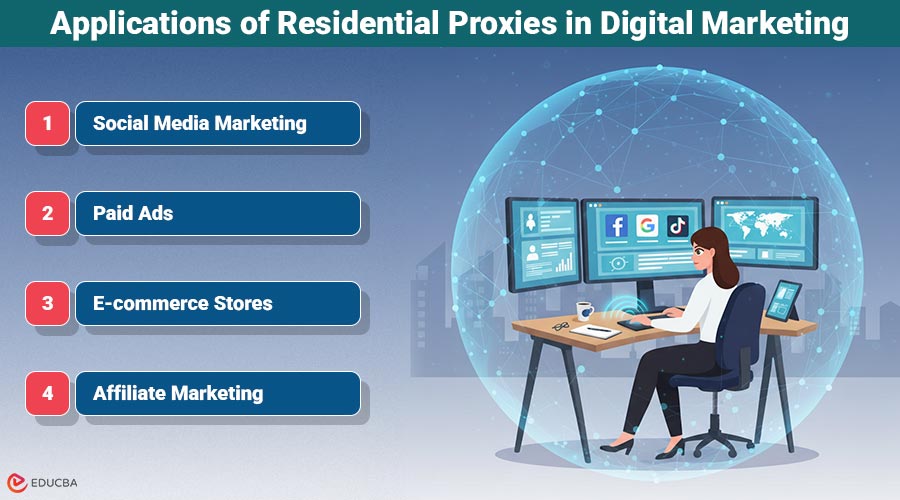
Here are the key ways residential proxies are applied in digital marketing across various campaigns.
1. Social Media Marketing
Social campaigns demand volume. One team might run twenty or more profiles across Facebook, Instagram, and TikTok for different clients. Without residential proxies, all those accounts connect from the same network, and platforms quickly connect the dots. Using diverse residential IP addresses makes each profile appear independent, reducing the risk of sudden bans.
2. Paid Ads
Scaling ads on Google requires more than good copy. Multiple accounts logging in from a single location often trigger security systems designed to block fraud. Residential proxies help distribute this activity, letting marketers expand campaigns across regions without constant interruptions or account verifications.
3. E-commerce Stores
For e-commerce, every shop needs its own digital identity. Reviews, customer support, and storefront management must appear authentic. Residential proxies give each store a unique presence, tied to specific cities or ISPs. This maintains the credibility of local operations and shields shops from platform scrutiny.
4. Affiliate Marketing
Affiliate marketers rely on testing many offers simultaneously. Dozens of accounts may be required to experiment with creatives and landing pages. Residential proxies sustain this process by assigning one IP per account, running campaigns in parallel, and distributing risk across stable connections.
Building Operational Stability with Residential Proxies
Proxies are more than a ticket to log in. They help build stability in daily workflows. Teams often choose between shared proxy pools for flexibility and dedicated lines for long-term accounts. Both approaches have value, depending on the campaign. Dashboards and monitoring tools are essential. They allow managers to track account health, flag anomalies early, and reduce downtime.
There is also a direct budget impact. Lower ban rates translate into lower cost per acquisition (CPA). Every blocked account adds overhead; every active account extends the life of a campaign. Finally, integration matters. Residential proxies work best when paired with automation tools, such as trackers, bots, and anti-detect browsers. Together, they form a technical backbone that keeps digital marketing campaigns efficient and secure.
Case Study: Gonzo Proxy for Digital Marketing
An agency managing campaigns for multiple clients faced frequent account bans, resulting in significant budget losses. Initially, accounts on Facebook Ads, TikTok, and Google appeared manageable, but many were blocked within a short period, affecting campaign performance. The solution was implementing Gonzo Proxy, which provided each account with a dedicated residential IP in the appropriate city and maintained sticky sessions. This reduced the appearance of duplicate accounts and minimized the number of blocks. The ability to select specific ISPs and control load further enhanced stability.
Integration with anti-detect browsers and automated IP rotation simplified account management, saving time and reducing manual errors. Prompt support via Telegram ensured smooth operations and optimized session settings. As a result, campaigns ran reliably, and cost per acquisition decreased due to fewer bans and less wasted creative effort. Today, the agency views Gonzo Proxy as a core part of its infrastructure, providing stability, prolonging account life, and ensuring consistent client results.
Final Thoughts
Using residential proxies in digital marketing is essential for scaling campaigns safely across multiple accounts. They provide realistic user behavior, support geo-targeting, ensure session stability, and integrate seamlessly with automation tools. Whether managing social media, paid ads, e-commerce stores, or affiliate campaigns, residential proxies help marketers protect accounts, optimize budgets, and maintain operational efficiency.
This infrastructure is no longer optional it is a critical component for teams aiming to succeed in the competitive digital landscape of 2025.
Frequently Asked Questions (FAQs)
Q1. How many accounts can I safely run with residential proxies?
Answer: You can typically run one account per unique IP to minimize the risk of bans or verification checks. With a large proxy pool, marketing teams can safely manage hundreds of accounts in parallel, as long as each session is isolated and secure.
Q2. Do I need dedicated or rotating IPs for ads?
Answer:
- Dedicated IPs are useful if you need long-term, stable sessions (e.g., managing business manager accounts).
- Rotating IPs are more suitable for activities such as bulk ad testing, scraping competitor data, or refreshing campaigns across multiple geographies.
- Most marketing teams use a hybrid approach, combining sticky sessions for account logins with rotation for high-volume tasks.
Q3. Can multiple team members share one pool?
Answer: Yes, most enterprise-grade providers allow team members to share a proxy pool under one subscription. This ensures consistent performance while keeping account identities separate. Look for services with multi-user dashboards and granular usage stats to manage this effectively.
Q4. What about billing and scaling costs?
Answer: Residential proxies are typically billed by traffic (in GBs) rather than by the number of IP addresses.
- Small teams may start with plans ranging from 1 to 10 GB.
- Agencies and large ad teams often scale to over 100 GB of data monthly.
- Costs scale with volume, but smart allocation (rotating IPs only when needed, using sticky for stability) helps keep expenses predictable.
Recommended Articles
We hope this guide to residential proxies in digital marketing helps you manage multiple accounts safely and effectively scale your campaigns. Check out these recommended articles for more such topics.


