


Updated May 25, 2026
How AI Improves the Accuracy of Video Transcription?
In recent years, the process of converting spoken words into written text has become increasingly important for accessibility, content analysis, and SEO. To efficiently use a video to text converter, many rely on AI video transcription tools. These systems leverage machine learning models to not only speed up the transcription process but also enhance its accuracy, making them an indispensable tool for businesses and content creators.
Comprehending AI Video Transcription
The emergence of Artificial Intelligence has revolutionized digital communication, with video transcription being a prime example of its transformative power. Essentially, transcription involves transforming spoken words into written text. Although past transcription methods heavily depended on human labor or rule-based programs, AI-powered transcription tools utilize natural language processing (NLP), machine learning, and advanced neural networks to deliver significantly faster and more precise results.
Unlike traditional tools that struggle with accents, specialized vocabulary, or background noise, AI transcription models train on vast datasets covering diverse speech patterns. This capacity for self-learning enables AI systems to persistently evolve and adapt to new accents, dialects, and even niche industry language, thereby enhancing their reliability for professional and commercial uses.
The Enhancement of Accuracy through Artificial Intelligence
AI improves transcription accuracy in several key ways, which are as follows:
1. Improving Speech Recognition Accuracy
AI transcription software uses automatic speech recognition (ASR) systems, which train extensively on diverse audio recordings. These systems decipher words by examining acoustic patterns, changes in tone, and phonetic structures. Through exposure to thousands of hours of spoken language, the systems learn to distinguish subtle differences in pronunciation, vocal pitch, and intonation, resulting in a marked decrease in errors compared to older transcription techniques.
2. Contextual Understanding
A key advantage of AI video transcription is its capability to grasp context. Earlier systems often failed when encountering homophones (e.g., “their” vs. “there”) or technical phrases. AI, however, applies NLP to assess surrounding words and the overall sentence structure. This contextual awareness allows it to choose the most appropriate transcription, whether it is for legal discussions, medical terminology, or technical product demonstrations.
3. Noise Reduction
Background noise has long been a challenge in transcription, particularly for recordings made in uncontrolled environments such as conferences, busy offices, or outdoor interviews. AI models integrate sophisticated noise-canceling algorithms that isolate human speech from ambient sounds. This ensures that transcriptions remain clear and accurate, even when recordings come from low-quality equipment.
4. Real-Time Transcription
Traditional transcription methods required waiting for hours or even days to receive final transcripts. AI has introduced the possibility of real-time transcription, where speech is converted into text instantly as the conversation unfolds. This capability is highly valuable for live broadcasts, online meetings, virtual classrooms, and webinars, enabling participants to access accurate transcripts on the spot.
Benefits of Using AI Video Transcription
Here are some of the main advantages that make AI transcription a valuable tool for businesses and content creators.
1. Faster Turnaround Times
AI-based transcription platforms can process hours of recorded content within minutes. This efficiency is critical for industries that work with large volumes of video, such as media, education, and corporate communications. By automating the transcription process, teams can focus their time on analysis, decision-making, and content creation instead of manual typing.
2. Higher Consistency
Human transcribers may vary in skill, style, or concentration, leading to inconsistencies across transcripts.AI video transcription tools, such as ScreenApp follow standardized rules and algorithms that produce consistent results across projects. Whether transcribing a two-minute promotional clip or a two-hour documentary, the consistency in terminology and formatting remains intact.
3. Cost Efficiency
While investing in AI transcription software may appear costly at first, the return on investment is significant. Automated transcription reduces the need for large teams of human transcribers and minimizes the expenses associated with corrections or rework. Over time, businesses save both money and labor hours while maintaining quality output.
Common Applications of AI Video Transcription
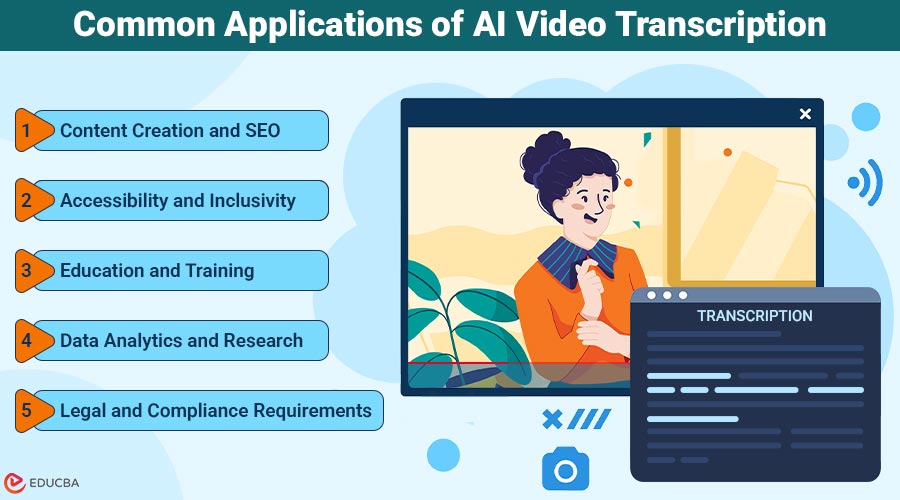
Industries and professionals use AI video transcription in a variety of scenarios. Here are some of the most common applications:
1. Content Creation and SEO
For content creators, transcription adds measurable value. Written transcripts improve search engine optimization (SEO) by making video content discoverable through text-based searches. A video with an accompanying transcript has a higher chance of ranking in search results, thereby reaching wider audiences. Additionally, transcripts can be repurposed into newsletters, blog posts, or social media captions, maximizing the return on a single piece of content.
2. Accessibility and Inclusivity
AI-powered transcription plays a crucial role in making content accessible to individuals with hearing impairments. By providing accurate captions and subtitles, creators ensure compliance with accessibility standards while fostering inclusivity. This not only benefits users but also enhances brand reputation by demonstrating commitment to equal access.
3. Education and Training
In academic and professional training environments, transcription supports learning by providing written records of lectures, seminars, and instructional videos. Learners can revisit transcripts to reinforce their understanding, while institutions can archive these materials for future reference. Real-time transcription also supports remote and hybrid learning models, ensuring that participants do not miss key points even in unstable network conditions.
4. Data Analytics and Research
Researchers and businesses often rely on qualitative analysis of interviews, focus groups, and recorded discussions. Manual transcription of such content is time-intensive. AI enables large-scale transcription, followed by text analysis tools that can identify themes, sentiment, or frequently mentioned terms. This accelerates the process of turning raw conversations into actionable insights.
5. Legal and Compliance Requirements
In legal proceedings, accurate transcription is essential for maintaining records of testimonies, hearings, or depositions. Similarly, businesses in regulated industries use transcription to maintain compliance with documentation requirements. AI reduces delays and ensures reliable records that meet regulatory standards.
Challenges and Considerations
While AI transcription delivers remarkable advantages, it is not entirely without challenges. Factors such as heavy accents, overlapping speech, or highly technical jargon may still require human review. Furthermore, organizations must pay attention to data privacy, as transcribing sensitive recordings through third-party platforms may introduce security concerns. Many modern AI video transcription providers address this by offering encrypted services or on-premises solutions for industries handling confidential information.
Another consideration is the ethical responsibility of using AI in transcription. Automated systems may occasionally generate biased interpretations, especially if the training data lacks diversity. Continuous improvement in dataset inclusivity and algorithm refinement is necessary to ensure fairness and accuracy across global user bases.
Future of AI Video Transcription
The future of AI transcription points toward even greater accuracy and integration with other technologies. As models continue to evolve, transcription tools will not only capture spoken words but also detect emotions, speaker identities, and conversational intent. This expanded functionality can enrich applications in customer support, user experience analysis, and multilingual communications.
Another area of advancement is multilingual transcription and translation. Emerging AI systems are capable of transcribing speech in one language and simultaneously translating it into another. This feature has significant implications for international businesses, online education, and global media distribution. Integration with video editing tools is also becoming common. Transcripts can serve as searchable indexes within video platforms, allowing editors to locate specific sections of footage quickly. This streamlines the production process and enhances content management efficiency.
Final Thoughts
AI video transcription converts spoken content into text, transforming how videos are documented and analyzed. With advanced speech recognition, contextual understanding, noise reduction, and real-time processing, AI surpasses traditional transcription methods in speed and accuracy. The technology supports SEO, accessibility, education, compliance, and research, making content more inclusive, actionable, and strategically valuable. As AI transcription tools continue to advance, they will become even more integrated, multilingual, and context-aware, solidifying AI’s role as a powerful tool for businesses, content creators, and institutions worldwide.
Recommended Articles
We hope this guide to AI video transcription helps improve your workflow and content accessibility. Check out these recommended articles for more tips and insights on leveraging AI transcription effectively.


