
Introduction to Types of Phishing Attacks
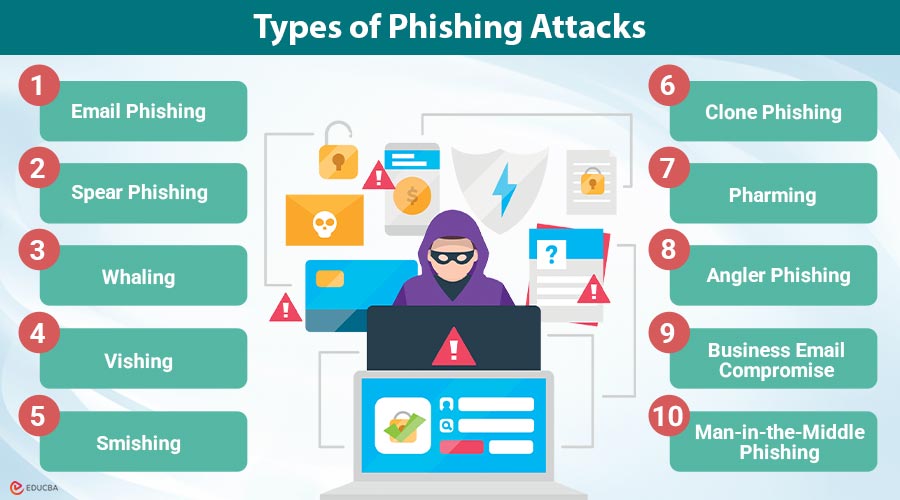
Phishing attacks are deceptive cyber threats in which attackers impersonate trusted entities to steal sensitive data, such as login information, credit card details, or personal data. These attacks exploit human psychology and digital trust, often through emails, phone calls, or messages. Understanding different types of phishing attacks is important for individuals and organizations to identify, prevent, and defend against these increasingly sophisticated and widespread cybercrimes.
Different Types of Phishing Attacks
Lets see the most common and dangerous forms of phishing attacks:
#1. Email Phishing
Email phishing is the most extensive form of phishing, where attackers send bulk emails impersonating trusted institutions. These emails frequently include harmful attachments, links, or phony login pages that are intended to fool recipients into disclosing private information like credit card numbers or passwords.
How it Works:
These emails often contain:
- Urgent language (e.g., “Your account will be suspended!”)
- Links to fake login pages
- Malicious attachments
#2. Spear Phishing
Spear phishing is a focused type of phishing attack that uses carefully tailored messages aimed at specific individuals or organizations. Attackers research their victims and often impersonate trusted colleagues or superiors to trick recipients into sharing sensitive data, transferring money, or opening malicious links or attachments.
How it Works:
- Often aimed at specific individuals within an organization.
- The message appears to come from a trusted colleague or boss.
- May include details such as the recipient’s name, job title, or recent transactions.
#3. Whaling
Whaling is a phishing attack targeting high-ranking executives, including CEOs and CFOs. Attackers impersonate other top officials or legal departments to deceive these individuals into authorizing large financial transfers or disclosing confidential information, exploiting their authority and access to critical company resources.
How it Works:
- Attackers mimic high-level executives using lookalike domains or compromised accounts.
- Focus is often on financial gain or data theft.
#4. Vishing
Vishing uses phone calls rather than of emails or texts to deceive victims. Scammers impersonate representatives from banks, tax agencies, or tech support, using urgency or fear to manipulate users into revealing sensitive personal, financial, or security information over voice communication.
How it Works:
- The caller pretends to be from a legitimate institution (e.g., bank, IRS, tech support).
- Asks for personal or financial details under pretenses.
#5. Smishing
Smishing attacks utilize fake SMS messages to deceive recipients into disclosing private information or clicking on malicious links. These communications often contain urgent or disturbing content to encourage prompt action and frequently appear to be from reliable sources, such as banks, delivery services, or government organizations.
How it Works:
- Victims receive a fake text message with a link or prompt.
- Often impersonates delivery services, banks, or government agencies.
#6. Clone Phishing
In clone phishing, cybercriminals replicate a legitimate email that the victim previously received. They copy the original message but replace attachments or links with malicious versions and send it from a spoofed or compromised email address to appear authentic and trustworthy, deceiving recipients easily.
How it Works:
- Attackers copy the contents of the original email.
- Attackers swap attachments or links with malicious versions.
- Sent from a spoofed address.
#7. Pharming
Without the users’ knowledge, pharming diverts them from trustworthy websites to fraudulent ones. By compromising DNS servers or infecting devices, attackers deceive victims into believing they are visiting a legitimate website when, in fact, they are entering sensitive data on a fake, attacker-controlled site.
How it Works:
- Attackers exploit DNS servers or infect a user’s machine.
- Attackers redirect users to a fake version of the site even when they type a correct URL.
#8. Angler Phishing
Angler phishing leverages social media platforms to deceive users. Attackers pose as customer service agents or company representatives, engaging victims through comments or direct messages. They send malicious links under the guise of assistance, luring users into giving up credentials or downloading malware. In addition to brand impersonation, bad actors on social platforms frequently manipulate individuals through cyber-extortion tactics like sextortion.
How it Works:
- Fake customer support profiles engage with victims.
- Attackers share links to phishing sites via comments or DMs.
#9. Business Email Compromise
BEC targets employees managing business finances or sensitive data. Attackers spoof or hack executive or vendor email accounts, sending requests for wire transfers or sensitive documents. These schemes are highly convincing and often result in significant financial or data losses for organizations.
How it Works:
- Attackers compromise or spoof business emails.
- Pose as executives or vendors requesting wire transfers or sensitive data.
#10. Man-in-the-Middle Phishing
MitM phishing occurs when attackers intercept communication between two parties, usually via unsecured public Wi-Fi. Attackers secretly monitor or alter transmitted data during a session to capture login credentials, session tokens, or private information, often without the victim’s awareness.
How it Works:
- Attacker sets up a fake Wi-Fi network or hijacks an existing one.
- Captures credentials and session cookies in real-time.
Final Thoughts
Phishing is not a single technique, but a multifaceted cybercrime strategy that continues to evolve. From generic email traps to highly targeted executive-level frauds, phishing attacks are capable of causing severe financial and reputational damage. Building a strong cybersecurity defense begins with understanding the various types of phishing attempts.
Frequently Asked Questions (FAQs)
Q1. What is the most common type of phishing?
Answer: Email phishing remains the most common due to its low cost and high reach.
Q2. Can phishing happen over phone calls?
Answer: Yes, this is called vishing, where attackers impersonate trusted entities over the phone.
Q3. What should I do if I fall for a phishing scam?
Answer: Immediately change your passwords, enable MFA, report to your IT department or bank, and monitor for unauthorized activity.
Q4. Are phishing attacks illegal?
Answer: Yes, phishing is a criminal offense under cybersecurity and fraud laws globally.
Recommended Articles
We hope that this EDUCBA information on “Types of Phishing Attacks” was beneficial to you. You can view EDUCBA’s recommended articles for more information.


