


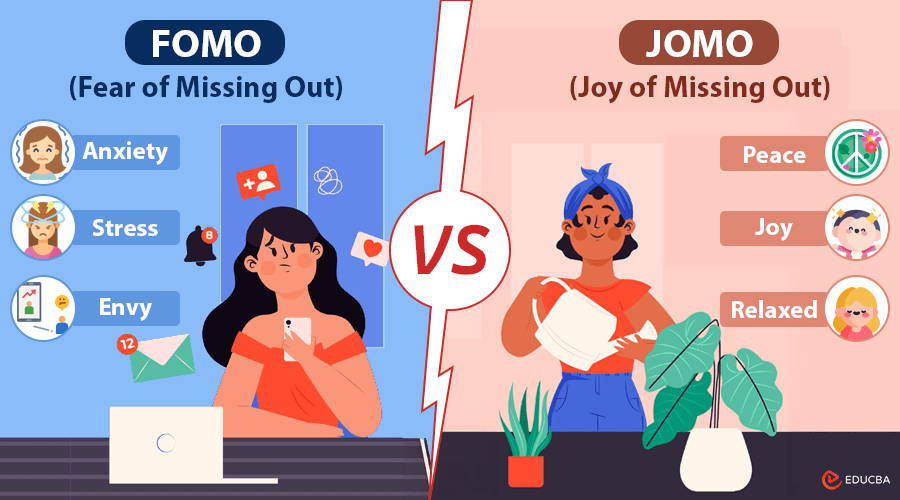
Introduction to FOMO vs. JOMO
Have you ever opened social media and suddenly felt that everyone else was having more fun, traveling more, achieving more, or living a better life? Or have you ever decided to put your phone away, skip an event, and genuinely enjoy having time to yourself?
These two experiences illustrate the basic idea behind FOMO vs. JOMO.
FOMO means Fear of Missing Out, while JOMO means Joy of Missing Out. FOMO involves concern that other people may be having rewarding experiences without you. JOMO, in contrast, describes finding satisfaction in intentionally stepping away from activities, updates, or social pressure and focusing on what matters to you.
Although they are often presented as opposites, FOMO and JOMO are more nuanced than simply “bad” versus “good.” Understanding the difference can help you develop a healthier relationship with social media, social activities, work, and your own time.
Table of Content
- What is FOMO?
- What is JOMO?
- FOMO vs. JOMO: Key Differences
- Is JOMO Better Than FOMO?
- How to Shift from FOMO to JOMO?
- FOMO vs. JOMO: Which Mindset Should You Choose?
What is FOMO?
FOMO stands for Fear of Missing Out. It refers to the uneasy feeling that other people may be enjoying valuable, exciting, or rewarding experiences while you are absent.
FOMO can make you feel as though you constantly need to know what others are doing, where they are going, what they are buying, or what opportunities they are pursuing.
For example, imagine spending a quiet Friday evening at home. You open Instagram and see several friends attending a party. Even though you were perfectly comfortable a few minutes earlier, you suddenly start thinking:
- “Should I have gone?”
- “Am I missing something important?”
- “Why wasn’t I there?”
- “Everyone seems to be having more fun than me.”
That shift from contentment to worry is a simple example of FOMO.
FOMO is not limited to parties or social events. People may experience it in relation to careers, travel, relationships, investments, shopping, entertainment, education, and many other areas of life.
Common Signs of FOMO
Experiencing occasional FOMO does not necessarily indicate a serious problem. However, frequent FOMO may influence how you spend your time and make decisions.
Common signs may include:
- Frequently checking social media for updates
- Feeling uncomfortable when you do not know what friends are doing
- Comparing your life with other people’s online lives
- Saying yes to activities primarily because you fear being excluded
- Finding it difficult to disconnect from your phone
- Checking notifications during work, study, meals, or conversations
- Feeling disappointed after seeing other people’s achievements
- Worrying that you chose the wrong event, opportunity, purchase, or activity
- Constantly looking for something more interesting to do
- Feeling pressure to keep up with trends.
The central theme is not simply being active or social. It is the fear of missing out.
What Causes FOMO?
FOMO usually does not have one single cause. Instead, different psychological, social, and technological factors may contribute to it.
1. Social Comparison
People naturally compare themselves with others.
However, digital platforms can expose users to many people at once. If those people primarily share holidays, promotions, celebrations, purchases, achievements, and other positive moments, the comparison can become distorted.
You may begin comparing your ordinary daily life with someone else’s selected highlights.
2. Desire to Belong
People generally value social connection and belonging. Therefore, discovering that friends or colleagues participated in an activity without you can sometimes feel uncomfortable.
The fear of exclusion can encourage people to remain constantly connected.
3. Too Many Choices
Modern life offers enormous choice.
You might have multiple social events, streaming services, career opportunities, restaurants, products, courses, travel destinations, and entertainment options available at once.
More options can sometimes create another question:
“What if another choice would have been better?”
That uncertainty can contribute to FOMO.
4. Notifications and Constant Connectivity
Smartphones let you receive updates throughout the day.
Messages, notifications, trending topics, breaking news, new videos, sales, and social-media posts can create the impression that something is always happening.
As a result, disconnecting may feel like falling behind.
5. Limited-Time Opportunities
Messages such as:
- “Only 2 left”
- “Sale ends tonight”
- “Trending now”
- “Limited seats”
- “Don’t miss out”
can create urgency.
Sometimes that urgency reflects a genuinely limited opportunity. In other situations, it may simply increase the pressure to act quickly.
Recognizing the difference can help you make more deliberate decisions.
Examples of FOMO in Everyday Life
FOMO can appear in many situations.
- Social FOMO: Your friends are attending a gathering, and you feel compelled to go even though you are exhausted.
- Career FOMO: You see former classmates announcing promotions on LinkedIn and begin questioning your career progress.
- Travel FOMO: You repeatedly see travel photographs and start feeling that you are wasting your life because you are not traveling as often.
- Shopping FOMO: A website announces a limited-time sale, and you buy something you had not planned to purchase because you fear losing the deal.
- Investment FOMO: An asset rises rapidly in price, and you feel pressure to invest because everyone appears to be making money.
- Entertainment FOMO: A new series becomes popular, and you feel you must watch it immediately to join the conversation.
These situations are different, but they share a common psychological element: the fear that something valuable is happening elsewhere.
What is JOMO?
JOMO stands for Joy of Missing Out. It describes the satisfaction that can come from intentionally choosing not to participate in everything and being comfortable with that decision.
JOMO does not necessarily mean rejecting social interaction, deleting every app, or avoiding opportunities.
Instead, it involves recognizing that you do not have to participate in every event, conversation, trend, or opportunity to live a satisfying life.
Imagine the same Friday-night scenario.
Your friends are attending a party, but you are tired and want a quiet evening. You see their photographs online and think:
“They look like they are having fun. I am glad they are enjoying themselves, but I am happy staying home tonight.”
That response captures the basic idea of JOMO.
You recognize what you are missing without automatically assuming that you should be there.
Common Signs of JOMO
JOMO is not simply about staying home or avoiding social activities. It is more about feeling comfortable with your choices without constantly worrying about what you might be missing.
Common signs of JOMO may include:
- Feeling comfortable declining invitations that do not interest you
- Enjoying time alone without constantly checking social media
- Being able to put your phone away without worrying about updates
- Focusing on your current activity instead of wondering what others are doing
- Making decisions based on personal priorities rather than social pressure
- Feeling less need to compare your experiences with those of others
- Setting boundaries around work, social activities, and technology
- Accepting that you cannot participate in every opportunity
- Enjoying quiet or unplanned time
- Feeling satisfied with your choices even when others choose differently.
A key sign of JOMO is the ability to think, “I know I am missing something, and I am comfortable with that choice.”
What Encourages JOMO?
Unlike FOMO, JOMO is generally associated with intentionally stepping away from constant comparison and external pressure. Several habits and circumstances may encourage a JOMO mindset.
1. Clear Personal Priorities
Knowing what matters to you can make it easier to decide which opportunities deserve your time.
For example, if spending time with family is a priority, you may feel comfortable declining another social event without worrying about what you are missing.
2. Healthy Digital Boundaries
Constant notifications can make disconnecting difficult.
Turning off unnecessary notifications, setting phone-free periods, or limiting social media use can create space to focus on the experience in front of you.
3. Less Social Comparison
JOMO becomes easier when you stop evaluating your life primarily against other people’s experiences.
Instead of asking:
“What is everyone else doing?”
you begin asking:
“What do I want to do?”
4. Acceptance of Trade-Offs
Every choice involves giving something else up.
If you spend Saturday traveling, you cannot spend the same Saturday relaxing at home. If you accept one professional opportunity, you may need to decline another.
JOMO involves accepting these trade-offs rather than constantly worrying about the alternatives.
5. Comfort With Solitude
Being comfortable spending some time alone can make it easier to enjoy activities without requiring constant social participation.
This does not mean avoiding relationships. It means recognizing that time alone can also be valuable.
6. Intentional Decision-Making
JOMO is easier when you base choices on your goals, energy, interests, and priorities rather than pressure from other people.
The question changes from:
“What if I miss out?”
to:
“Is this worth my time and attention?”
Examples of JOMO in Everyday Life
Like FOMO, JOMO can show up in social life, work, shopping, travel, entertainment, and other everyday situations.
- Social JOMO: Your friends invite you to a late-night party, but you are tired and would rather stay home. You decline the invitation without repeatedly checking what everyone is doing. You are not upset about missing the party because resting is more important to you that evening.
- Social Media JOMO: You put your phone away during dinner and do not feel compelled to check notifications. You know that new posts and messages may appear, but you are comfortable responding later.
- Career JOMO: Several colleagues begin pursuing a new professional certification. Instead of enrolling immediately because everyone else is, you evaluate whether the qualification actually supports your career goals. If it does not, you comfortably choose not to pursue it.
- Travel JOMO: You see friends posting photographs from international holidays. Instead of comparing your life with theirs, you appreciate their experiences while remaining comfortable with your own plans and financial priorities.
- Shopping JOMO: An online store announces a major limited-time sale. Rather than buying something simply because the discount is ending, you ask whether you actually need the product. You decide not to purchase it and feel comfortable missing the deal.
- Investment JOMO: A particular investment suddenly becomes popular, and people begin discussing large potential returns. Instead of investing out of fear of missing the opportunity, you evaluate whether it fits your financial goals, risk tolerance, and investment strategy. If it does not, you are comfortable staying out.
- Entertainment JOMO: Everyone seems to be discussing a popular new series, but you are not interested in watching it. Instead of watching simply to keep up with conversations, you spend your free time on something you genuinely enjoy.
- Weekend JOMO: Your weekend has no major plans. Instead of assuming an empty schedule means you are missing out, you enjoy having time to rest, read, exercise, pursue a hobby, or simply do nothing.
FOMO vs. JOMO: Key Differences
| Basis | FOMO | JOMO |
| Full Form | Fear of Missing Out | Joy of Missing Out |
| Core Feeling | Concern about missing experiences | Contentment with intentional choices |
| Attention | What others are doing | What matters to you now |
| Social Media | Desire to keep checking | Comfort with disconnecting |
| Decision-Making | May be influenced by external pressure | More intentionally guided by priorities |
| Comparison | Often involves comparison with others | Less dependent on comparison |
| Social Events | “I should go so I don’t miss anything.” | “I can skip this if it isn’t right for me.” |
| Technology | Pressure to stay updated | Willingness to disconnect |
| Opportunities | Desire to pursue many possibilities | Acceptance that not every opportunity must be pursued |
| Mindset | “What am I missing?” | “Is this important to me?” |
Is JOMO Better Than FOMO?
Not necessarily in every situation.
FOMO can occasionally provide useful information.
For example, seeing friends participating in activities might make you realize that you genuinely want more social connection. Seeing colleagues develop new skills might motivate you to invest in your professional development.
The problem occurs when fear, not personal values, consistently controls your choices.
Similarly, JOMO becomes less helpful if it turns into an excuse to avoid meaningful relationships, responsibilities, or experiences you genuinely want.
Therefore, the objective is not necessarily:
FOMO = bad
JOMO = good
A healthier question is:
“Am I making this choice because it matters to me, or because I am reacting to pressure, comparison, or fear?”
How to Shift from FOMO to JOMO?
Moving from FOMO to JOMO does not require abandoning technology or becoming less social. It involves becoming more intentional about where you direct your attention.
1. Identify Your FOMO Triggers
Notice when FOMO appears.
Ask yourself:
- Does it happen after using Instagram?
- When colleagues discuss promotions?
- When friends travel?
- During sales?
- When investment prices rise?
- When you decline social invitations?
Identifying triggers makes the feeling easier to understand.
2. Ask “Do I Actually Want This?”
Before responding to an invitation or opportunity, ask:
“Would I still want this if I didn’t know what everyone else was doing?”
This simple question can separate genuine interest from social pressure.
3. Reduce Unnecessary Notifications
Not every update requires immediate attention.
Consider turning off notifications that repeatedly interrupt your day without providing meaningful value.
4. Schedule Social Media Time
Instead of checking your phone automatically throughout the day, choose specific times to check social platforms.
The goal is intentional use rather than automatic checking.
5. Stop Treating Other People’s Highlights as Complete Stories
Online posts rarely show every aspect of someone’s life.
A holiday photograph does not show every stressful moment.
A promotion announcement does not show years of uncertainty.
A successful business post does not reveal every failure.
Remembering this can make online comparison more realistic.
6. Practice Saying No
Every “yes” uses time that could have been spent elsewhere.
Before committing, ask:
- Is this important?
- Do I genuinely want to participate?
- Do I have enough time and energy?
- What am I giving up by saying yes?
Choosing deliberately is an important part of JOMO.
7. Create Phone-Free Activities
Try activities where your phone is not constantly accessible, such as:
- Walking
- Exercising
- Reading
- Cooking
- Spending time with family
- Meeting friends
- Pursuing a hobby
- Working on a personal project.
This can help reduce the habit of constantly checking what is happening elsewhere.
8. Define What Matters to You
JOMO becomes easier when your priorities are clear.
If your priorities are family, health, learning, financial stability, or meaningful relationships, it becomes easier to evaluate opportunities against those values.
9. Accept Trade-Offs
You cannot attend every event, pursue every career path, visit every destination, watch every series, follow every trend, or accept every opportunity.
Choosing one path inevitably means missing another.
JOMO involves accepting that reality without assuming that every unchosen option represents a loss.
10. Focus on Your Current Experience
When you choose something, try to give it your attention.
If you decide to spend Saturday evening reading, enjoy reading rather than checking whether another activity might have been better.
If you attend a dinner, participate in the conversation rather than continuously monitoring other events online.
FOMO vs. JOMO: Which Mindset Should You Choose?
The objective is not to eliminate FOMO permanently or avoid every exciting opportunity.
Instead, aim for intentional participation.
Attend events because you want to attend.
Pursue opportunities because they align with your goals.
Use social media because it provides value.
Buy products because you need or genuinely value them.
Take breaks because rest matters.
Say no when an opportunity does not fit your priorities.
In other words, JOMO is not about missing everything. It is about being comfortable missing the things you consciously decide are not important to you.
Final Thoughts
The discussion around FOMO vs. JOMO reflects a broader challenge of modern life: we have access to more information, opportunities, entertainment, products, and social updates than we can consume.
FOMO, or Fear of Missing Out, can make people worry that better experiences are happening somewhere else. JOMO, or Joy of Missing Out, emphasizes becoming comfortable with intentional choices and accepting that it is impossible and unnecessary to participate in everything.
The goal is not to disconnect from the world completely. It is to develop a healthier relationship with choice.
When faced with the fear of missing something, ask yourself:
“Do I genuinely want this, or am I simply afraid of being left out?”
That question can help turn FOMO into more intentional decision-making and, sometimes, JOMO.
Frequently Asked Questions (FAQs)
Q1. Can you experience both FOMO and JOMO at the same time?
Answer: Yes, it is possible to feel both emotions depending on different situations. You might enjoy solitude (JOMO) but still feel left out when seeing social events online (FOMO).
Q2. Is FOMO always related to social media?
Answer: No, FOMO can also stem from real-life situations, such as missing workplace events, social gatherings, or even trends and opportunities.
Q3. Is JOMO a sign of introversion?
Answer: Not necessarily. Even extroverts can embrace JOMO by choosing when to engage socially and when to enjoy personal time without guilt.
Q4. Does FOMO ever have positive effects?
Answer: Sometimes, FOMO encourages you to try new things, but it needs careful handling.
Recommended Articles
We hope this guide helped you understand FOMO vs. JOMO and its impact on your well-being. Check out these recommended articles for more insights on mindful living and digital wellness.

