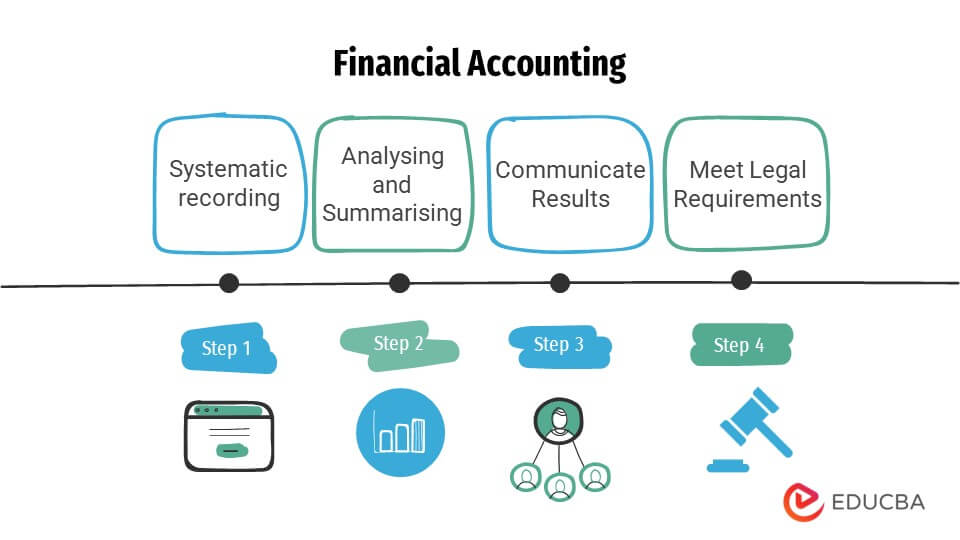
Financial accounting is the process of classifying, summarizing, analyzing, and reporting an organization’s financial transactions for a specific period.
For instance, every month, Mr. X purchases goods from company ABC. In this case, the company will record all invoices and receipts concerning Mr. X to analyze sales gained from Mr. X.
Companies can consistently apply these standard rules and procedures in order to achieve reliable results. Most importantly, it is used to prepare financial statements, such as income statements, balance sheets, and cash flow statements. It takes a company’s raw data, such as sales and revenue, and performs critical calculations to produce valuable reports.
Key Highlights
- Financial accounting measures a company’s performance by summarizing its various financial transactions for a period. It generally involves recognizing and measuring business transactions through financial statements.
- The three primary financial statements are the balance sheet, income statement, and statement of cash flows. Financial accounting also uses two bases: accrual and cash.
- Companies use them as internal tools to analyze performance and their ability to meet future commitments. It also helps communicate with external parties like stockholders, banks, suppliers, and regulators.
- When preparing financial statements, organizations must follow accounting principles such as objectivity, revenue recognition, and the cost principle. Many businesses also partner with global accounting firms for expert guidance on compliance, outsourced accounting, and accurate financial reporting, especially for complex or cross-border operations. Using the best accounting software for small businesses can help ensure these principles are followed efficiently while also simplifying financial statement preparation.
How Does Financial Accounting Work?
Financial accounting begins with recording transactions in the company’s accounting system. Transactions can include sales, purchases, payments, receipts, and other financial events. These transactions are recorded using the double-entry accounting system, which ensures every transaction has equal debit and credit entries.
Let’s say ABC Inc. sells a product to a customer for $1,000. The sale generates revenue for ABC Inc. To record this transaction in the company’s accounting system, the following entries are made using the double-entry accounting system:
| Account | Debit | Credit |
| Accounts Receivable | $1,000 | |
| Sales Revenue | $1,000 |
In this example, the debit and credit entries are equal and opposite, as the double-entry accounting system requires. By recording this transaction, ABC Inc. has recorded an increase in its revenue and assets. This information can be used to prepare financial statements such as income and balance sheets.
Financial Accounting Principles
Financial accounting follows established principles and reporting concepts to maintain consistency, transparency, and reliability. The applicable requirements depend on the accounting framework and jurisdiction. Some important principles and concepts include:
1. Cost Principle
- It clearly states that there should be an accurate record of all cost transactions
- It includes costs incurred to acquire goods, services, and even assets
- For instance, if an employer purchases services from employees and pays them wages. There should be a definitive salary transaction record, including the amount and the payee’s name.
2. Matching Principle
- According to this principle, companies must record income and expenses together
- It simplifies the understanding of how much a business has to spend to earn revenue
- For example, a company purchases products at the beginning of the year (January). The sales for the inventory come in till the end of March. The company has to record the purchase amount and sales together in March.
3. Revenue Recognition Principle
- It is a crucial principle as it presents a company’s current financial position
- It requires companies to file the sales amount as soon as they sell the product and not when they receive the cash
- Suppose company XYZ makes sales of $25,000 on credit. They will receive the cash amount in 90 days. However, they should document the sales amount now and not wait for the cash in hand.
4. Objectivity Principle
- The presentation of financial documents that the company participates in without bias is an example of objectivity
- The data must be verifiable and must reflect a neutral view of the activities
- Suppose an employee incurs business expenses on the company’s account but has no receipt or bill to verify the claims. The firm cannot record transactions.
5. Consistency Principle
- This principle indicates that a business must carry uniformity in its methods through their accounting period
- An organization can change its accounting techniques only after completing the current year’s financials
- For example, a firm follows the cost method to record its transactions. Midyear, they realize its limitations and want to switch to an accrual method. However, they can do so only after finishing their current accounting year.
Types of Financial Accounting
Businesses generally use two primary methods to record transactions: accrual accounting and cash-basis accounting.
1. Accrual Accounting Method
- This method records all sales and purchases as they happen, even if no money changes hands. For example, if a customer pays $500 on their credit card, the company will record $500 as income, even if it takes two weeks to process the transaction
- This method allows you to track the money customers owe to the business (accounts receivable) and the money the company owes to suppliers (accounts payable)
- It does a better job of matching income with expenses. However, it is difficult to apply, as to keep track of outstanding invoices, one must use additional accounts, which might increase costs and complexity
- While using this, expenses begin to accrue as soon as you receive the purchased product/service, regardless of the payment date
- It is ineffective at tracking cash, as the income statement may show funds even if there’s no cash on hand
- With high sales, accrual accounting may result in a higher tax bill.
2. Cash Accounting Method
- Here, a sale does not count until you receive payment from your customer, and a purchase does not matter until you pay for the products or services. Simply put, transactions only count when cash changes hands
- This method makes it simple to track your cash flow and avoid cash shortages, benefiting people who have no accounting experience
- It is based on cash flow (sales to customers) and cash flow from operations (purchases made from suppliers)
- As sales do not record until you receive payment from your customers, it may result in a lower tax bill. However, even expenses don’t count until the final payment, so one cannot deduct expenses to save tax
- Cash-basis accounting does not match income with expenses. Therefore, this can be a problem if you buy products one month and sell them the next.
Financial Accounting Reporting
Financial accounting produces several reports that help stakeholders understand a company’s financial performance and position.
1. Income Statement
- The profit and loss account reports the flow of income and expenses in the company over the year. The result of an exercise can be either a profit or a loss
- When creating an accounting report, this statement helps reflect a company’s ability to generate wealth, which is the economic goal of every business
- The balance sheet and profit and loss account ratios accurately represent the year’s outcome. If there is a profit, net worth increases; otherwise, net worth decreases.
2. Balance Sheet
- It is unquestionably a fundamental accounting report that reflects a company’s patrimonial situation at any given time
- Provides information on accumulated wealth and its financing
- It has two parts: assets and liabilities. At the end of a financial year, a company ensures that the assets and liabilities should be equal on the balance sheet.
3. Cash Flow Statement
- The treasury report is another name for the cash flow statement report
- It reflects a fiscal year’s liquidity performance, both its generation & consumption
- Its interpretation can be critical in making decisions in situations of excess or scarcity of liquidity.
Examples of Financial Accounting Using Apple’s Financial Statements
Apple’s Consolidated Income Statement
According to Apple’s financial statements, the company reported net income of $132,175 million in fiscal 2026, compared with $112,010 million in fiscal 2025.
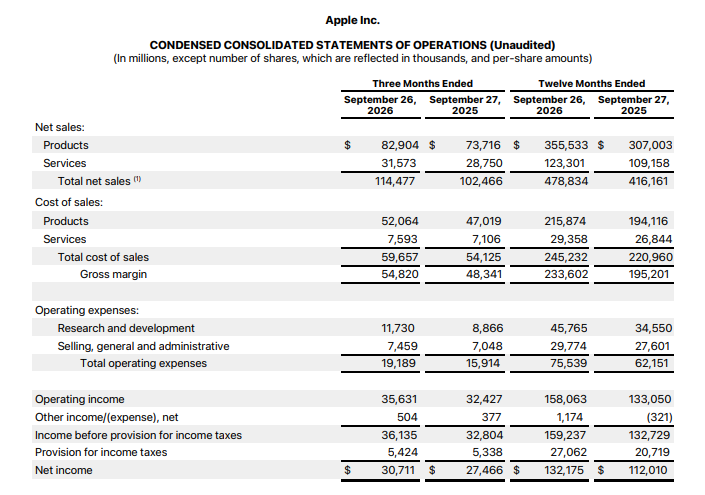
- Apple’s total net sales increased from $416,161 million in 2025 to $478,834 million in 2026.
- Operating income increased from $133,050 million to $158,063 million.
- Net income rose about 18% to $132,175 million in 2026.
- The company reported gross margin of $233,602 million, compared with $195,201 million in the previous fiscal year.
Apple’s Consolidated Balance Sheet
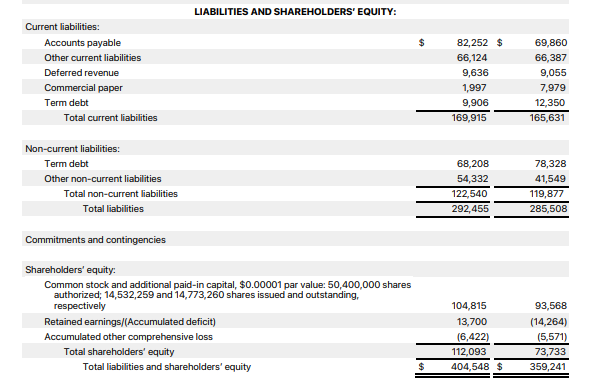
The balance sheet provides information about Apple’s assets, liabilities, and shareholders’ equity as of September 26, 2026, compared with September 27, 2025.
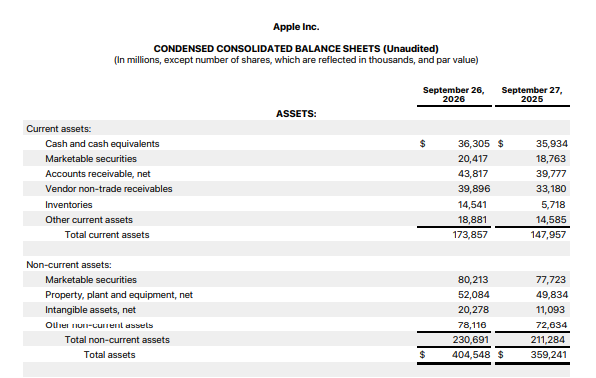
- Total current assets increased from $147,957 million in 2025 to $173,857 million in 2026.
- Total non-current assets increased from $211,284 million to $230,691 million.
- Total liabilities increased from $285,508 million to $292,455 million.
- Shareholders’ equity increased from $73,733 million to $112,093 million.
- Total assets increased from $359,241 million to $404,548 million.
Apple’s Consolidated Cash Flow Statement
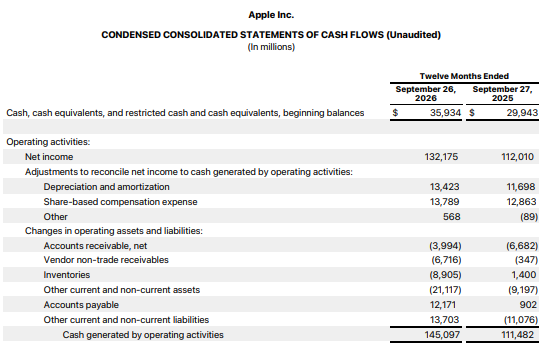
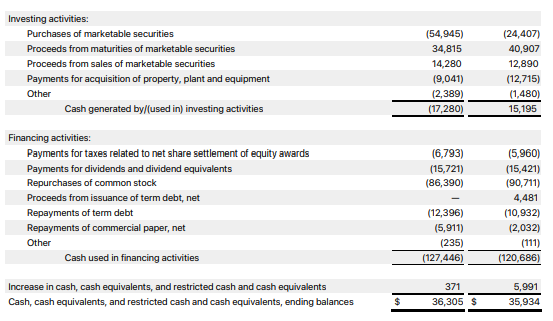
- Cash generated by operating activities increased from $111,482 million in 2025 to $145,097 million in 2026.
- Cash used in investing activities was $17,280 million in 2026, compared with cash generated of $15,195 million in 2025.
- Cash used in financing activities increased from $120,686 million in 2025 to $127,446 million in 2026.
- Apple’s cash, cash equivalents, and restricted cash rose from $35,934 million at the start of fiscal 2026 to $36,305 million by year-end.
Financial Accounting Journal Entry
- Journal entries are the basis of recording every business transaction efficiently. We can classify journal entries as simple or composite. While a single journal entry files a single debit-credit activity, a composite journal entry may include multiple debit-credit entries
- Journal entries allow businesses to classify their transactions into manageable data. They provide a chronological summary of debit and credit financial transactions and note the affected accounts.
Example:
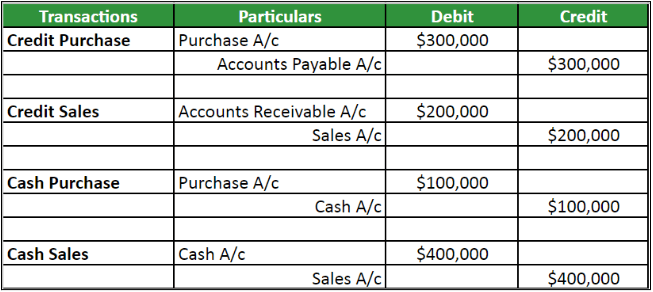
Consider a fictional company, ABC Traders, that records the following transactions:
- Credit Purchase = $300,000
- Credit Sales = $200,000
- Cash Purchase = $100,000
- Cash Sales = $400,000
The journal entries will be,
Financial Accounting Standards
Financial Accounting Standards were developed to unify and standardize how companies manage their accounting. These are various rules governing how to record the balances of a company’s accounts. It ensures that the financial statements accurately reflect the business’s economic situation. Generally Accepted Accounting Principles (GAAP) and International Accounting Standards (IAS) are common accounting standards.
Financial Accounting Standards Board (FASB)
- Founded in 1973, FASB is an independent body established by the American Institute of Certified Public Accountants (AICPA). It is recognized as a standard-setting body by the International Federation of Accountants
- It provides U.S. accounting standards for private enterprises and non-profits, which include accounting for assets, liabilities, equity, revenue, and expenses
- Their standards are updated regularly through exposure drafts, which allow public participation and comment before formal approval
- ASCs focus on establishing accounting principles for general-purpose financial reports. The goal is that all companies in a given market, such as a country or industry sector, must apply these consistently
- It makes financial information more comparable between companies and, therefore, more useful for business and investment decisions.
Some prominent ASC standards are,
| Standard | Name |
| ASC 205 | Presentations of Financial Statements |
| ASC 210 | Balance Sheet |
| ASC 215 and 225 | Shareholder Equity and Income Statement |
| ASC 230 | Statement of Cash Flow |
| ASC 310 | Receivables |
| ASC 330 | Inventory |
International Financial Reporting Standards (IFRS)
- The IASC was established in 1973 when ten countries built this regulatory body. It later came to be known as IFRS
- They developed a set of standards for preparing and presenting financial statements. These standards are known as IAS standards
- The purpose is to ensure companies issuing shares on different stock exchanges present financial results using the same accounting principles.
Some prominent IAS standards are:
| Standard | Name |
| IAS 1 | Financial Statement Presentation |
| IAS 7 | Statement of Cash Flow |
| IAS 8 | Accounting Policies, Changing In Accounting Estimates, and Errors |
| IAS 15 | Revenue from Contracts with Customers |
| IAS 27 | Consolidated and Individual Financial Statements |
| IAS 28 | Investments in Related Companies |
Careers in Financial Accounting
People with financial accounting skills can choose various career paths in finance. Here is a list of jobs that one can pursue,
1. Financial Analyst
- They are responsible for analyzing the company’s financials along with market trends and external factors
- They advise the management on future investment strategies and predict the returns on current investments
- The average salary for this role is $71250.
2. Financial Controller
- Financial controller primarily oversee the various finance departments of the company
- They create and present financial reports like financial statements, performance reports, and many more
- The salary for this position averages $101484.
3. Financial Accounting Manager
- The primary task for the managers is to maintain a connection with other departments and acquire the necessary information
- They also have to ensure that the records and reports adhere to accounting standards and principles
- The salary for this position is an average of $90426.
4. Chief Financial Officer (CFO)
- Their principal duty is to supervise the management of budgeting, financial planning, accounting, and much more
- They are also authorized to build strategies, policies, and regulations to sustain efficiency and consistency in the company
- Their average salary is $155370.
5. Finance Manager
- The critical role is to create financial forecasts, manage current & future budgets, provide valuable feedback to the staff
- They guide monthly income & expenses and track overspending or in-budget transactions
- This role’s salary is $107564.
How Does Financial Accounting Support Business Operations?
Financial accounting is a critical part of business operations because it provides essential information that helps managers and other stakeholders make informed decisions. Here are some ways financial accounting supports business operations:
- Monitoring financial performance: Financial accounting provides information on a company’s financial performance, such as revenues, expenses, profits, and cash flow. This information helps managers monitor the company’s financial health and make decisions to improve its operations.
- Planning and budgeting: Financial accounting information helps develop budgets and financial plans for the business. By analyzing past financial performance, managers can identify areas where they must allocate more resources and plan accordingly.
- Facilitating investment decisions: Investors and creditors use financial accounting information to make investment decisions. By providing accurate, reliable financial statements, a company can attract investors and secure financing to support its operations.
- ompliance with regulatory requirements: Financial accounting plays a vital role in complying with regulatory requirements. Companies must adhere to various accounting standards, laws, and regulations, and financial accounting ensures that they follow these rules and report their financial information accurately.<
- Facilitating communication: Financial accounting provides a common language for communicating financial information to stakeholders. Companies can effectively communicate financial information to investors, creditors, and other stakeholders using standardized financial statements and accounting principles.
Role of Financial Accounting in Budgeting
Financial accounting plays a critical role in budgeting. Budgeting involves developing a plan for allocating resources over a specific period, typically one year. Here are some ways financial accounting supports budgeting:
- Historical financial data: Financial accounting provides historical financial data that can be used to forecast future financial performance. This data can support budget assumptions, such as revenue growth rates, expense trends, and capital expenditure needs.
- Cost analysis: Financial accounting provides cost data to analyze expenses and identify areas for cost savings. This information is critical in developing a budget that maximizes profitability while minimizing costs.
- Revenue analysis: inancial accounting provides revenue data to analyze sales trends, customer behavior, and market conditions. This information is critical in developing a budget that maximizes revenue growth and profitability.
- Capital expenditure planning: Financial accounting provides information on the company’s capital expenditure needs, such as investments in property, plant, and equipment. This information is critical for developing a budget that includes the capital expenditures needed to support the company’s growth and operations.
- Performance monitoring: Financial accounting provides performance data that can be used to compare actual results with budgets. This information is critical in identifying variances and taking corrective action to keep the company on track to meet its financial goals.
Challenges in Financial Accounting
Financial accounting can present a range of challenges. Some of the most common include:
- Complexity: Financial accounting can be complex, involving a range of rules, regulations, and standards that can be difficult to navigate. The complexity can be further compounded by the size and nature of the organization, making it difficult to develop an appropriate accounting system
- Timeliness: Financial accounting must be done promptly, requiring accurate and up-to-date information available to key decision-makers. This can be challenging, particularly in larger organizations with complex financial structures, where information may be spread across multiple departments and systems
- Accuracy: Financial accounting requires a high degree of accuracy, and even minor errors can cause significant problems. This can be challenging when dealing with large volumes of data or complex transactions and requires attention to detail and a rigorous approach to record-keeping
- Compliance: Financial accounting must comply with various regulations, standards, and laws, which can vary by jurisdiction and industry. Ensuring compliance requires an in-depth understanding of the relevant rules and regulations, which can be challenging to maintain in a constantly changing environment
- Technology: Financial accounting is becoming increasingly technology-driven, with a growing range of tools and systems available to automate and streamline processes. However, implementing new systems can be challenging and requires significant investment of time and resources to ensure they integrate properly with existing systems and processes.
How to Address Ethical Challenges in Financial Accounting?
Addressing ethical challenges in financial accounting is crucial to maintaining the integrity and credibility of financial reporting. To address these challenges effectively, take several steps.
- Establish a code of ethics: Develop a code of ethics that outlines the principles and values that guide financial accounting practices. The code should be communicated to all stakeholders and serve as a reference point for making ethical decisions
- Implement internal controls: Establish internal controls to ensure financial transactions are properly authorized, recorded, and reported. Internal controls can help prevent fraud, errors, and other unethical behavior
- Provide training and education: Provide ongoing training and education for financial accounting staff to ensure they understand the importance of ethical behavior and the consequences of unethical conduct
- Encourage whistleblowing: >Establish a process for whistleblowers to report unethical behavior or concerns without fear of retaliation. This can help identify and address unethical behavior before it becomes a more significant problem
- Conduct regular audits: Conduct regular audits of financial records to ensure that they are accurate and comply with relevant accounting standards and regulations. Audits can help detect errors, omissions, or irregularities and help address them promptly
- Hold individuals accountable: Hold individuals accountable for any unethical behavior, including fraud, misrepresentation, or other violations of the code of ethics. This can help deter future unethical behavior and reinforce the importance of ethical conduct.
Financial Accounting vs. Management Accounting vs. Cost Accounting
These three branches of accounting serve distinct purposes within an organization.
Financial Accounting
- It concerns a company’s past data and its performance analysis
- Companies employing this accounting technique must adhere to several rules and principles set by the regulatory bodies
- It helps outsiders, such as shareholders, investors, and creditors, assess the company’s financial health.
Management Accounting
- This accounting technique tries to provide a glimpse into the company’s future. It usually focuses on the present to make decisions about future investments and strategic planning
- Companies create these reports for internal use, i.e., for the information requirements of management within an organization
- This information is unregulated and not available to the public.
Cost Accounting
- This accounting approach oversees only the cost expenditures of a business
- It allows measuring expenses to predict capital available to the company in the future and design efficient budgeting plans
- Businesses use this process to build internal reports.
Accounting vs. Financial Accounting
| Accounting | Financial Accounting |
| It records, classifies, summarizes, and analyzes transactions that occur in an organization. | It is a subset of accounting. Therefore, following the same process for specific data. |
| It deals with both internal and external transactions | It deals with only external transactions |
| This process helps prepare various kinds of statements. Example: Statement of shareholder’s equity | This process helps in creating financial statements. Example: Income statement |
| It encompasses all transactions, even non-monetary | It deals with monetary transactions |
| Accountants’ education is not as specialized. | Accountants should specialize in financial accounting. |
Why Is Financial Accounting Important?
Financial accounting plays an important role in maintaining a business’s financial stability and transparency.
- It is essential for regularly monitoring the company’s commercial operations and can help keep records of a company’s financial events
- By examining financial data, one can track spending and corresponding outcomes over time. Therefore, they can assess the significance of a company’s expenses for its operations
- Additionally, it can help carry out concrete actions to determine which operations to reduce and which to prioritize
- It makes transmitting financial information to internal users of the company simple. Such as, participants or partners can view financial reports to evaluate their invested finances
- The financial statements usually provide an overall picture of the company’s profitability. Understanding these reports can help you make better decisions.
Final Thoughts
Future Outlook for Financial Accounting
The future of financial accounting is dynamic and constantly evolving. Technological advancements, globalization, cloud accounting software, and regulatory reform are some of the primary drivers of change. To succeed in this rapidly changing landscape, businesses must remain informed about emerging trends and technologies. They also need to adapt proactively to stay competitive.
Resources for Learning More About Financial Accounting
Many resources are available for learning more about financial accounting, such as textbooks, online courses, professional organizations, industry publications, and online resources. The key is to find the best resources for you and commit to ongoing learning and development.
Frequently Asked Questions (FAQs)
Q1. Who uses financial accounting?
Answer: The primary audience for financial accounting is investors, creditors, vendors, and others who need information about a business’s finances. Other users include auditors, regulatory bodies, banks, etc.
Q2. What are financial accounting and advisory services?
Answer: Financial Accounting Advisory Services usually offer financial management advice. Individuals or businesses that need financial counseling often seek experienced professionals. This type of work is known as financial advisory services and generally falls into two categories, personal and business. Accounting firms and independent financial advisory firms offer these services.
Q3. What is the objective of financial accounting? Why is it important?
Answer: Financial accounting ensures the business operates efficiently, on time, and in compliance with legal regulations. Moreover, financial accounting is a fundamental pillar because it tracks income and expenses, which helps determine available capital. Additionally, financial accounting helps verify timely payments and invoices, prevent fraudulent activities, and prepare documents required by law, among other benefits.
Q4. Name a few limitations of financial accounting.
Answer: While financial accounting can provide insight into a business’s performance, it has a few limitations. Financial statements don’t give much information about a company’s internal operations. The classification technique can be complex and inconvenient. Moreover, companies using different ways to create their financial statements cannot be effectively compared across industries.
Recommended Articles
We hope this guide to financial accounting helps you understand its principles, processes, and importance in business. Check out these recommended articles for more insights into accounting practices and strategies for effective financial management.