


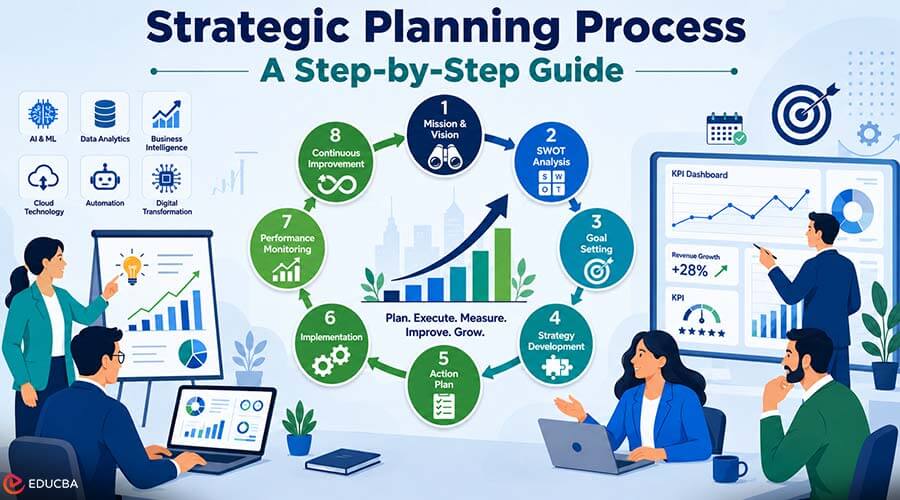
In today’s fast-changing business environment, organizations need more than short-term plans to remain competitive. They require a clear roadmap that aligns their vision, resources, and decision-making with long-term objectives. The strategic planning process enables organizations to prioritize key initiatives, adapt to changing market conditions, and support long-term business growth.
Strategic planning is an ongoing process of evaluating an organization’s current position, setting future goals, developing strategies, and monitoring progress. Whether an organization is a startup, a nonprofit, or a global enterprise, an effective strategic plan guides informed decision-making, efficient resource allocation, and adaptability to changing business conditions.
According to Sharplin:
“Strategic Management is defined as the formulation and implementation of plans and carrying out of activities relating to matters that are of vital and pervasive importance to the total organization.”
Today, organizations leverage digital tools, business intelligence, and data analytics to enhance strategic planning and respond proactively to evolving opportunities and business challenges.
Key Takeaways
- Strategic planning provides a structured roadmap for achieving long-term organizational goals.
- A comprehensive planning process begins with environmental analysis and ends with continuous monitoring and improvement.
- SWOT analysis helps organizations identify internal strengths and weaknesses while evaluating external opportunities and threats.
- Clearly defined mission, vision, and strategic goals provide direction for decision-making.
- Action plans translate strategies into measurable tasks and responsibilities.
- Regular reviews and performance monitoring ensure the strategic plan remains relevant and effective.
- Modern technologies, including AI, analytics, and collaboration platforms, support more informed and agile strategic planning.
What is the Strategic Planning Process?
The strategic planning process is a structured method that helps organizations define their future direction and identify the steps required to accomplish their goals. It involves assessing the current business environment, setting strategic priorities, developing actionable plans, and continuously monitoring progress to keep organizational goals aligned with evolving market conditions.
At its core, strategic planning answers three important questions:
- Where are we now?
- Where do we want to be?
- How will we get there?
By answering these questions, organizations can create a practical roadmap that guides decision-making, improves operational efficiency, and supports sustainable growth.
Why is Strategic Planning Important?
Strategic planning establishes a structured approach that supports informed and objective business decisions. Instead of reacting to challenges as they arise, organizations can proactively identify opportunities, minimize risks, and prepare for future growth.
Some key benefits of strategic planning include:
- Aligns organizational goals with long-term vision.
- Improves decision-making through data and performance analysis.
- Enhances resource allocation and budget planning.
- Encourages collaboration across departments and leadership teams.
- Helps organizations respond effectively to market changes and competition.
- Creates measurable objectives for tracking progress and success.
- Supports innovation and continuous improvement.
In today’s digital landscape, many organizations also use strategic planning software and analytics tools to monitor performance, collaborate across teams, and make data-driven decisions more efficiently.
Evolution of Strategic Management
The idea of strategy has evolved over centuries. Originating from the Greek word strategos, meaning “generalship,” it was first used to describe the planning and execution of military campaigns.
Over time, strategy evolved beyond military applications and became an essential component of business management. Modern strategic management focuses on helping organizations achieve long-term success by aligning business objectives with changing customer expectations, technological advancements, and market trends.
Today, strategic management combines traditional planning techniques with modern practices such as:
- Data-driven decision-making
- Digital transformation
- Scenario planning
- Risk management
- Artificial intelligence and predictive analytics
- Agile business planning
This evolution has made strategic planning more flexible, allowing organizations to adapt quickly while maintaining focus on their long-term objectives.
Overview of the Strategic Planning Process
Strategic planning is a collaborative effort involving leadership, management, employees, and key stakeholders. It requires organizations to evaluate their current position, define a clear vision, develop actionable strategies, and regularly monitor progress.
A successful strategic planning process typically includes the following stages:
- Decide on a common strategic planning process.
- Evaluate the internal and external environment.
- Identify strategic issues and priorities.
- Define the organization’s mission, vision, and core values.
- Develop a shared organizational vision.
- Set strategic goals and objectives.
- Formulate strategies to achieve those goals.
- Create an actionable implementation plan.
- Finalize and communicate the strategic plan.
- Monitor, evaluate, and update the strategy regularly.
Each stage builds on the previous one, helping organizations stay focused on their long-term objectives while remaining adaptable to changing business conditions.
Step 1: Decide on a Common Strategic Planning Process
The first step is to establish a standardized planning approach that everyone within the organization understands and follows. A common planning process ensures consistency, improves collaboration, and helps align organizational objectives across departments.
Before beginning the planning process, organizations should:
- Understand the purpose and benefits of strategic planning.
- Define the planning methodology and timeline.
- Assign roles and responsibilities to key participants.
- Ensure leadership commitment throughout the planning process.
- Allocate sufficient financial, technological, and human resources.
Organizations experiencing significant operational or financial challenges should first stabilize their current situation before launching a comprehensive strategic planning initiative.
Form a Strategic Planning Committee
Creating a dedicated strategic planning committee helps coordinate planning activities and ensures representation from different areas of the organization.
The committee may include:
- Board members
- Senior leadership
- Middle management
- Technical and support staff
- Key stakeholders
- External advisors or consultants (when required)
Including diverse perspectives leads to better decision-making and more comprehensive strategic plans.
Allocate Time and Resources
Strategic planning requires focused attention. Organizations should dedicate sufficient time to workshops, planning sessions, discussions, and reviews, while temporarily reducing routine responsibilities for key participants whenever possible.
A structured planning schedule helps maintain momentum and ensures every stage of the process receives sufficient attention.
Step 2: Evaluate and Assess the Environment
Before developing strategies, organizations must understand their current position. Evaluating both the internal and external environment helps leaders identify opportunities, address challenges, and make informed strategic decisions.
This assessment is commonly conducted using a SWOT Analysis, which evaluates an organization’s Strengths, Weaknesses, Opportunities, and Threats.
Analyze the External Environment
The external environment includes factors outside the organization’s control that may influence its performance and long-term success. Understanding these factors enables businesses to anticipate changes and respond proactively.
Key areas to evaluate include:
- Political and regulatory changes that may affect operations.
- Economic conditions, such as inflation, interest rates, and market trends.
- Social and demographic shifts that influence customer behavior.
- Technological advancements, including automation, artificial intelligence (AI), and digital transformation.
- Environmental and sustainability factors that may impact business operations.
- Industry trends and evolving customer expectations.
Organizations should also identify:
- Emerging market opportunities.
- Potential business risks.
- Current and future competitors.
- Strategic partnerships and alliances.
- Funding opportunities and resource availability.
By continuously evaluating external influences, organizations can remain flexible, identify emerging opportunities, and strengthen their competitive position.
Analyze the Internal Environment
An internal assessment focuses on evaluating the organization’s existing capabilities, resources, and overall performance.
Key areas to review include:
- Human resources and workforce capabilities.
- Financial performance and budget allocation.
- Operational efficiency and business processes.
- Technology infrastructure and digital capabilities.
- Organizational culture and leadership.
- Brand reputation and customer satisfaction.
Organizations should also evaluate their performance using three key components:
- Inputs: Human resources, finances, technology, and infrastructure.
- Processes: Existing workflows, operational procedures, and business strategies.
- Outputs: Products, services, customer satisfaction, revenue, and overall business performance.
A thorough internal review highlights strengths to leverage and weaknesses to improve.
Conduct a SWOT Analysis
After gathering internal and external information, organizations should perform a SWOT analysis to summarize their findings.
Strengths may include:
- Strong leadership
- Skilled workforce
- Established brand reputation
- Advanced technology
- Financial stability
Weaknesses may include:
- Limited resources
- Outdated systems
- Skill gaps
- Inefficient processes
- High operational costs
Opportunities may include:
- Expanding into new markets
- Emerging technologies
- Changing customer demands
- Strategic partnerships
- Government incentives
Threats may include:
- Increased competition
- Economic uncertainty
- Regulatory changes
- Supply chain disruptions
- Cybersecurity risks
The results of the SWOT analysis provide a clear picture of the organization’s current position and form the foundation for strategic decision-making.
Step 3: Identify Strategic Issues and Priorities
Once the environmental assessment is complete, organizations should identify the most important issues that need immediate attention. These strategic issues influence long-term success and help determine where leadership should focus its efforts.
Strategic issues often arise from:
- Market changes
- Customer expectations
- Financial challenges
- Operational inefficiencies
- Competitive pressures
- Technological advancements
- Regulatory requirements
The strategic planning committee should review the SWOT analysis and prioritize issues based on their potential impact on organizational goals.
When evaluating each issue, consider questions such as:
- Why is this issue important?
- What risks arise if it is ignored?
- What opportunities could result from addressing it?
- Does it align with the organization’s mission and long-term objectives?
Organizations should rank strategic priorities based on urgency, business impact, available resources, and overall feasibility.
Prioritizing the most critical issues enables organizations to use their resources more efficiently and achieve stronger long-term outcomes.
Step 4: Define the Organization’s Mission, Vision, and Core Values
A successful strategic plan begins with a clear understanding of why the organization exists and what it aims to achieve.
The mission, vision, and core values provide the foundation for strategic decision-making and ensure alignment across the organization.
Define the Mission
The mission statement explains the organization’s purpose and identifies whom it serves.
An effective mission statement should:
- Clearly define the organization’s purpose.
- Describe the value it delivers.
- Reflect customer and stakeholder needs.
- Guide strategic decision-making.
Establish the Vision
The vision statement describes the organization’s desired future state. It provides a clear sense of direction and motivates employees to work toward common long-term objectives.
A strong vision should be:
- Clear and inspiring.
- Future-focused.
- Realistic yet ambitious.
- Easy to communicate throughout the organization.
Identify Core Values
Core values represent the principles that guide organizational behavior and decision-making.
Examples include:
- Integrity
- Innovation
- Accountability
- Customer focus
- Collaboration
- Sustainability
- Excellence
These values influence company culture and ensure consistency across business operations.
Step 5: Create a Shared Organizational Vision
After defining the mission and values, organizations should develop a shared vision that aligns leadership, employees, and stakeholders around common goals.
A shared vision provides clarity about where the organization wants to be over the next three to five years and serves as a roadmap for future growth.
The vision should describe the organization’s future in terms of:
- Products and services
- Market position
- Customer experience
- Brand reputation
- Innovation capabilities
- Financial performance
- Workforce development
- Community impact
- Sustainability initiatives
Creating this vision should involve collaboration across departments rather than relying solely on senior leadership. When employees contribute to the planning process, they are more likely to support and successfully implement the organization’s strategic initiatives.
Once the vision has been established, organizations should communicate it clearly to stakeholders and assess it periodically to keep it aligned with evolving business priorities and industry developments.
Step 6: Set Strategic Goals and Objectives
Once the organizational vision is defined, strategic goals should be developed to support its mission and achieve long-term objectives. These goals provide clear direction and help transform the vision into measurable outcomes.
Strategic goals should address the organization’s key priorities while remaining realistic and achievable. Breaking major goals into manageable, actionable steps helps organizations track progress and assess success more effectively.
Organizations can develop well-defined goals by applying the SMART framework. Goals should be:
- Specific: Clearly state the objective that needs to be accomplished.
- Measurable: Define clear indicators to monitor and evaluate progress.
- Achievable: Ensure the goal is realistic considering the available resources and capabilities.
- Relevant: Make sure the goal supports the organization’s mission and strategic direction.
- Time-bound: Set a clear deadline or timeframe for achieving the goal.
Examples of strategic goals include:
- Increase customer satisfaction over the next three years.
- Expand into new regional or international markets.
- Improve operational efficiency through digital transformation.
- Strengthen employee engagement and retention.
- Enhance sustainability and corporate social responsibility initiatives.
By setting measurable objectives, organizations can evaluate performance consistently and make informed adjustments when necessary.
Step 7: Develop Strategies to Achieve Strategic Goals
After defining strategic goals, organizations must determine how they will accomplish them. This involves developing broad strategies that guide decision-making and resource allocation.
An effective strategy bridges the gap between the organization’s current position and its desired future state. It should answer three important questions:
- Where are we now?
- Where do we want to be?
- How will we get there?
The planning committee and leadership team should evaluate multiple strategic options before selecting the most suitable approach. Factors to consider include:
- Available financial and human resources.
- Market opportunities and competitive landscape.
- Organizational strengths and capabilities.
- Potential risks and challenges.
- Expected return on investment.
Examples of strategic initiatives include:
- Investing in new technologies and automation.
- Expanding product or service offerings.
- Entering new customer segments.
- Strengthening customer relationships through personalized experiences.
- Improving operational efficiency and cost management.
- Building strategic partnerships and collaborations.
Once strategies are finalized, responsibilities should be assigned to the appropriate departments or teams to ensure effective implementation.
Step 8: Develop an Action Plan
A strategic plan is effective only when supported by a practical action plan. This plan outlines the specific activities, timelines, responsibilities, and resources required to implement each strategy successfully.
Each action plan should include:
- Strategic objective.
- Key initiatives and tasks.
- Responsible individuals or departments.
- Timeline and milestones.
- Budget and resource requirements.
- Performance indicators (KPIs).
Because business environments change rapidly, organizations often prepare detailed action plans for the first one or two years while keeping later activities more flexible.
Annual action plans should be reviewed regularly to ensure they remain aligned with strategic priorities and changing business conditions.
The Board typically approves the overall strategic direction, while management and employees are responsible for executing day-to-day activities and reporting progress.
Clear communication and accountability at every level help ensure successful implementation.
Step 9: Finalize and Communicate the Strategic Plan
Once all goals, strategies, and action plans have been developed, the organization should prepare the final strategic planning document.
Although there is no fixed format, an effective strategic plan generally includes:
- Executive summary.
- Mission, vision, and core values.
- Environmental analysis.
- SWOT analysis.
- Strategic goals and objectives.
- Key initiatives and strategies.
- Action plans and implementation timelines.
- Performance metrics and evaluation methods.
- Risk management considerations.
After approval, the strategic plan should be shared with employees, stakeholders, and relevant partners to ensure everyone understands the organization’s direction and priorities.
Many organizations now use digital collaboration platforms and strategic planning software to make plans accessible, improve transparency, and track implementation in real time.
Effective communication encourages alignment across departments and increases employee engagement throughout the implementation process.
Step 10: Monitor, Evaluate, and Review Progress
Strategic planning is not a one-time activity. Organizations should continuously monitor performance, evaluate outcomes, and update strategies as business conditions evolve.
Regular reviews help determine whether strategic objectives are being achieved and identify areas that require improvement.
Key activities include:
- Measuring progress against established KPIs.
- Reviewing annual objectives and milestones.
- Evaluating financial and operational performance.
- Monitoring changes in customer needs and market trends.
- Assessing emerging risks and opportunities.
- Updating strategies based on new insights and business priorities.
Organizations should treat the strategic plan as a flexible guide rather than a rigid document. This enables organizations to respond effectively to technological developments, economic shifts, regulatory changes, and competitive challenges.
Leadership plays a critical role in reviewing progress, while managers and employees contribute by providing performance data, implementation updates, and recommendations for improvement.
Many organizations also use dashboards, business intelligence tools, and AI-powered analytics to monitor strategic performance and support data-driven decision-making.
Regularly reviewing the strategic plan helps organizations stay aligned with their long-term vision while adapting to evolving market conditions.
Best Practices for an Effective Strategic Planning Process
A strategic plan is most successful when it is regularly reviewed, supported by leadership, and embraced across the organization. Following proven best practices can improve implementation and help organizations achieve their long-term objectives.
1. Align Strategic Goals with the Organizational Vision
Every strategic initiative should support the organization’s mission and long-term vision. Clear alignment ensures that all departments work toward common objectives and contribute to overall business success.
2. Involve Key Stakeholders
Strategic planning should not be limited to senior management. Involving employees, department heads, Board members, customers, and other stakeholders encourages diverse perspectives, improves decision-making, and increases commitment to implementation.
3. Use Data to Drive Decisions
Successful organizations rely on accurate data rather than assumptions. Performance metrics, customer insights, market research, and financial analysis help leaders make informed strategic decisions and identify new opportunities.
4. Set Measurable Objectives
Clearly defined objectives make it easier to monitor progress and evaluate performance. Organizations should establish measurable Key Performance Indicators (KPIs) that align with their strategic goals.
5. Remain Flexible
Business environments continue to evolve due to technological advancements, changing customer expectations, and economic conditions. Strategic plans should remain flexible enough to adapt to new opportunities and emerging risks.
6. Review the Plan Regularly
Strategic planning is a continuous process rather than a one-time exercise. Conducting quarterly or annual reviews helps organizations assess progress, update priorities, and maintain alignment with business objectives.
7. Leverage Technology
Many organizations now use strategic planning software, business intelligence dashboards, project management tools, and AI-powered analytics to improve collaboration, monitor performance, and make faster, data-driven decisions.
Common Challenges in the Strategic Planning Process
Even the most well-designed strategic plans can encounter obstacles during implementation. Recognizing these challenges early enables organizations to develop proactive solutions.
Lack of Clear Objectives
Unclear or unrealistic goals can create confusion and make it difficult to measure success. Organizations should establish specific, measurable, and achievable objectives from the outset.
Poor Communication
When employees do not understand the organization’s strategy, implementation becomes inconsistent. Effective communication helps everyone clearly understand their roles and responsibilities.
Resistance to Change
Employees may hesitate to adopt new strategies or processes. Effective change management, leadership support, and regular communication can help overcome resistance.
Limited Resources
Budget constraints, staffing shortages, or inadequate technology can delay implementation. Organizations should prioritize initiatives based on available resources and expected business impact.
Inadequate Performance Monitoring
Without regular reviews, organizations may fail to identify issues before they become significant problems. Tracking KPIs and conducting periodic evaluations help maintain progress toward strategic goals.
Changing Market Conditions
Economic fluctuations, new competitors, evolving regulations, and technological innovations can affect strategic priorities. Organizations should continuously monitor external factors and adjust their strategies when necessary.
Final Thoughts
The strategic planning process is essential for organizations seeking long-term success in an increasingly dynamic business environment. It establishes a structured approach to setting objectives, assessing opportunities and risks, distributing resources, and tracking progress.
However, creating a strategic plan is only the beginning. The real value comes from consistently executing the plan, regularly evaluating progress, and responding to evolving market conditions. Organizations can strengthen their long-term growth and competitive position by consistently reviewing strategies, encouraging collaboration, and making informed, data-driven decisions.
By following a structured strategic planning process and embracing continuous improvement, businesses can confidently navigate uncertainty, seize new opportunities, and build a resilient foundation for future success.
Recommended Articles
We hope this guide on the strategic planning process helps you develop effective strategies and achieve your organization’s long-term goals. Explore these recommended articles for additional insights and best practices to strengthen your strategic management and business planning skills.


