


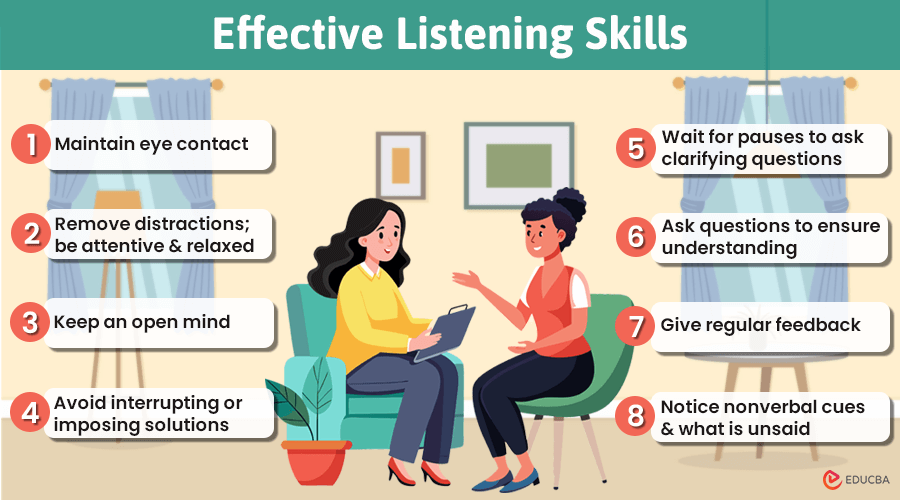
Introduction to Effective Listening Skills
Listening skills hold the key to effective communication. The ability to accurately receive and interpret messages during communication is known as listening. Concentrating along with using other senses is a practical listening skill. If you listen carefully, the communication process will stay smooth despite the misunderstandings, making the sender feel satisfied. Listening has become so crucial in organizations today that several top employers are providing training in effective listening skills to their employees as they are aware that effective listening skills facilitate better satisfaction to the consumers, increase productivity in the workplace, assure adequate information sharing, lead to more innovative and creative work, lesser errors and less wastage of time. At home, effective listening skills help develop children who are self-reliant and resourceful and can solve their problems. It helps in building relationships.
Effective Listening Skills:
1. Maintaining eye contact
It would help if you prepared yourself to listen. Listening to a person while working on a computer screen or scanning the room will only give the speaker a certain percentage of your divided attention. Therefore, facing the speaker and maintaining eye contact is essential for effective listening skills. Maintaining eye contact does not mean you must constantly stare at the speaker. Now and then, you can look away and then resume the conversation usually, but it is vital to be present entirely when someone is speaking to you. If there is something important in between, tell the speaker about it and inform them that you are again ready to listen after completing that work.
2. Remove distractions, be attentive and relaxed
After establishing eye contact, it is important to relax. Distractions like social media, books, papers, and other things should be away, as this behavior will disrupt the listening process and give the speaker a message that you are not interested. Other distractions like noise and activity in the background need to be screened out. Focus your attention on the speaker and what the speaker is trying to communicate by putting other things, like your feelings, thoughts, and biases, out of your mind. Personal prejudices must be avoided, and you must try and be impartial. Besides this, focus less on the speaker’s accent and speech mannerisms; otherwise, they will become distractions. The important thing here is to pay attention to what the speaker is attempting to communicate.
3. Keep an open mind
Listening skills will improve by not judging the speaker or mentally criticizing the things spoken by the other person. If what the speaker says alarms you, then feel alarmed but do not say it out loud, “This move was stupid.” The moment you start to make judgments, you compromise effective communication. Do not jump to conclusions. It should be kept in mind that language represents the feelings and thoughts in the speaker’s brain. These feelings and thoughts can only be interpreted by applying your effective listening skills. Let the speaker complete his sentence and do not try to interrupt and finish the sentences of the listener.
4. Practice active listening and listen to the words of the speaker
The mind should be allowed to create a mental model of the communicated information. The brain will arrange the abstract contacts or form a literal picture. If you are listening for a longer duration, try to concentrate and keep in mind the key phrases and words. You need to focus and only think about what the speaker is saying, even if it may not sound interesting.
Most people think about how they will reply when somebody else is speaking. Direct your focus totally on what is said by the speaker. You should immediately refocus in case your thoughts have begun to wander. Pretend that you have a test on what you have heard and understood. You can sit with a friend or family member and then give them feedback on what you’ve heard. The focus becomes easier when you are not worrying about your response.
5. Do not interrupt or impose “solutions”
The rate at which an individual thinks and speaks is subjective. In case you are a person who thinks quickly and have agility in talking, you need to slow down, relax your pace and listen to the other person who might be having trouble expressing himself or who might be a thoughtful communicator. It would help if you did not interrupt the speaker as it sends indications like you are more important than him, or you have something more interesting, relevant, or accurate to say, or you do not care about what the speaker thinks, or you do not have the time for his opinion or that it is not a conversation but a contest which you are trying to win.
When somebody is talking about a problem, you should refrain from offering solutions as people generally want to be self-reliant and would ask in case they need advice. The other person usually wants you to listen and help him figure out his solution. If you have a perfect solution, take the speaker’s permission by asking him if he would like to hear your ideas and then offer him that solution.
6. If you need to ask clarifying questions, wait for the speaker to pause
If you cannot understand anything, you need to ask the speaker for an explanation. However, you need to be patient. Instead of interrupting the speaker, you should wait for the speaker to pause and then ask him to clarify that particular point by saying something such as, “I did not understand what you mentioned regarding…”
7. Ask questions to ensure understanding
Suppose during lunch, a friend is telling you about a trip to Dubai and sounds very excited about it. She describes all the beautiful things that she did and saw there. While describing things, she also mentions a mutual friend she met there. When you hear about that mutual friend, you should not jump up by asking, “Oh, how is Shaheed? I have not heard from her for a long time.” Time will pass, and the trip to Dubai will be forgotten. It will shift the discussion from the journey to Shaheeda and her divorce, her children, and consequently to the laws regarding the custody of her children.
Such types of conversational affronts happen most of the time. Our questions often lead to directions unrelated to where we had thought the discussion would go. In such cases, working our way back to the topic initially meant for discussion becomes essential. When you realize that your question has resulted in the speaker going astray, you need to take responsibility for bringing the conversation on the right track again, like mentioning something such as, “It was nice to hear about Shaheeda after such a long time but tell me more about your trip to Dubai.”
8. Try to feel what the speaker is feeling
Empathy is the heart as well as the soul of effective listening skills. If you are experiencing a feeling of sadness when the speaker is expressing sadness or if you feel joyful when the person to whom you are speaking depicts joy, or if you feel fearful when the other person is describing her fears, it means you can communicate those feelings through your words as well as facial expressions.
To experience empathy, you need to put yourself in the other person’s shoes and also feel what it is to be like the other person at that particular point, from where they are coming and why. Imagine what their life may be like and the struggles that they face. You need to look at the issues from the speaker’s pov. This requires concentration along with energy. However, it is helpful and generous; it shows your effective listening skills and helps facilitate communication like no other thing can do. People will appreciate that you heard them and tried to understand them.
9. Give regular feedback
For effective listening skills, you must show that you understand the speaker’s origin by reflecting on his feelings. “You must have felt excited!” “What a terrible ordeal for you.” “I can make out that you must have been confused.” If the feelings of the speaker are not clear or hidden, then you need to paraphrase the message’s content at times. You may also nod or demonstrate your understanding by facial expressions or an “uh huh” or “hmmm” that is well-timed. These actions will give the speaker proof that you have been listening and that you have been following their cycle of thoughts and not just lost in some dreamland while the speaker is talking.
10. Pay attention to the cues that are nonverbal or to what has not been said
Listen not only with your ears but also with your eyes. You must watch and pick up the additional information transmitted through non-verbal communication. Please pay close attention to the speaker’s body language, like facial expressions, eye movements, and posture. These give clues to the meaning behind the words spoken and what the other person is actually trying to convey. When you are face to face with somebody, it is easy to detect irritation, boredom, and enthusiasm very quickly by looking at the expressions in the eyes, the way the mouth twitches, or the slope of the shoulders. Remember that only a fraction of the messages can be conveyed when listening.
Most of the direct communication is nonverbal. A telephone conversation also reveals a lot about a person by the tone of the voice.
Recommended Article
We hope that this EDUCBA information on “ReactJs Interview Questions” was beneficial to you. You can view EDUCBA’s recommended articles for more information,

