


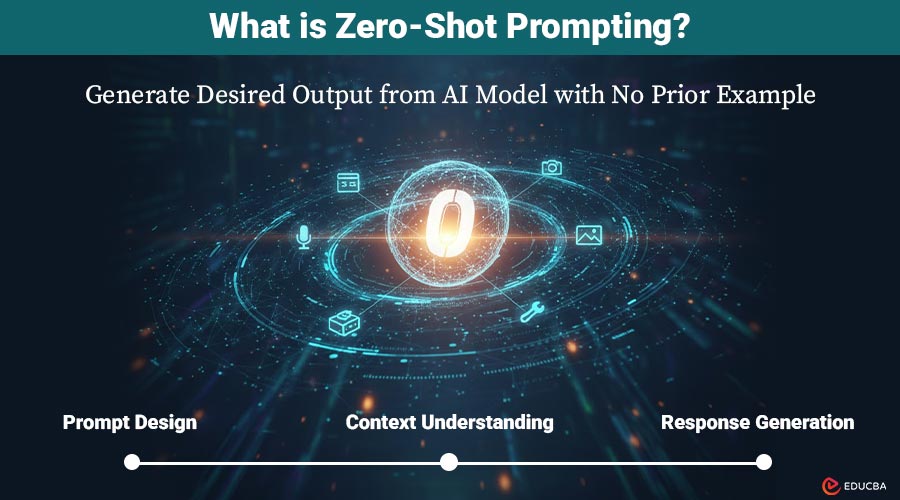
What is Zero-Shot Prompting?
Zero-shot prompting is a technique in NLP (natural language processing) where a model handles a task it has never seen before, generating a response using only its pre-existing knowledge. Unlike traditional AI training, which requires large, labeled datasets for each task, zero-shot prompting leverages the model’s ability to apply knowledge across different situations without task-specific examples.
In simpler terms, imagine teaching a student to solve math problems without ever giving them examples of that type of problem. Instead, the student applies general logic and reasoning skills to arrive at the answer. That is essentially how zero-shot prompting works for AI models.
Table of Contents
- What is Zero-Shot Prompting?
- Why It Matters?
- How Does it Work?
- Examples
- Challenges
- Best Practices
- Real-World Applications
- The Future
Why Zero-Shot Prompting Matters?
Zero-shot prompting has become a game-changer in AI for several reasons:
- No Dataset Dependency: Traditional AI methods usually need large labeled datasets, making them expensive and slow to create. Zero-shot prompting eliminates this need.
- Versatility: The same model can handle multiple tasks with ease, from translation and summarization to sentiment analysis and code generation, with minimal instruction.
- Rapid Prototyping: Developers can rapidly experiment with new ideas and workflows without spending time on task-specific training.
- Accessibility: Businesses, educators, and developers can leverage AI without deep technical knowledge or resources to build custom datasets.
How Does Zero-Shot Prompting Work?
Zero-shot prompting leverages pre-trained AI models, like OpenAI’s GPT series or other large language models (LLMs), which have learned patterns, facts, and reasoning capabilities from massive datasets. When you provide a prompt essentially a question or instruction the model interprets the context and generates a response, even if it has never encountered the exact task before.
The process involves three steps:
- Prompt Design: Crafting a clear and specific instruction for the AI. For example: “Translate this sentence into French: ‘Good morning, how are you?’”
- Context Understanding: The AI analyzes the instruction using its pre-trained knowledge and predicts the most likely correct output.
- Response Generation: The AI produces an answer that aligns with the prompt, demonstrating its ability to generalize knowledge.
The beauty of zero-shot prompting lies in its flexibility; you do not need to fine-tune the AI for every new task.
Practical Examples
Here are some engaging and practical examples to illustrate how zero-shot prompting works:
1. Language Translation
Prompt: Translate this sentence into Spanish: ‘The weather is beautiful today.’
Output: El clima está hermoso hoy.
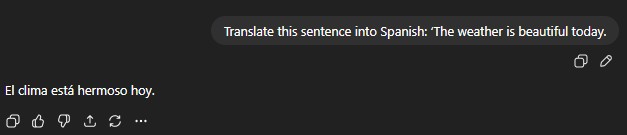
Even if the model has never been specifically trained to translate every sentence, it uses its understanding of English and Spanish grammar and vocabulary to produce an accurate translation.
2. Sentiment Analysis
Prompt: Determine if this review is positive or negative: ‘The movie was thrilling, and I loved every moment!’
Output: Positive
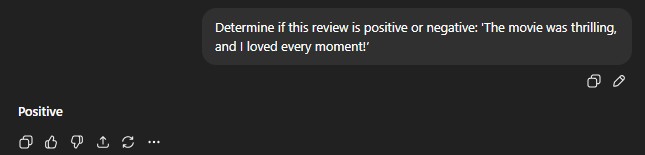
Here, the model identifies the sentiment without needing a labeled sentiment dataset.
3. Question Answering
Prompt: “Who is the author of Pride and Prejudice?”
Output: The author of Pride and Prejudice is Jane Austen.
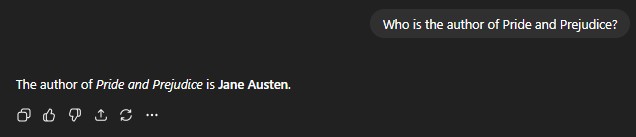
The AI retrieves this knowledge from its pre-trained data, even without explicit training for this specific question.
4. Creative Writing
Prompt: “Write a short poem about autumn in the style of Shakespeare.”
Output:
“Lo, Autumn comes with robes of amber hue,
The gentle breeze doth whisper tales anew.
The orchard bends beneath the heavy gold,
While twilight’s hand the fleeting day doth hold.”

This example demonstrates the ability of zero-shot prompting to combine creativity with learned linguistic style.
Challenges of Zero-Shot Prompting
Despite its advantages, zero-shot prompting has limitations:
- Accuracy Can Vary: Since the model has not been trained on examples, its responses might be less accurate than those of fine-tuned models, especially for highly specialized or domain-specific tasks.
- Ambiguous Prompts: The quality of output heavily depends on the clarity of the prompt. Vague or poorly phrased instructions can lead to responses that are irrelevant or incorrect.
- Bias and Reliability: Models trained on large datasets can inherit biases from the data. Zero-shot prompting does not inherently mitigate these biases; therefore, careful evaluation is necessary.
- Complex Tasks: For highly technical or nuanced tasks, zero-shot prompting may struggle to provide precise outputs without additional context or examples.
Best Practices for Effective Zero-Shot Prompting
Zero-shot prompting can be incredibly powerful, but its effectiveness depends on how you craft your prompts. Here are some best practices with examples to make your zero-shot AI tasks more accurate and useful:
1. Be Clear and Specific
Clarity is critical. Vague prompts often lead to irrelevant or incomplete responses. Always specify the task and the desired output format.
Example:
- Vague Prompt: “Explain AI.”
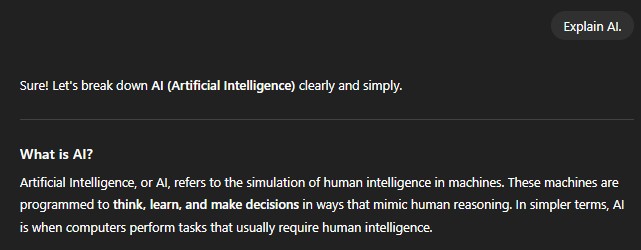
- Better Prompt: “Explain artificial intelligence in simple terms for a 12-year-old.”
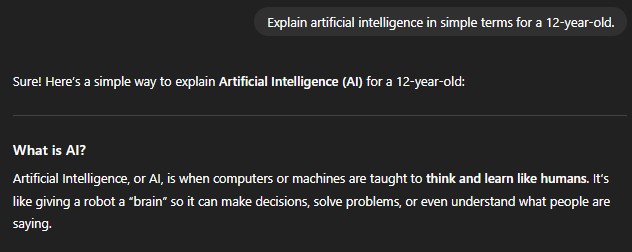
The second prompt guides the model to generate a concise, easy-to-understand explanation, which is more useful for the target audience.
2. Provide Context When Possible
Adding relevant context can help the model generate more accurate results, especially for complex or specialized tasks.
Example:
- Prompt without context: “Summarize the text.”
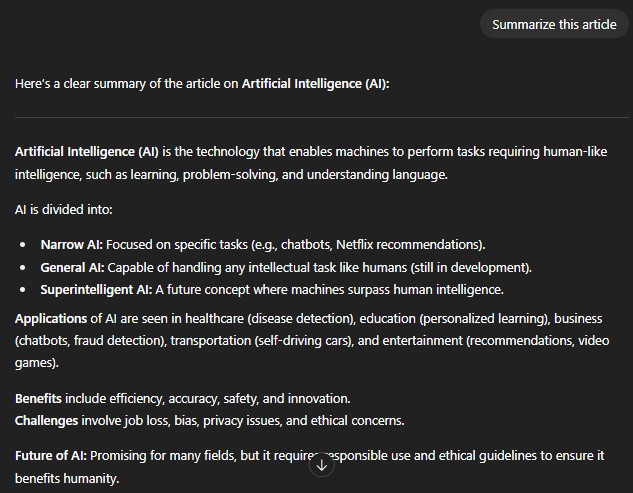
- Prompt with context: “Summarize the following article in two sentences.”

Here, the model understands that the summary should focus on marketing trends rather than general content.
3. Use Step-by-Step Instructions
Breaking down the task into smaller steps in your prompt often improves accuracy and structure.
Example:
- Prompt: “Create a meal plan.”
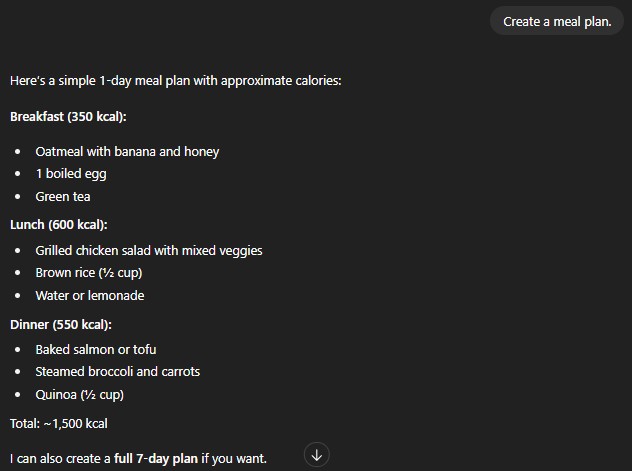
- Better Prompt: “Create a 3-day vegetarian meal plan. Provide breakfast, lunch, and dinner for each day, including the approximate calorie count for each meal.”
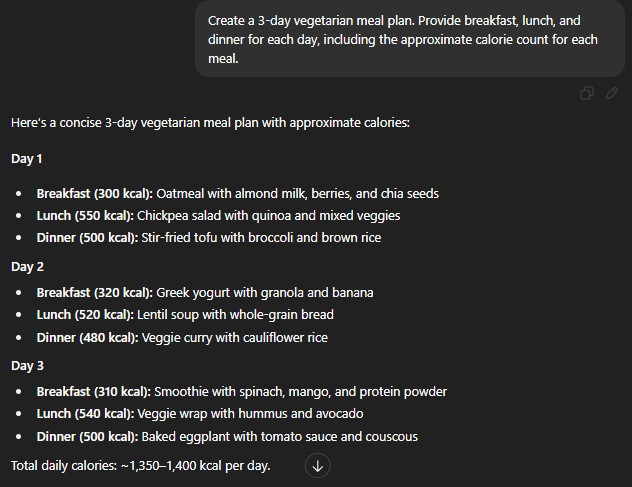
The AI now has a clear structure to follow, which reduces ambiguity and improves its usefulness.
4. Experiment with Wording
Small changes in phrasing can significantly affect AI outputs. Testing multiple prompt versions helps identify the most effective instructions.
Example:
- Prompt 1: “Generate a creative Instagram caption about coffee.”

- Prompt 2: “Write a witty and engaging Instagram caption about coffee that encourages people to visit a café.”

Prompt 2 is likely to produce more focused and effective marketing content.
Real-World Applications
Zero-shot prompting has a wide range of practical applications across industries:
- Customer Support: AI chatbots can handle questions and provide answers without needing pre-labeled data, boosting scalability and speed.
- Marketing and Content Creation: Marketers can quickly generate blog posts, social media content, ad copies, and email campaigns, reducing their dependence on content teams.
- Translation Services: Zero-shot prompting enables instant translation between languages, even for rare language pairs, without extensive datasets.
- Data Analysis: AI can classify data, detect trends, and summarize reports without requiring manually labeled examples, thereby facilitating faster decision-making.
- Education and Tutoring: AI-powered tutoring systems can generate explanations, quizzes, and study guides tailored to student needs without prior examples.
The Future
Zero-shot prompting is still evolving. With the advent of larger and more sophisticated language models, their accuracy, reliability, and versatility continue to improve. Future trends may include:
- Better Understanding of Context: Models will become more capable of interpreting subtle instructions.
- Reduced Biases: Advanced training techniques will mitigate unintended biases in outputs.
- Integration with Multimodal AI: Zero-shot prompting will extend beyond text to images, audio, and video, enabling AI to perform cross-modal tasks effortlessly.
- Automation of Complex Workflows: AI systems will leverage zero-shot prompting to autonomously perform multi-step tasks without human intervention.
Final Thoughts
Zero-shot prompting is a revolutionary approach that allows AI models to perform tasks without prior examples. Its versatility, speed, and cost-effectiveness make it a powerful tool for businesses, educators, developers, and creatives alike. While it presents challenges such as potential inaccuracies and biases, careful prompt design and thoughtful review can help maximize its effectiveness. In an era where AI continues to reshape industries, zero-shot prompting exemplifies the potential of language models to adapt, learn, and perform tasks intelligently with minimal guidance. Whether you are generating content, analyzing data, or developing innovative applications, zero-shot prompting unlocks a future where AI operates with unprecedented flexibility and efficiency.
Recommended Articles
If you enjoyed learning about zero-shot prompting, check out these articles for more insights into AI and its applications:


