


What Is the Working Class?
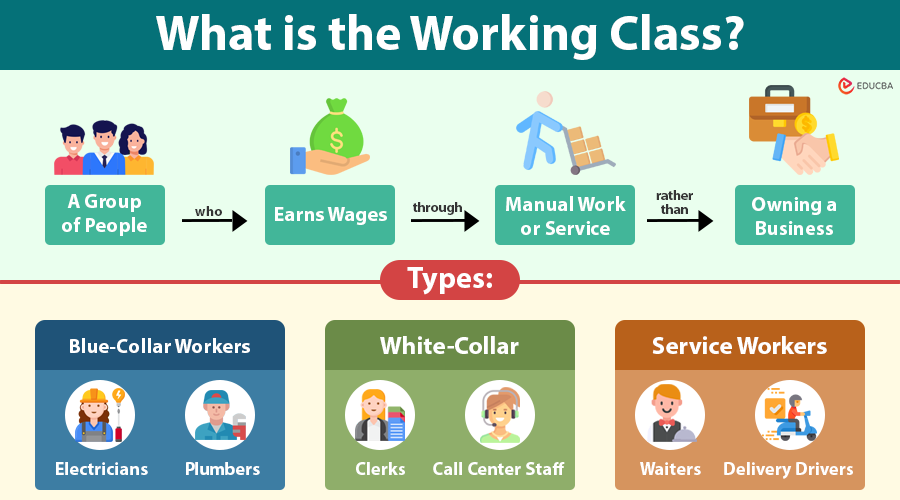
The working class refers to a social and economic group whose primary source of income comes from manual labor, industrial work, service jobs, or technical work rather than from ownership of capital or managerial roles. Individuals in this group generally earn wages or hourly pay, distinguishing them from salaried professionals, business owners, or investors.
Members of the working class play a crucial role in society, as they produce goods, provide services, and maintain essential systems across all industries. Without their labor, economies would struggle to function efficiently.
For example, a factory worker assembling automobiles, a delivery driver, or a retail cashier all belong to the working class because their income depends directly on the work they perform. Similarly, healthcare support staff, such as nursing assistants or hospital attendants, also fall within this category.
Table of Contents
- Meaning
- Characteristics
- Historical Background
- Types
- Working Class in Modern Society
- Examples
- Importance
- Challenges Faced
- Working Class vs Middle Class
- Future of the Working Class
Characteristics of the Working Class
Several defining social, economic, and occupational traits identify the working class:
- Dependence on wages or hourly pay: Members primarily rely on their work for income, rather than earning from investments, property, or business ownership.
- Manual or routine work: Many working-class roles involve physical labor, repetitive tasks, or routine operations in factories, construction, or service sectors.
- Limited economic power: Unlike business owners or senior professionals, working-class individuals typically have minimal influence over production processes or workplace decision-making.
- Income levels: Working-class individuals often earn moderate to low wages, sometimes struggling to keep pace with rising living costs.
- Collective work culture: Jobs often involve structured work environments, teamwork, and adherence to schedules.
- Skill-based jobs: Many roles require vocational training, apprenticeships, or technical expertise rather than advanced academic degrees.
- Occupational diversity: While historically associated with industrial labor, the working class today encompasses a wide range of roles, including manufacturing, transportation, retail, healthcare, hospitality, and the gig economy.
Historical Background of the Working Class
The term “working class” gained prominence during the Industrial Revolution (18th–19th centuries), when mechanized production transformed societies.
Before industrialization, most people worked in agriculture or artisanal trades. However, with the rise of factories, wage-dependent laborers congregated in cities, forming a distinct social class: the industrial working class.
Historically, the working class has been central to:
- Labor movements: Advocating for fair wages, reasonable work hours, and safer conditions.
- Trade union formation: Enabling collective bargaining and worker representation.
- Political change: Inspiring socialist, labor-oriented, and workers’ rights movements worldwide.
Over time, the definition expanded to include workers in service industries, logistics, healthcare, and digital platforms.
Types of Working Class
The working class is diverse, with multiple subcategories depending on occupation and skill level:
| Type | Description | Examples |
| Blue-Collar Workers | Perform manual or industrial labor | Factory workers, electricians, plumbers |
| White-Collar (Lower Tier) | Office or administrative roles with fixed wages | Clerks, data entry operators, call center staff |
| Service Workers | Provide personal or customer services | Waiters, delivery drivers, retail employees |
| Skilled Tradespeople | Require vocational training or technical expertise | Mechanics, welders, carpenters |
| Gig and Contract Workers | Freelancers or platform-based workers | Uber drivers, freelancers, couriers |
Working Class in Modern Society
The working class remains critical to the economy, but the nature of work has undergone significant evolution due to globalization, automation, and the emergence of the gig economy.
1. Shift from Manufacturing to Services
Traditional factory jobs have declined in developed economies, while employment in the service sector, particularly in healthcare, logistics, retail, and hospitality, has increased.
2. Rise of the Gig Economy
Platforms such as Uber, DoorDash, and Fiverr have created a digital working class. These workers often enjoy flexibility but frequently lack benefits and long-term job security.
3. Income Inequality
Despite their contributions, many working-class individuals face stagnant wages and rising living costs, which contribute to widening economic inequality.
4. Labor Rights and Unionization
Labor unions advocate for fair pay, workplace safety, and benefits. However, union membership has declined in some regions, weakening collective bargaining power.
5. Impact of Technology
Automation, artificial intelligence, and robotics have displaced certain manual jobs, but they have also created opportunities for upskilling in technical and digital roles.
Examples of Working-Class Jobs
| Sector | Example Jobs |
| Manufacturing | Assembly line worker, machinist, quality inspector |
| Transportation | Truck driver, delivery personnel, metro operator |
| Construction | Carpenter, electrician, plumber |
| Retail | Cashier, sales associate, store clerk |
| Hospitality | Waiter, chef, hotel staff |
| Healthcare | Nursing assistant, medical technician |
| Technology | Data entry operator, technical support staff |
Importance of the Working Class
The working class is vital for both economic growth and social stability:
- Economic backbone: They ensure the production, transportation, and distribution of goods and services.
- Consumer demand: Their spending drives business revenue and economic cycles.
- Social cohesion: Representing a large portion of society, they shape political and cultural dynamics.
- Innovation & productivity: Skilled laborers contribute to efficiency and technological advancement.
- Public services: Healthcare, transportation, and essential services often rely on working-class labor.
Challenges Faced by the Working Class
- Low wages and job insecurity: Many jobs offer low pay and lack long-term security or benefits.
- Limited education and training: Economic barriers may hinder skill development or access to higher education.
- Health and safety risks: Physical labor often involves exposure to hazardous conditions or strenuous work environments.
- Declining labor representation: Reduced union membership and protections weaken workers’ collective influence.
- Economic inequality: Wage gaps and wealth disparities continue to grow in many societies.
Working Class vs Middle Class
| Aspect | Working Class | Middle Class |
| Income Source | Wages or hourly pay | Salaries, business, or professional income |
| Education Level | High school or vocational training | College or university degree |
| Job Type | Manual, technical, or service-based | Managerial, professional, administrative |
| Economic Stability | Moderate to low | Higher and more secure |
| Assets Owned | Limited | May own property or investments |
Future of the Working Class
The working class is adapting to technological and economic shifts:
- Automation and AI will transform jobs, reducing demand for certain manual tasks.
- Digital platforms and remote work create new opportunities for flexible employment.
- Governments and businesses must invest in reskilling programs to help workers transition.
- Policies ensuring fair wages, benefits, and job security will be crucial for maintaining a stable workforce.
The future depends on empowering the working class through education, labor protections, and inclusive economic policies.
Final Thoughts
The working class forms the foundation of all economies, providing essential labor that keeps industries running and services accessible. Recognizing their contribution, addressing their challenges, and ensuring fair opportunities are crucial for social equity and economic growth.
Frequently Asked Questions (FAQ)
Q1. What defines someone as working class?
Answer: Individuals who earn wages through manual, technical, or service work rather than from ownership or managerial roles.
Q2. What are examples of working-class jobs?
Answer: Factory workers, delivery drivers, retail cashiers, carpenters, and nursing assistants.
Q3. How is the working class different from the middle class?
Answer: Working-class jobs are wage-based and often manual, while the middle class earns salaries through professional or managerial work.
Q4. What challenges does the working class face?
Answer: Low wages, job insecurity, limited access to education, and risks from automation.
Q5. Why is the working class important?
Answer: They drive production, services, and consumer demand, forming the backbone of the economy.
Recommended Articles
We hope this guide on the working class helps you understand its importance, challenges, and role in society. Explore related topics to learn more about social classes, labor economics, and workforce dynamics in modern economies.


