
What is Win-Loss Analysis?
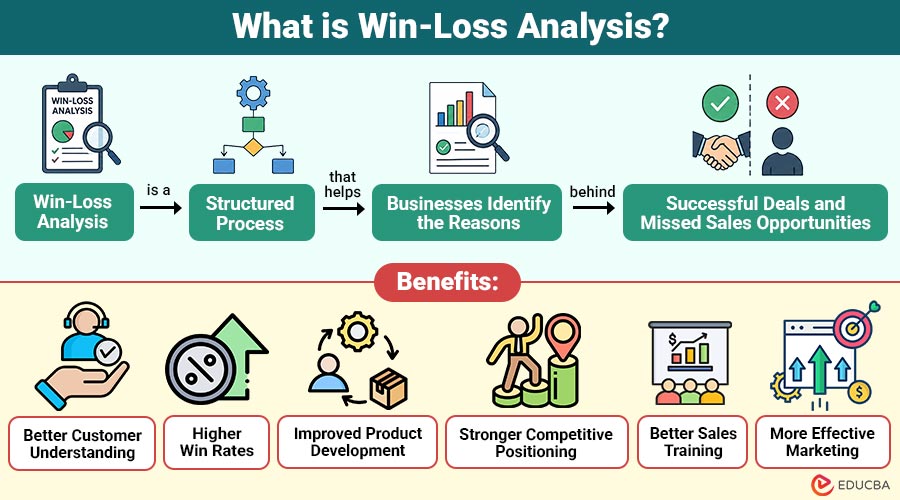
Win-Loss Analysis is a structured process that helps businesses identify the reasons behind successful deals and missed sales opportunities. It involves collecting feedback from customers, prospects, and internal sales teams to identify the factors that influenced buying decisions. The insights gained help organizations improve their products, pricing, messaging, customer experience, and overall sales strategy.
Unlike simply reviewing sales reports, win-loss analysis focuses on understanding the reasons behind customer decisions. Businesses can make well-informed enhancements that boost future win rates and customer happiness by evaluating their strengths and limitations.
For example, an insurance company learns that many customers chose competitors because of a simpler claim process. It streamlines its claims procedure, resulting in more successful sales.
Table of Contents:
- Meaning
- Why Win-Loss Analysis Matters?
- Working
- Common Questions
- Benefits
- Example
- Metrics Used
- Challenges
- Tools
Key Takeaways:
- Win-loss analysis identifies customer decision factors to effectively improve sales strategies, products, and overall business performance.
- Customer feedback reveals strengths, weaknesses, and competitor advantages, enabling informed decisions and higher future win rates.
- Regular analysis supports better sales messaging, product development, customer experience, and stronger competitive market positioning consistently.
- Tracking win-loss metrics helps businesses optimize processes, increase customer satisfaction, and drive sustainable long-term revenue growth.
Why Win-Loss Analysis Matters?
Winning more customers requires more than selling a quality product. Businesses must understand what customers value and where competitors perform better. Win-loss analysis provides this understanding by revealing real customer perceptions.
Key reasons why win-loss analysis is important include:
1. Customer Decision Insights
Reveals customer decision factors, helping teams understand purchase motivations and reasons for losing valuable opportunities.
2. Highlight Sales Strengths
Identifies winning advantages sales teams should highlight consistently to attract prospects and close more successful deals.
3. Identify Key Weaknesses
Uncovers product, service, or sales shortcomings that businesses should address quickly to improve future outcomes.
4. Improve Sales Messaging
Refines communication by aligning sales messages with customer needs, expectations, and purchasing decision factors effectively.
5. Enhance Customer Experience
Identifies experience gaps, enabling businesses to improve every customer interaction from awareness through final purchase.
6. Guide Product Development
Provides customer feedback to guide product improvements, feature priorities, and innovation based on market demand.
7. Strengthen Competitive Position
Helps businesses understand competitor advantages and develop stronger strategies to differentiate their offerings successfully.
How Win-Loss Analysis Works?
A successful win-loss analysis follows a structured process that gathers unbiased feedback and converts it into actionable insights.
1. Select Opportunities
Choose recently won and lost deals from different industries, customer sizes, or product categories to obtain balanced insights.
2. Collect Customer Feedback
Interview customers or prospects soon after their purchasing decision while their experience is still fresh.
3. Ask Objective Questions
Focus on understanding buying decisions rather than defending the sales process. Questions should explore pricing, product features, customer service, competition, and overall experience.
4. Gather Internal Sales Insights
Sales representatives provide valuable information about customer interactions, objections, and competitive challenges.
5. Identify Common Patterns
Analyze responses to identify recurring themes that explain why deals were won or lost.
6. Share Findings
Present results to sales, marketing, product development, customer success, and leadership teams.
Common Questions Asked During Win-Loss Analysis
Effective interviews usually include questions such as the following:
- What influenced your final decision?
- Which product features were most valuable?
- What concerns did you have during evaluation?
- How did our solution compare with competitors?
- Was pricing a deciding factor?
- How was your experience with our sales team?
- What could we improve?
- Would you consider purchasing from us in the future?
- What nearly changed your decision?
- How can we better serve similar customers?
These questions help uncover valuable insights that internal teams may otherwise overlook.
Benefits of Win-Loss Analysis
Businesses gain numerous benefits by consistently analyzing sales outcomes.
1. Better Customer Understanding
Helps businesses understand customer priorities, buying motivations, preferences, and decision factors for creating more effective sales strategies.
2. Higher Win Rates
Enables sales teams to refine approaches using customer feedback, increasing successful deals and improving overall conversion rates.
3. Improved Product Development
Provides valuable customer insights that guide feature improvements, innovation, and products better aligned with evolving market expectations.
4. Stronger Competitive Positioning
Reveals competitor advantages, helping businesses strengthen differentiation and develop strategies that outperform market rivals consistently.
5. Better Sales Training
Equips sales representatives with practical insights to handle objections, improve conversations, and close deals more successfully.
6. More Effective Marketing
Helps marketing teams create targeted messages that address customer needs, consistently increasing engagement, trust, and campaign effectiveness.
Win-Loss Analysis Example
A cloud storage provider notices declining sales despite positive product reviews. The company interviews both successful and unsuccessful prospects.
The analysis reveals several patterns:
- Customers appreciate the platform’s security features.
- Many prospects believe implementation takes too long.
- Competitors offer simpler onboarding.
- Sales presentations focus heavily on technical features instead of business outcomes.
- Existing customers request more training resources.
Using these findings, the company simplifies onboarding, develops customer training materials, and shifts its sales messaging toward productivity improvements. Within several months, sales conversions increase significantly.
Metrics Used in Win-Loss Analysis
Organizations monitor several performance indicators to evaluate sales effectiveness.
| Metric | Purpose |
| Win Rate | Percentage of opportunities successfully closed |
| Loss Rate | Percentage of opportunities lost |
| Competitive Win Rate | Success rate against specific competitors |
| Sales Cycle Length | Average time required to close deals |
| Deal Value | Average revenue generated per sale |
| Customer Satisfaction | Measures buyer experience after purchase |
| Conversion Rate | Percentage of qualified leads becoming customers |
| Objection Frequency | Common customer concerns during sales |
| Product Feature Requests | Frequently requested improvements |
| Customer Retention | Percentage of customers continuing business |
Challenges of Win-Loss Analysis
Although valuable, win-loss analysis presents several challenges.
1. Limited Customer Participation
Some customers decline to participate in interviews or provide limited feedback, reducing the accuracy and completeness of valuable business insights.
2. Biased Responses
Customers may withhold honest opinions, creating incomplete feedback that affects the reliability of win-loss analysis results.
3. Internal Assumptions
Sales teams sometimes rely on assumptions rather than verified customer feedback, leading to inaccurate business decisions.
4. Small Sample Sizes
Analyzing limited sales opportunities may yield unreliable findings that fail to accurately represent overall customer purchasing behavior.
5. Poor Follow-Up
Organizations lose valuable insights when recommended improvements are ignored or implemented inconsistently across teams and processes.
6. Data Collection Difficulties
Collecting consistent customer feedback across departments requires standardized processes, collaboration, and reliable data management practices.
Tools Used for Win-Loss Analysis
Businesses use various tools to collect, organize, analyze, and act on customer feedback throughout the sales process.
1. Customer Relationship Management Platforms
Store customer interactions, sales opportunities, and deal outcomes, providing valuable data for comprehensive win-loss analysis.
2. Survey Software
Collect structured customer feedback through questionnaires, helping businesses understand buying decisions and reasons behind sales outcomes.
3. Customer Interview Platforms
Support structured interviews with customers, capturing detailed insights about purchasing experiences, expectations, and decision-making factors.
4. Business Intelligence Tools
Analyze large datasets, identify trends, and generate actionable reports that support informed business and sales decisions.
5. Sales Analytics Dashboards
Monitor sales performance, conversion rates, pipeline metrics, and win-loss trends through interactive visual reports and dashboards.
6. Data Visualization Software
Transforms complex sales data into clear charts, graphs, and dashboards to enable easier analysis and decision-making.
7. Customer Feedback Management Systems
Centralizes customer opinions from multiple channels, making feedback easier to organize, analyze, and act upon effectively.
Final Thoughts
Win-loss analysis helps businesses understand why customers buy or reject their offerings. These insights improve sales strategies, product development, customer experiences, and competitive positioning. By learning from every sales opportunity, organizations make informed decisions, increase win rates, strengthen customer relationships, and achieve sustainable revenue growth in competitive markets.
Frequently Asked Questions (FAQs)
Q1. Who should conduct Win-Loss Analysis?
Answer: Independent researchers, customer success teams, product managers, or trained analysts often conduct win-loss interviews to obtain unbiased feedback.
Q2. How often should businesses perform Win-Loss Analysis?
Answer: Most organizations conduct win-loss analysis quarterly or continuously, depending on sales volume and market changes.
Q3. What information is collected?
Answer: Businesses gather feedback about pricing, product features, competitors, customer experience, sales interactions, implementation, and purchasing decisions.
Q4. How does Win-Loss Analysis improve sales?
Answer: It identifies customer preferences, competitive weaknesses, and process improvements that help sales teams close more opportunities.
Recommended Articles
We hope that this EDUCBA information on “Win-Loss Analysis” was beneficial to you. You can view EDUCBA’s recommended articles for more information.

