


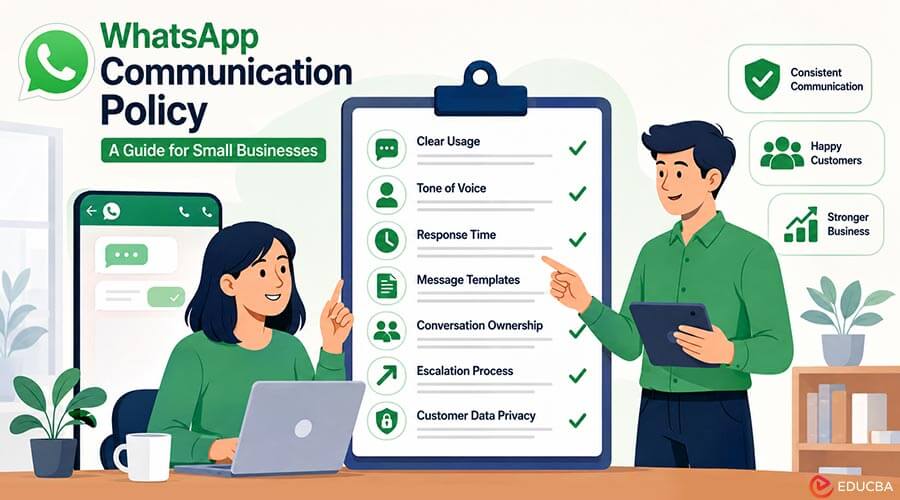
When several employees communicate with customers through WhatsApp, inconsistency can quickly become a problem. One team member may answer within minutes while another waits several hours. Sales staff may use a casual tone, while support agents write much more formally. Important information may be shared differently depending on who handles the conversation.
A simple WhatsApp Communication Policy can solve many of these issues. It provides employees with clear guidelines for handling customer conversations consistently and professionally.
A WhatsApp Communication Policy does not need to be a long corporate document. For a small business, a few clear rules covering tone, response times, message types, customer data, and escalation are often enough.
1. Define What WhatsApp Should Be Used For
Start by deciding which business conversations belong on WhatsApp. This is one of the first areas a WhatsApp Communication Policy should address.
Typical uses may include:
- answering product inquiries;
- confirming appointments;
- sending order or delivery updates;
- following up with existing leads;
- sharing service information;
- and handling simple customer questions.
At the same time, identify conversations that should move elsewhere. Contracts, sensitive account information, detailed proposals, or complex support cases may be better handled through email, a CRM, or another appropriate system.
This prevents WhatsApp from gradually becoming the default place for every type of business communication.
2. Set a Consistent Tone of Voice
Customers should not feel as though they are speaking with a completely different company every time another employee replies. Your WhatsApp Communication Policy can define a few simple tone rules.
For example:
Be clear.
Avoid unnecessary jargon or complicated sentences.
Be friendly but professional.
A conversational tone works well on WhatsApp, but employees should still communicate as representatives of the business.
Give enough context.
Do not assume the customer remembers the previous conversation.
Avoid unnecessary messages.
One complete reply is often better than sending several short messages in sequence.
You can also provide examples.
Instead of:
Hi. Order sent.
Use:
Hi Sarah, your order #1652 has been shipped today. We’ll send the tracking details as soon as they are available.
A few examples make the communication standard easier for employees to understand and follow.
3. Establish Response-Time Expectations
Not every business needs instant replies, but customers benefit from predictable response times. A WhatsApp Communication Policy should establish reasonable response-time expectations based on the type of enquiry.
A small company might define standards such as:
- Sales Enquiries: Within two business hours;
- Customer Support: Within one hour during opening hours;
- Appointment Changes: As soon as possible;
- Non-Urgent Follow-Ups: Within one business day.
These are internal guidelines, not promises that every situation will follow exactly the same schedule.
The purpose is to prevent messages from being ignored simply because nobody knows who should respond.
Teams should also decide what happens outside working hours. An automatic acknowledgment or clearly stated business hours can help manage customer expectations.
4. Create Rules for Routine Messages
Some messages occur repeatedly. Examples include:
- appointment reminders;
- payment instructions;
- booking confirmations;
- shipping updates;
- event information;
- and standard follow-ups.
For these situations, approved templates can improve consistency and make it easier for employees to follow the WhatsApp Communication Policy.
A template should provide a message structure without forcing employees to use identical wording in every situation.
For example:
Hi [Name], this is a reminder that your appointment is scheduled for [Date] at [Time]. Please reply if you need to make any changes.
The employee can still adjust the message when necessary.
For teams handling larger lists of routine communication, a browser-based WhatsApp Sender can help prepare messages through WhatsApp Web, but the same communication rules should apply regardless of which tool is used.
The tool changes how you prepare the message. It should not change the standard expected from the message itself.
5. Decide Who Owns Each Conversation
Shared responsibility often becomes no responsibility. If several employees use WhatsApp for work, define who handles different types of conversations.
Document this responsibility clearly in the WhatsApp Communication Policy so employees know who should respond to each type of customer message.
For example:
| Message Type | Responsible Team |
| New sales enquiry | Sales |
| Order status | Operations |
| Appointment change | Service team |
| Product issue | Customer support |
| Refund request | Support manager |
Small businesses may not have separate departments, but ownership still matters.
Even if the same three people handle everything, deciding who takes which type of message reduces duplicated replies and missed conversations.
6. Create an Escalation Rule
Employees also need to know when they should stop trying to solve a problem themselves. An effective WhatsApp Communication Policy should explain when an employee must escalate a conversation to a manager or another responsible team member.
A conversation may need escalation when:
- a customer makes a formal complaint;
- a refund is requested;
- payment information does not match;
- a customer becomes abusive;
- the issue involves sensitive data;
- or the employee does not have authority to make the requested decision.
The policy should identify who receives these cases and how quickly they should be reviewed.
This protects both the customer and the employee handling the conversation.
7. Set Basic Rules for Customer Data
WhatsApp conversations may contain names, phone numbers, addresses, order details, and other customer information. Employees should know how that information can be used.
Customer data handling should therefore be an important part of your WhatsApp Communication Policy.
Basic rules may include:
- only access customer information needed for the task;
- do not copy customer details into unrelated personal tools;
- avoid sharing screenshots containing customer information unnecessarily;
- keep business contacts separate from personal use where possible;
- and follow applicable privacy requirements.
Exact requirements depend on the business and location, but data handling should be part of the communication policy, not an afterthought.
8. Review the Policy Regularly
A WhatsApp Communication Policy should change as the business changes.
A process that works when one person handles 20 conversations a day may no longer work when five employees manage hundreds.
Review the policy when:
- message volume increases significantly;
- new employees join;
- new tools are introduced;
- common customer complaints appear;
- or responsibilities between teams change.
Employees should also be able to identify unclear or impractical rules.
Regular reviews help ensure that the policy continues to support the team’s actual communication needs.
Create a Clear WhatsApp Communication Policy
The best WhatsApp Communication Policy is not the longest one.
For a small business, one or two pages may be enough to cover:
- where WhatsApp should be used;
- expected tone;
- response times;
- approved message types;
- conversation ownership;
- escalation;
- and customer data handling.
The objective is consistency.
When employees understand how the business expects WhatsApp conversations to be handled, customers receive clearer communication and team members spend less time deciding what to do in routine situations.
Final Thoughts
A WhatsApp Communication Policy gives small business teams a simple framework for managing customer conversations consistently. By defining communication rules, response times, message ownership, escalation procedures, and data-handling practices, businesses can reduce confusion and provide a more reliable customer experience.
The policy does not need to be complicated. Keep it clear, practical, and easy for employees to follow. Review it as your team and communication needs grow to ensure WhatsApp remains an effective business communication channel.
Recommended Articles
We hope this guide helps you understand how a WhatsApp Communication Policy can improve team communication, maintain consistent customer interactions, and establish clear messaging standards for small businesses. Explore more useful resources covering business communication, customer service, team collaboration, digital communication tools, and workplace productivity.

