


Updated March 23, 2023
Introduction to Spring Integration
One of the highest used extension of Spring programming, Spring Integration, is used for supporting Enterprise Integration patterns. Enterprise Integration Patterns are solutions that are tested for specific design problems and the solutions are totally technology agnostic, which means it doesn’t matter which programming language one uses. It enables the developer to use lightweight messaging within Spring-based applications. The main intuition behind the development of Spring integration is to have a simple model that can be used to build an enterprise integration solution and maintain separate concerns essential for the production of maintainable and testable code. In this article, we would look into tools available for simplifying the process of Spring application development.
What is Spring Integration?
As already mentioned that it is a way to simplify the production of commercial products for solving a particular business unit problem. The problem solved is measures as an enterprise solution or just a few lines of code by the complexity and magnitude of steps involved. The problem of this enterprise application is that few portions of the code are already available using older technologies and it becomes not-so cost-effective to write the same thing from scratch again and go through pains of testing that again. This is where the integration plays a major role by inter-operating the new components built using the older technology or the legacy portion of the code.
It takes into consideration all the technical aspects required for the seamless integration of multiple components, be it a legacy portion of the newer components. Post analyzing the issues and other technological aspects Spring provides an environment for developers to build code for easy integration. It achieves this feat by:
- Loose Coupling: Since multiple parts are involved in building Enterprise level applications, each part would have its own concerns. Having a loose coupling between the different components will enable fewer design threats and maintenance implications will be easier.
- Event-Driven Spring Integration: The architecture design followed here is that the different components involved in an Enterprise level application interact via events which get generated by other components, called as the publisher of events, and allows the components to subscribe to it to receive the event details for taking the next appropriate actions.
Application of Spring Integration
Now that we have understood that it is and what is the intent behind having a Spring Integration Framework in making an application, let us look at developing an application using a Spring Integration framework. Also, before we jump on to the sample application let us look at 3 components on which the framework is built on.
- Messages: This component helps in encapsulating the data which needs to be transferred from one place to another.
- Channels: This component provides a mechanism that allows the transportation of messages from one point to another.
- Endpoints: These are either the consumer or producer of the messages.
Main Dependency of Spring Integration
The main dependency of spring integration is declared in the pom.xml with relevant spring integration jar. This is done by:
Code:
<dependencies>
<dependency>
<groupid>org.springframework.integration</groupid>
<artifactid>spring-integration-stream</artifactid>
<version>5.2.2.RELEASE </version>
</dependency>
</dependencies>
Then we would invoke maven exec plugin to clean, package and run the application.
Now that we have declared the relevant spring integration jar we would look at a scenario of the online store to better understand the concept.
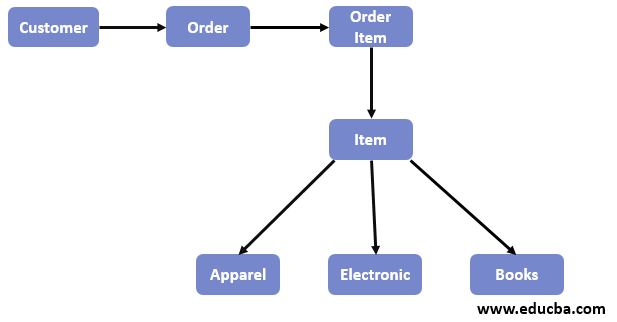
In the above flow diagram, the customer can order a lot of things under a particular order ID from different genres available and each block representing the class in Java. The above flow diagram can be designed for the pipeline as follows:
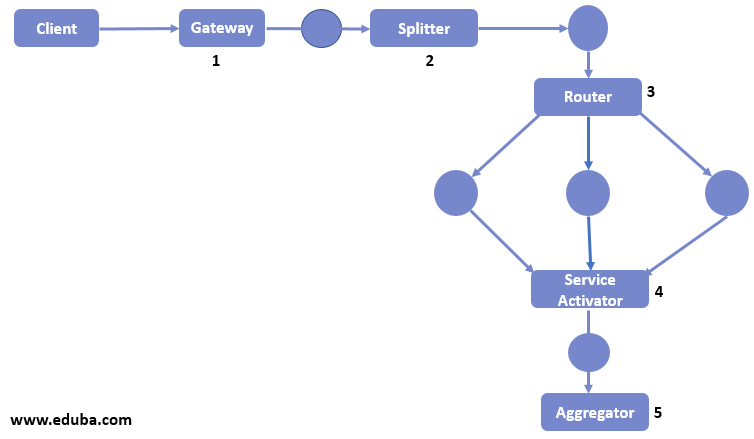
Now that we have designed the pipeline let us understand each of the components numbered from 1 to 5. Firstly, each circular object is a channel and each rectangular box is an endpoint. In number 1, which is the gateway components marks the entry of the messaging system. Any new order s=comes as a message to this component for further processing of encapsulating the message and put into the first channel. Now from this channel, each order is decomposed into their individual item instances and then each is wrapped using Splitter and placed into the next channel for the next steps.
Now using the router considers each decomposed bits of items and transfers it into the respective Channel of either Apparel, electronics, or books. Once it is placed in a respective channel the Service Activator takes in from all the 3 channels and activates any required command for example discount, offers or any promotional gifts and places it in the next channel. From the aggregator component, the individual items are aggregated and then finally the entire order is reconstructed per order ID.
One component which is not a part of this diagram is the Poller component, which configures the frequency of interrogation of respective input channels for messages. With this, we complete an entire flow of Spring Integration framework and next we would jump into looking at different advantages Spring Integration brings in its bag.
Advantages
This has a lot of advantages at its disposal along with the core advantages that Spring brings with itself. This is a list of few advantages of using Spring Integration:
- Inversion of Control (IoC): This advantage is exclusively for the usage of Spring Integration. It basically decouples the execution of a task from implementation so that each module might be able to focus on what the intent of the module basically is.
- Use of Aspect-oriented programming (AOP) to address cross-cutting concerns. In this, the programming paradigm of AOP separates the concern of software application and hence improves modularization. Doing this it becomes easier to maintain the grouping features and behavior into manageable parts.
Conclusion
In this article, we looked into what Spring Integration is and what are the different components on which the entire Spring Integration framework is built on. Keeping this in mind it will be easier for you to clear out some close similarities confusion which might have crept in mind during studying Spring Integration. This framework is widely used among developers to build something to not only address the business problem but also address it in an easier way!
Recommended Articles
This is a guide to What is Spring Integration?. Here we discuss the different components, applications, flow diagram along with the advantages of spring integration. You can also go through our other related articles to learn more –

