

Updated March 21, 2023
Introduction to Unsupervised Machine Learning
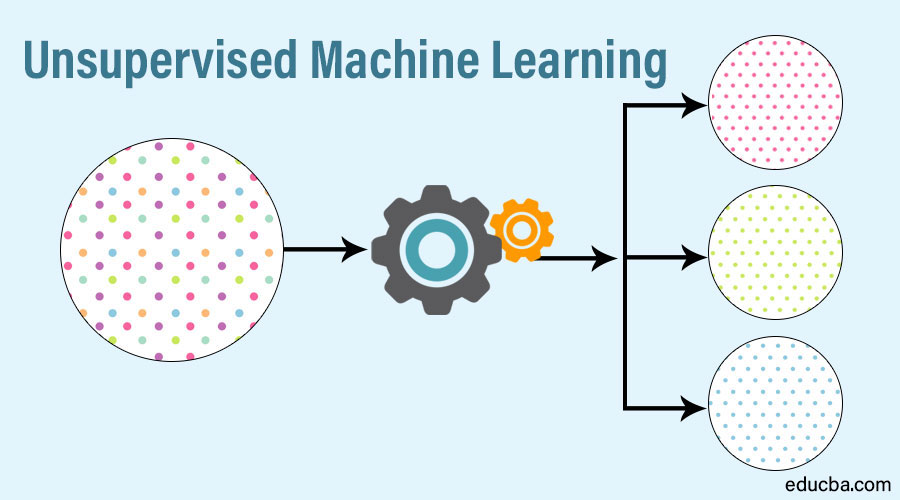
Unsupervised Machine Learning is one of the three main techniques of machine learning. It’s a self-organized learning algorithm in which we don’t need to supervise the data by providing a labelled dataset as it can find a previously unknown pattern in the unlabelled dataset on its own to discover useful information by performing complex tasks (such as principal component analysis and cluster analysis) as compared to the other machine learning techniques like supervised learning. So let’s see how we can do that! In this topic, we are going to learn about Unsupervised Machine Learning.
“Machine learning,” as the term suggests, we are teaching machines to do human-like tasks and how do humans learn, either from someone or by observation. Same as humans, the way the machine learns.
Machine learning can be divided into 3 parts:
- Supervised learning
- Unsupervised learning
- Reinforcement learning
Types of Machine Learning
Reinforcement learning is agent-based learning which involves reward and punishment upon actions taken by an agent. The end goal is to maximize the overall reward in the process of learning from the environment.
When you have input-output data, in short, labelled data, for example, given height and weight to determine whether a person is male or female, can be considered a Supervised learning task (from someone in the case of humans).
But in many real-life scenarios, this labelled or annotated data is not always available. As a result, many times, we face problems of segmenting objects based on their properties that are not explicitly mentioned. So how to solve this problem? Well, Unsupervised learning is the solution.
Wikipedia says Unsupervised learning is a type of self-organized Hebbian learning that helps find previously unknown data set patterns without pre-existing labels. In unsupervised learning, we don’t have any label information, but still, we want to get insights from the data based on its different properties.
Types of Unsupervised Machine Learning
Unsupervised learning tasks can be broadly divided into 3 categories:
- Association rule mining
- Clustering
- Recommendation system
1. Association Rule Mining
When we have transactional data for something, it can be for products sold or any transactional data for that matters; I want to know, is there any hidden relationship between buyer and the products or product to product, such that I can somehow leverage this information to increase my sales. Extracting these relationships is the core of Association Rule Mining. We can use the AIS, SETM, Apriori, FP growth algorithms for extracting relationships.
2. Clustering
Clustering can be done with any data where we do not have the class or label information. We want to group the data such that the observations with similar properties belong to the same cluster/group, and inter-cluster distance should be maximum. At the same time, the intra-cluster distance should be minimum. We can cluster the voter’s data to determine the opinion about the government or cluster products based on their features and usage. Segment population based on income features or use clustering in sales and marketing.
We can use K-Means, K-Means++, K-Medoids, Fuzzy C-means (FCM)
Expectation-Maximisation (EM), Agglomerative Clustering, DBSCAN, Hierarchical Clustering types such as single linkage, complete linkage, median linkage, Ward’s method algorithms for clustering.
3. Recommendation System
Recommendation System is basically an extension of Association rule mining in a sense; we are extracting relationships in ARM. In the Recommendation System, we are using these relationships to recommend something which is having higher acceptance chances by the end-user. Recommendation systems have gained popularity after Netflix announced a grand prize of US$1,000,000 prize in 2009.
Recommendation Systems works on transactional data, be it financial transaction, e-commerce, or grocery shop transactions. Nowadays, giant players in the e-commerce industry are luring customers by making a customized recommendations for each user based on their past purchase history and similar behaviour purchase data from other users.
Methods to develop Recommendation Systems can be broadly divided into Collaborative filtering and Content-Based filtering. In Collaborative filtering, we have user-user Collaborative filtering and Item-Item Collaborative filtering, which are memory-based approaches & Matrix factorization and Singular Value Decomposition (SVD) model-based approaches.
Applications of Unsupervised Learning
As the world’s data is increasing tremendously every day, unsupervised learning has many applications. We are always creating data by using social media platforms or some video content on YouTube, and many times we don’t even do it deliberately. All this data is unstructured, and labelling it for supervised learning tasks will be tiring and expensive.
The following are some cool applications of unsupervised machine learning:
- Grocery shop or e-commerce store/ marketplace: Extract Association rules from customers transactional data and recommendations for consumers to buy products.
- Social media platform: Extract relationships with different users to suggest products or services. Recommend new people for social connect.
- Services: Recommendations of travel services, a recommendation of houses to rent, or matchmaking services.
- Banking: Cluster customers based on their financial transactions. Cluster fraudulent transaction for fraud detection.
- Politics: Cluster voter’s opinions about chances of a win for a particular party.
- Data visualization: With clustering and t-distributed Stochastic Neighbor Embedding (t-SNE), we can visualize high-dimensional data. Also, this can be used for dimensionality reduction.
- Entertainment: Recommendations for movies, music, as Netflix and Amazon are doing.
- Image segmentation: Cluster images portions based on nearest pixel values.
- Content: Personalized newspapers, recommendations of Web pages, e-learning applications, and email filters.
- Structural discovery: With clustering, we can discover any hidden structure in the data—cluster twitter data for sentiment analysis.
Conclusion
Unsupervised machine learning is not too quantifiable but can solve many problems in which supervised algorithms fail. There are many applications to unsupervised learning in many domains where we have unstructured and unlabelled data. We can use unsupervised learning techniques to teach our machines to do a better job than us. In recent years, machines have outperformed humans in terms of tasks that are considered to be solved by humans for centuries. I hope with this article you understood what is and how unsupervised machine learning techniques can be used to solve real-world problems.
Recommended Articles
This is a guide to Unsupervised Machine Learning. Here we discuss the types of machine learning and types of unsupervised machine learning along with its applications. You may also have a look at the following articles to learn more –

