


What is a Research Report?
A research report is a concise document that summarizes the findings, methods, and conclusions of a research study or investigation. There are various types of research reports available for different purposes.
It typically includes details on the research question, methodology, data analysis, and results, providing a structured and informative account of the research process and outcomes.
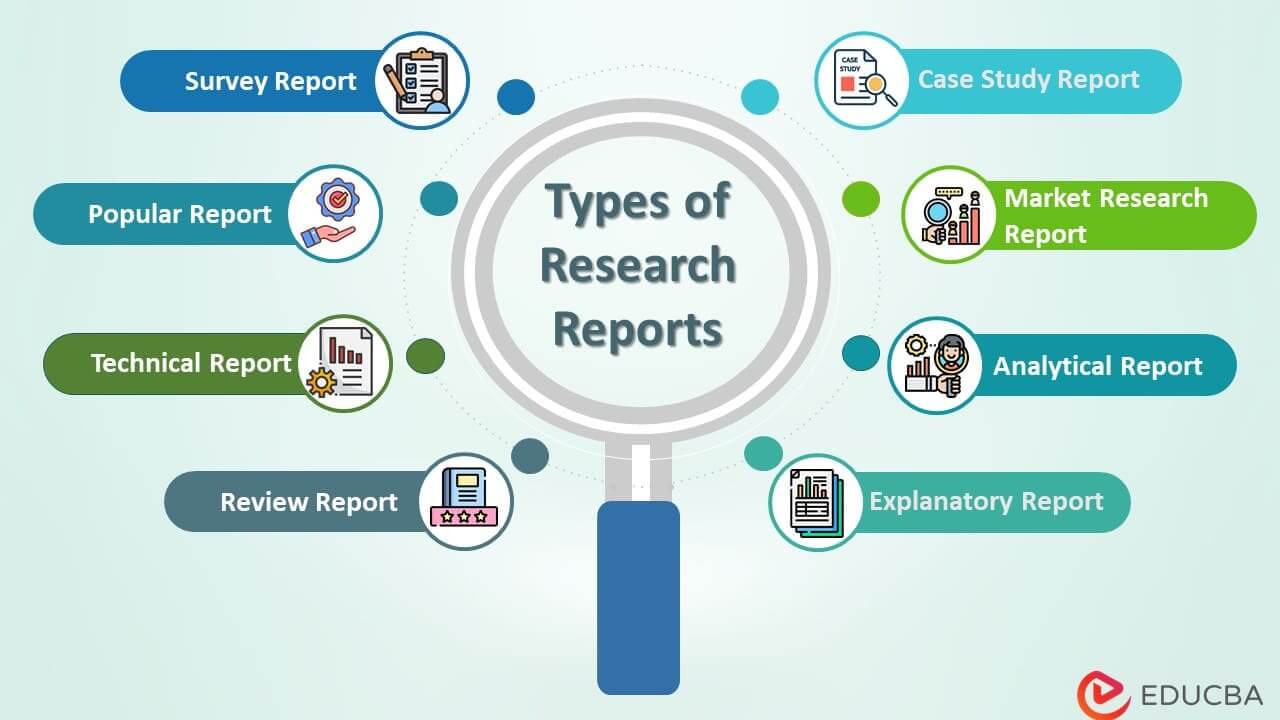
Table of Contents
- Definition
- Types of Research Reports
- Components
- How to Write a Research Report?
- Example
- Types of Research Report Writing
- Common Mistakes in Research Report Writing
- Importance
- Limitations
Key Highlights
- A research report provides a brief overview of a research study.
- Types of research reports offer a standardized format and structure, making it easier for readers to navigate and comprehend the information.
- They are useful in fields such as academia, business, healthcare, and the social sciences.
- Different types of report writing determine the report’s primary purpose, e.g., whether it should be short, long, or for internal use.
Different Types Of Research Reports
1. Technical or Scientific Reports
Technical and scientific reports communicate research findings to experts and professionals in a particular field.
Characteristics:
- These reports include technical jargon, detailed methodologies, and in-depth analysis.
- They often have a standardized format for peer review.
2. Popular Reports
Popular reports are designed for a general audience and aim to inform, educate, or entertain on a wide range of topics.
Characteristics:
- Includes clear and jargon-free language
- Uses storytelling, visuals, and anecdotes to engage readers
- Prioritizes readability over deep analysis.
3. Survey Reports
Survey reports include data collected through surveys and focus on presenting insights and opinions on specific issues or questions.
Characteristics:
- Contains information on survey methodology, including sample size and data collection methods.
- Presents statistical summaries, such as percentages and charts.
4. Market Research Reports
Market research reports provide insights into consumer behavior, market trends, and industry analysis.
Characteristics:
- Includes market surveys, competitor analysis, and consumer demographics.
- Helps businesses in making strategic decisions.
5. Case Study Reports
Case study reports focus on an in-depth examination of a single entity, often to explore complex, real-life situations.
Characteristics:
- Includes detailed descriptions of the case, data collection methods, and analysis.
- Common in the business and psychology fields.
6. Analytical Research Reports
Analytical research reports involve a deep analysis of data to uncover patterns, trends, or relationships.
Characteristics:
- Uses statistical tools and software to analyze data comprehensively
- Common in fields such as economics and the social sciences.
7. Review or Literature Survey Reports
Literature review reports provide an overview of existing research on a specific topic, highlighting gaps and trends.
Characteristics:
- Synthesizes findings from various sources and provides a historical context
- Often offers recommendations for future research.
8. Experimental Research Reports
Experimental research reports involve controlled experiments to test hypotheses and determine whether the results support or reject them.
Characteristics:
- Uses random sampling and control groups to minimize bias.
- Includes detailed descriptions of the experiment, hypothesis, methods, and statistical analyses.
9. Descriptive Research Reports
Descriptive research reports aim to provide a comprehensive picture of a phenomenon, group, or situation. They seek to answer the “what” and “how” questions.
Characteristics:
- Typically, it relies on observations, surveys, and content analysis.
- Focuses on describing and summarizing data.
10. Exploratory Research Reports
Exploratory research reports are conducted when there is little prior knowledge about a subject. They aim to identify key variables and research questions.
Characteristics:
- Involves open-ended interviews, focus groups, and literature reviews.
- The findings are preliminary and serve as a basis for further research.
11. Explanatory Research Reports
Explanatory research reports seek to understand relationships among variables and to explain why certain phenomena occur.
Characteristics:
- Uses experimental designs, surveys, and statistical analyses.
- Provides in-depth insights into the research problem.
12. Policy or White Papers
Policy documents and white papers aim to inform policymakers, stakeholders, and the public about specific issues and to recommend actions.
Characteristics:
- Presents research findings in a concise and accessible manner
- Often consists of policy recommendations.
Components of Research Reports
These are some common components you should know when writing various types of research reports.
1. Title Page:
- Title of the Report
- Your Name
- Institutional Affiliation
- Date
2. Abstract:
Add a concise summary of the research, including the research question or objective, methodology, key findings, and implications. Typically, it should be no more than 150-250 words.
3. Table of Contents:
Include a list of sections and subsections with page numbers.
4. List of Figures and Tables:
If your research includes numerical data, include all statistics and tables, along with their corresponding page numbers. It is similar to a table of contents for quantitative data.
5. List of Abbreviations and Symbols:
Include any abbreviations or symbols you have used in the report and their meanings.
6. Introduction:
- Provide background information on the topic.
- State the research question or objective.
- Explain the significance and purpose of the study.
- Provide an outline of the report’s structure.
7. Literature Review:
- Review relevant literature and previous research on the topic.
- Identify gaps in existing knowledge.
- Explain how your study contributes to the field.
8. Methodology:
- Describe the research methods and techniques that you used.
- Explain the sampling methods, data collection, and data analysis procedures.
- Discuss any ethical considerations.
9. Results:
- Present the findings of your research.
- Use tables, figures, charts, and graphs to illustrate key points.
- Include descriptive and inferential statistics as needed.
10. Discussion:
- Interpret the results and relate them to the research question.
- Discuss the implications of your findings.
- Compare your results to previous research.
- Address any limitations of your study.
11. Conclusion:
- Summarize the main findings and their significance.
- Restate the research question and how it was addressed.
- Suggest areas for future research.
12. References:
Include a list of all the sources cited in your report in a standardized citation style (e.g., APA, MLA, Chicago).
How to Write a Research Report? (Step-by-Step)
Writing a research report becomes easy when you follow clear steps. Here is a simple version:
- Choose a Topic: Select a clear and specific topic you want to study.
- Define the Research Objective: Decide what question you want to answer or what problem you want to solve.
- Review Existing Information: Read books, articles, and studies related to your topic to understand what is already known.
- Select a Research Method: Choose how you will collect data, such as surveys, experiments, interviews, or observations.
- Collect Data: Gather information using your chosen method.
- Analyze the Data: Organize and study the data to identify patterns, trends, or key findings.
- Present the Results: Show your findings using tables, charts, or simple explanations.
- Discuss the Findings: Explain what the results mean and how they answer your research question.
- Write the Conclusion: Briefly restate the key points and explain why your results matter.
- Add References: List all the sources you used in a proper citation format.
Example
Let us see an example of a research report.
Research Report: The Impact of Artificial Intelligence on the Labor Market
By: [Your Name]
Institutional Affiliation: [Your Institution]
Date: [Date]
Abstract
This study examines the profound changes in the labor market resulting from the increasing adoption of artificial intelligence (AI) technologies. The study examines the potential benefits and challenges AI poses for the workforce, job displacement, and the skills required in the future job market.
Table of Contents
- Abstract
- List of Figures and Tables
- Introduction
- Literature Review
- Methodology
- Results
- Discussion
- Conclusion
- References
List of Figures and Tables
- Figure 1: Trend in AI Adoption by Industry (Page 7)
- Table 1: Summary of Job Displacement Data (Page 9)
- Figure 2: Projected Growth of AI-Related Occupations (Page 11)
Introduction
The introduction section provides an overview of the research topic. It explains the significance of studying AI’s impact on the labor market, outlines the research questions, and previews the report’s structure.
Literature Review
The literature review section reviews existing research on the effects of AI on employment and the labor market. It examines the differing perspectives on whether AI will create new jobs or displace jobs. It also explores the skills and education required for the future workforce.
Methodology
This section explains the research methods employed, including data collection procedures, sources, and analytical techniques. It outlines how data on AI adoption, job displacement, and future job projections were gathered and analyzed.
Results
The results section presents the study’s key findings. It includes data on the extent of AI adoption across industries, job displacement rates, and projections for AI-related occupations.
Discussion
The discussion section interprets the results in the context of the research questions. It analyzes the potential benefits and challenges AI poses for the labor market, discusses policy implications, and explores the role of education and training in preparing the workforce for the AI era.
Conclusion
In conclusion, this research highlights the transformative impact of artificial intelligence on the labor market. While AI brings opportunities for innovation and efficiency, it also presents challenges related to job displacement and workforce adaptation. Preparing for this evolving job landscape is crucial for individuals and policymakers.
References
[Insert formatted references here following the chosen citation style.]Types of Research Report Writing
Given below are various types of research reports writing that researchers and organizations use to present findings, progress, and other information.
| Type of Report Writing | Definition | Example |
| Proposal | Outlines a plan for a project or research for approval or funding. | Research proposal submitted to study the impact of climate change on local ecosystems. |
| Periodic | Generated at regular intervals to provide project updates. | Weekly sales reports summarizing product sales figures. |
| Formal | Detailed, structured reports often used in academic, scientific, or business settings. | Formal business report analyzing a company’s financial performance for the year. |
| Informal | Less structured reports for quick internal communication. | Email summarizing key takeaways from a team meeting. |
| Short | Concise documents offering a brief overview of a specific topic. | A one-page summary of customer feedback from a product launch. |
| Long | Comprehensive reports with in-depth analysis and information. | 100-page research report on the effects of a new drug on a medical condition. |
| Analytical | Focus on data analysis and provide insights or recommendations. | Market research report analyzing consumer behavior trends and recommending marketing strategies. |
| Informative | Convey information without providing analysis or recommendations. | Report detailing the steps of a manufacturing process for new employees. |
| Vertical | Flow within the organizational hierarchy, moving up or down. | Report from a department manager to the company’s vice president on department performance. |
| Lateral | Sent between individuals or departments at the same organizational level. | Report from one project manager to another project manager in a different department. |
| Internal | Created and distributed within an organization for internal purposes. | Internal audit report examining the company’s financial records for compliance. |
| Outside | Prepared for external audiences, such as clients, investors, or regulators. | A publicly traded company publishes an annual report for shareholders and the general public. |
Common Mistakes in Research Report Writing
Even well-researched studies can lose credibility if their reports are poorly written or structured. Avoiding common mistakes helps ensure clarity, accuracy, and professionalism.
1. Unclear Research Objectives
Failing to clearly define the research question or objectives can confuse readers and weaken the report as a whole. Each section should align with the study’s stated purpose.
2. Weak Introduction and Background
A vague or overly brief introduction does not provide enough context. Readers should understand why the study matters and what problem it addresses from the start.
3. Inadequate Literature Review
Relying on outdated or irrelevant sources reduces the report’s credibility. A strong literature review should synthesize existing research and highlight gaps your study aims to fill.
4. Poor Methodology Explanation
Failing to explain the research design, data collection methods, or sampling process makes the study difficult to evaluate or replicate. Transparency in methodology is essential.
5. Data Without Proper Analysis
Presenting raw data without interpretation does not add value. Research reports should explain what the data mean and how they answer the research question.
6. Overuse of Technical Jargon
Using excessive jargon can make the report hard to understand, especially for non-technical audiences. Clear, simple language improves readability without sacrificing accuracy.
7. Lack of Logical Flow
Disorganized sections and abrupt transitions disrupt the reader’s understanding. A research report should follow a logical structure with smooth connections between sections.
8. Ignoring Research Limitations
Every study has limitations. Failing to acknowledge them can make the research appear biased or incomplete. Addressing limitations strengthens the report’s credibility.
9. Improper Citations and Referencing
Incorrect or missing citations may lead to plagiarism and reduce trustworthiness. Always follow a consistent citation style such as APA, MLA, or Chicago.
10. Weak Conclusion
A conclusion that merely repeats results without insight fails to make an impact. A strong conclusion should summarize the findings, highlight their significance, and suggest directions for future research.
11. Grammar and Formatting Errors
Spelling mistakes, inconsistent formatting, and poor presentation reduce professionalism. Proofreading and proper formatting are essential before submission.
Importance
Here is why the different types of research reports are important.
- Research reports are a primary means of sharing new knowledge and insights with the academic and scientific community. They contribute to the growth of human understanding in various fields.
- They provide a detailed and structured account of the research process, including methods, data, analysis, and conclusions. This documentation is crucial for transparency, replication, and future reference.
- These reports hold researchers accountable for their work. They provide a transparent record of the study, allowing others to assess its validity and reliability.
- These often influence policy decisions, business strategies, and practical applications. For instance, medical research informs healthcare practices, while market research guides business decisions.
Limitations
Below are some limitations of various types of research reports.
- Research reports can be influenced by the researcher’s biases, preferences, or the funder’s interests. It’s essential to critically assess the methodology.
- Findings in research reports may not always be directly applicable to other contexts or populations.
- Certain research reports are not available to everyone due to several barriers, making it hard for people to access important information.
- The process of conducting research, writing a report, and getting it published can be time-consuming.
Final Thoughts
Different types of research reports are important for disseminating knowledge, making informed decisions, and advancing research in various areas of study. It’s vital for both researchers and those who use research to grasp the different kinds of reports, what goes into them, and why they matter.
Frequently Asked Questions (FAQs)
Q1. Are research reports the same as research papers?
Answer: Research reports and research papers share similarities but have distinct purposes and structures. Research papers are often more academic and vary in structure, whereas research reports are typically more structured and intended for a broader audience.
Q2. How do I choose the right type of research report for my study?
Answer: The choice of research report type depends on your research goals, audience, and the nature of your study. Consider whether you are conducting scientific research, market analysis, academic research, or policy analysis, and select the format that aligns with your objectives.
Q3. Can research reports be used as references in other research reports?
Answer: Yes, research reports can be cited and used as references in other research reports, provided they are credible sources. Citing previous research reports adds depth and credibility to your work.
Recommended Articles
This article lists all the types of research reports available for research methodologies. We have also included its format, example, and several report-writing methods. For similar articles, you can check the following articles:


