

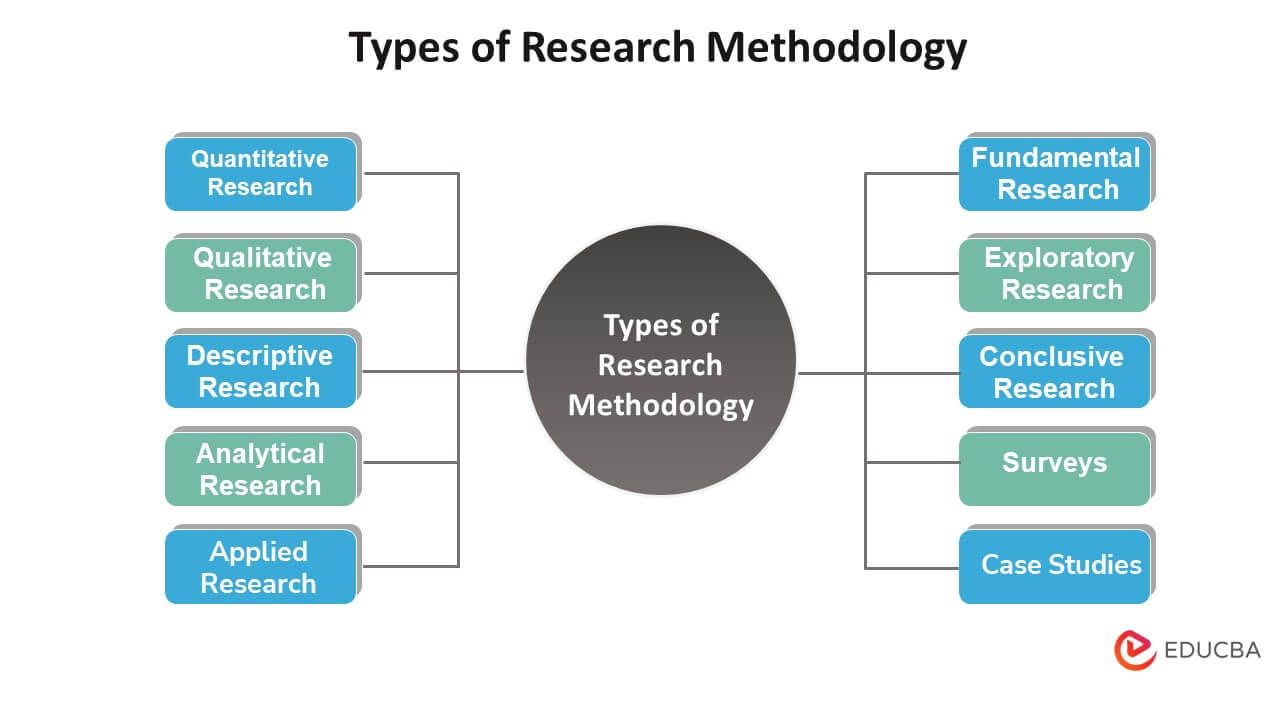
Introduction to Types of Research Methodology
Research is the backbone of knowledge, innovation, and informed decision-making. However, how do researchers systematically gather, analyze, and interpret data to draw meaningful conclusions? The answer lies in research methodology, the blueprint that guides every step of the study. Understanding the different types of research methodology is crucial, not just for academics but for anyone who wants to make data-driven decisions. From exploring human behavior to testing new scientific theories, the methods you choose shape the reliability, relevance, and impact of your findings.
In this guide, you will see the main types of research methods, explain their uses, and demonstrate real-life applications so you can choose the best approach for your study.
Table of Contents
- Introduction
- Types of Research Methodology
- Types of Data Collection Methods
- How to Choose the Right Research Methodology?
- Research Methodology by Discipline
- Common Mistakes in Research Methodology
Key Takeaways
- Research methodology is the structured approach researchers use to collect, analyze, and interpret data effectively.
- Choosing the right methodology quantitative, qualitative, or mixed depends on the research objectives, data type, and context.
- Each research method has unique strengths and limitations; selecting the appropriate one ensures reliable and actionable results.
- Data collection methods include surveys, interviews, observations, experiments, case studies, focus groups, and secondary data analysis.
- Avoid common mistakes such as unclear research questions, biased sampling, inadequate sample size, and ethical violations.
- Understanding research methodology across disciplines helps generate insights, support evidence-based decisions, and drive innovation.
List of Types of Research Methodology
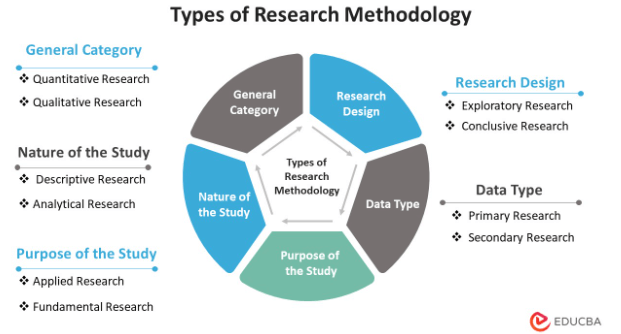
Research methodology is classified based on different categories. They include a general category, the nature of the study, the purpose, the research design, and the data type. There are also interviews and case studies based on research methodology. In some studies, researchers combine more than two methods; very few studies combine more than two.
Based on the General Category
1. Quantitative Research
Quantitative research is a method of gathering and analyzing numerical data to identify patterns, test ideas, and predict outcomes. It relies on measurable variables and uses statistical techniques to draw objective conclusions.
Key Characteristics of Quantitative Research
- Uses numerical and measurable data
- Involves large sample sizes for accuracy
- Follows a structured and controlled research design
- Uses statistical tools for data analysis
- Results are objective, reliable, and replicable
- Commonly presented using charts, tables, and graphs.
Real-World Example
Modern brands increasingly enhance traditional quantitative research with AI technologies to gain faster, deeper insights from survey and market data. For example, AI can automate survey setup, clean and validate large datasets, and uncover hidden patterns in responses that may not be obvious through manual analysis. This integration enables research teams to deliver actionable insights more quickly and helps analysts and business stakeholders explore trends with intuitive tools, while preserving rigorous methodological standards.
When to Use This Method?
- When the research objective involves measurement or comparison
- When testing a hypothesis or cause-and-effect relationship
- When you need to generalize results to a larger population
- When accuracy, consistency, and objectivity are required.
Advantages and Disadvantages
|
Advantages |
Disadvantages |
| Allows analysis of large data sets | Limited understanding of emotions or motivations |
| Produces objective and reliable results | Responses may not reflect real-life behavior |
| Enables statistical comparison and predictions | Restricted flexibility in survey design |
| Results are easy to replicate and verify | Can be costly and time-consuming |
| Supports decision-making with numerical evidence | Requires statistical expertise |
2. Qualitative Research
Qualitative research is a research methodology that focuses on non-quantitative data to understand human behavior, opinions, experiences, and motivations through detailed observations and interactions.
Key Characteristics
- Uses non-numerical data such as words, images, and observations
- Involves small, focused sample sizes
- Emphasizes depth over quantity
- Researchers collect data through interviews, focus groups, and observations
- Findings are interpretive and subjective
- Flexible and adaptable during the research process.
When to Use This Method?
- When the goal is to understand perceptions, attitudes, or experiences
- When exploring new or complex topics with limited existing data
- When numerical data alone cannot explain human behavior
- During the early stages of research to form hypotheses.
Real-World Example
A 2025 study published in Scientific Reports evaluated large language models like GPT‑4o for qualitative thematic analysis. Using transcripts from 107 participants, the AI achieved up to 0.99 semantic similarity (BERTScore F1) with human-coded themes, demonstrating high accuracy in theme identification, but highlighting limitations in contextual understanding and quote selection.
Advantages and Disadvantages
|
Advantages |
Disadvantages |
| Provides deep insights into human behavior | Results may be subjective |
| Allows flexible and open-ended data collection | Smaller samples limit generalization |
| Useful for exploring new or complex topics | Data analysis is time-consuming |
| Captures emotions, opinions, and motivations | Potential researcher bias |
| Helps generate theories and hypotheses | Difficult to replicate exactly |
Based on the Nature of the Research
3. Descriptive Research
Descriptive research is a method of study that aims to describe the attributes of a population or phenomenon. It focuses on answering the “what” questions rather than the “why,” providing an accurate picture of events or conditions as they exist.
Key Characteristics
- Observes and records data without manipulating variables
- Uses large or small sample sizes depending on research objectives
- Often involves surveys, observations, and case studies
- Focuses on describing trends, behaviors, and patterns
- Provides a snapshot of a population at a given point in time.
When to Use This Method?
- To summarize demographic or behavioral data
- When researchers need factual, quantitative, or qualitative descriptions
- To report current conditions, trends, or relationships
- To prepare for further analytical or exploratory studies.
Real-World Example
A 2026 multicenter descriptive study examined 176 newborns with urea cycle disorders (UCDs) in specialized neonatal intensive care units (NICUs). The study found that 95% of the infants needed transfer to specialized care, 40% experienced brain-related complications, and 12% died in the hospital. This highlights that UCD is a serious condition with high health risks and varied treatment needs.
Advantages and Disadvantages
| Advantages | Disadvantages |
| Provides an accurate snapshot of the population. | Cannot determine cause-and-effect relationships. |
| Helps identify trends, patterns, and frequencies. | May be limited by sample bias or nonresponse errors. |
| Data can be quantitative or qualitative, making it flexible. | Cannot explain why trends occur; only describes them. |
| Useful for generating baseline information for further studies. | Over-reliance on surveys or self-reported data may reduce reliability. |
4. Analytical Research
Analytical research is a type of study that examines existing information or data to explain why a phenomenon occurs. It goes beyond simply describing facts and focuses on understanding relationships, patterns, and causes.
Key Characteristics
- Relies on existing data, reports, and verified facts rather than primary data collection
- Seeks to explain the “why” behind observed trends or outcomes
- Often involves critical evaluation, comparison, or synthesis of previous studies
- Uses both qualitative and quantitative methods depending on the context.
When to Use This Method?
- When a researcher wants to validate or interpret existing theories or findings
- To understand patterns, correlations, or causes in historical, social, or scientific phenomena
- When collecting new primary data is impractical, costly, or time-consuming.
Real-World Example
A 2025 study examined how the addition of sugarcane bagasse fiber (SBF), a plant waste material, affects the properties of lightweight foamed concrete used in construction. They tested mixes with 0%–5% fiber and found that 4% fiber increased concrete strength by 53%, improved quality by 17%, and reduced shrinkage by 58% compared to normal concrete. This shows that researchers can use data and experiments to identify more sustainable building materials while reducing agricultural waste.
Advantages and Disadvantages
| Advantages | Disadvantages |
| Provides a deeper understanding of the cause-and-effect relationship. | Limited to the accuracy and completeness of existing data. |
| Helps validate or refute previous studies and theories. | May not capture real-time or current changes. |
| Can combine multiple data sources for comprehensive insights. | Risk of bias if sources are selectively analyzed. |
| Often more cost-effective than primary data collection. | Cannot control variables as in experiments, limiting causal claims. |
Based on the Purpose of the Study
5. Applied Research
Applied research is a type of research focused on solving specific, practical problems in real-world settings. Unlike fundamental research, which seeks to generate new knowledge, applied research aims to apply existing theories and principles to improve processes, products, or policies.
Key Characteristics
- Focused on solving specific, practical problems
- Often conducted in real-world environments (e.g., businesses, schools, hospitals)
- Uses both qualitative and quantitative methods depending on the problem
- Researchers design results to be directly implementable
- Often time-bound and resource-specific.
When to Use This Method?
- To improve efficiency, productivity, or performance in organizations
- To evaluate the effectiveness of new policies or technologies
- To make data-driven decisions in business, healthcare, education, or social programs
- When actionable outcomes are more important than theory building.
Real-World Example
In 2025, BBVA and the University of Navarra started a project on responsible AI. A team of 20 experts in data science, law, ethics, and economics is working to reduce bias in AI systems, protect privacy, and comply with EU regulations. This project demonstrates how applied research can address real-world problems by integrating technology, ethics, and regulations.
Advantages and Disadvantages
| Advantages | Disadvantages |
| Provides practical, actionable results that can be implemented immediately. | Results may be context-specific and not generalizable. |
| Helps organizations or policymakers make informed decisions. | Often resource-intensive in terms of time, money, and personnel. |
| Can improve processes, products, or services effectively and efficiently. | Focuses on short-term solutions, not long-term theory development. |
| Combines qualitative and quantitative methods for holistic insights. | May require specialized expertise for accurate application and interpretation. |
6. Fundamental Research
Fundamental research, also called basic or pure research, is research aimed at expanding knowledge and understanding of the underlying principles, theories, or phenomena, without immediate practical application.
Key Characteristics
- Focuses on theory development and knowledge expansion
- Seeks to answer “why” questions rather than “how to apply”
- Often involves experiments, surveys, or observational studies
- Typically conducted in controlled environments or academic settings
- Provides a foundation for applied research and innovations.
When to Use This Method?
- To explore new theories or scientific concepts
- When aiming to understand fundamental principles in a field
- Before launching applied or commercial research projects
- To create frameworks for future experiments or product development.
Real-World Example
A good example of fundamental research is Microsoft Research Asia, where scientists focus on basic AI research. They study new ways to make computers more intelligent and solve large problems across healthcare, finance, and everyday technology. This research does not aim for immediate products but lays the foundation for future innovations that can change how we live and work.
Advantages and Disadvantages
| Advantages | Disadvantages |
| Expands knowledge and contributes to scientific understanding | May not have immediate practical applications |
| Provides a foundation for applied research and innovations | Can be time-consuming and resource-intensive |
| Encourages creativity and the development of new theories | Results may not be commercially viable in the short term |
| Improves academic and intellectual expertise in a domain | Success or impact is uncertain and may take years to materialize |
Based on the Research Design
7. Exploratory Research
Exploratory research is a type of research methodology used to investigate an issue or topic that is not yet well understood. Its goal is to gain insights, identify patterns, and formulate hypotheses rather than provide conclusive answers.
Key Characteristics
- Flexible and open-ended approach
- Qualitative in nature (can include quantitative elements for larger samples)
- Focuses on discovering relationships and insights rather than testing hypotheses
- Often used as a preliminary step before conclusive research
- Uses methods such as interviews, focus groups, and observational studies.
When to Use This Method?
- When little prior information exists about a topic
- To explore new trends, behaviors, or markets
- For idea generation and hypothesis formulation
- Before conducting large-scale or conclusive research.
Real-World Example
In 2025, Eedi and Google DeepMind conducted an exploratory study in five UK secondary school classrooms to examine how a human‑in‑the‑loop AI tutoring model compares to traditional human tutoring. The results showed that the AI‑assisted approach was just as effective as human tutors at helping students correct mistakes (success rate ~93% vs. ~91%) and resolve misconceptions (about ~95%) in real time. The study also measured “knowledge transfer,” finding the human‑AI team boosted learning by 10 percentage points, more than double the improvement seen with human tutors alone. This type of research did not aim to draw conclusions; rather, it provided insights to inform larger 2026 trials.
Advantages and Disadvantages
| Advantages | Disadvantages |
| Helps generate new ideas and hypotheses | Findings cannot be generalized to the larger population |
| Flexible and adaptable to changing research needs | Lacks statistical rigor and precision |
| Provides an in-depth understanding of behavior and attitudes | Can be time-consuming and resource-intensive |
| Helps identify patterns for further study | Results may be subjective and prone to researcher bias |
8. Conclusive Research
Conclusive research is a structured type of research designed to provide clear, actionable insights and definitive answers to specific research questions. It aims to test hypotheses, measure variables, and support decision-making with quantifiable evidence.
Key Characteristics
- Highly structured and well-planned methodology
- Focused on testing hypotheses or confirming theories
- Primarily uses quantitative data, though qualitative insights may complement it
- Results are statistically valid and generalizable to a larger population
- Often employs surveys, experiments, or secondary data analysis.
When to Use This Method?
- To confirm trends or patterns identified in exploratory research
- To measure how well a marketing campaign or business strategy is working
- When a business or organization requires evidence-based decision-making
- For policy-making, program evaluation, or scientific validation.
Real-World Example
A 2025 study by the Woods Hole Oceanographic Institution found that the rate of U.S. coastal sea‑level rise has more than doubled over the past 125 years. According to the research, the average annual rise increased from less than 2 mm per year in 1900 to over 4 mm per year by 2024, resulting in approximately 40 centimeters (nearly 16 inches) of sea‑level rise along U.S. coastlines, well above the historical average. The study used data from 70 tide-gauge stations across the contiguous United States and concluded that the acceleration of sea‑level rise is consistent with ongoing climate change and ocean warming.
Advantages and Disadvantages
| Advantages | Disadvantages |
| Provides statistically valid, actionable results | Can be expensive and time-consuming |
| Supports decision-making with strong evidence | Requires large sample sizes for generalization |
| Reduces uncertainty in business or policy decisions | Less flexible than exploratory research |
| Allows comparison across variables and demographics | May not capture nuanced insights behind behaviors |
Based on the Type of Data
9. Primary Research
Primary research is the process of gathering original data directly from sources to address a specific research question. Unlike secondary research, primary research involves collecting data through surveys, interviews, observations, or experiments.
Key Characteristics
- Data is collected firsthand by the researcher
- Focuses on current, specific, and relevant information
- Can be qualitative, quantitative, or mixed-methods
- Often time-consuming and resource-intensive
- Methods include surveys, interviews, focus groups, experiments, and observations.
When to Use This Method?
- When no existing data is available on the research topic
- To validate or update secondary data
- When insights must be specific to a target audience or population
- To study behavioral patterns, preferences, or emerging trends.
Real-World Example
At Primary Children’s Hospital in Utah, researchers are conducting clinical research projects that enroll patients and collect new data to improve treatment outcomes. For example, a neurosurgical research team is examining how computational flow modeling of cerebrospinal fluid affects symptoms and outcomes in children with Chiari I malformation, using patient‑specific data to inform surgical decisions. The same team also compared outcomes for children with post‑hemorrhagic hydrocephalus with and without necrotizing enterocolitis, producing evidence that influences clinical practice.
Advantages and Disadvantages
| Advantages | Disadvantages |
| Provides accurate and specific data relevant to the research question | Can be time-consuming and costly to conduct |
| Enables real-time insights into behaviors and trends | Requires expertise to design effective data collection tools |
| Helps in making informed business or policy decisions | May face low response rates or participant bias |
| Allows researchers to control the quality of data collected | Limited sample size may reduce generalizability |
Types of Data Collection Methods
1. Surveys / Questionnaires
Customer Service Feedback Form
Researchers commonly use surveys and questionnaires to collect data. They involve collecting data from a large sample of respondents using structured questions, either online or offline. Surveys primarily generate quantitative data but can also include open-ended questions for qualitative insights. Researchers commonly use surveys to measure opinions, attitudes, satisfaction levels, and behavioral patterns because they are cost-effective, time-efficient, and amenable to statistical analysis.
2. Interviews
Interviews enable researchers to speak directly with participants to obtain detailed information. This method allows researchers to explore opinions, experiences, and motivations in detail. Interviews may be structured, semi-structured, or unstructured, depending on the required level of flexibility. Although interviews provide rich, detailed data, they are time-consuming and may be subject to interviewer bias if not conducted carefully.
3. Observations
In this method, researchers collect data by observing and recording behaviors or events as they occur naturally. This method can be either qualitative or quantitative, depending on whether behaviors are described or counted. Observations are especially useful when studying real-life behaviors that participants may not accurately report themselves. However, researchers must carefully control observer bias and address ethical concerns.
4. Experiments
Experiments involve manipulating one or more variables to assess their effects on outcomes in a controlled setting. This method is commonly used in scientific and behavioral research to establish cause-and-effect relationships. Experimental data are typically quantitative and highly reliable when properly controlled. However, experiments may lack real-world applicability due to their artificial environments.
5. Case Studies
Case studies focus on the in-depth analysis of a single individual, group, organization, or event over time. This qualitative method helps researchers better understand complex issues in real-world contexts. Researchers commonly use case studies in social sciences, business, and education. They provide detailed insights, but researchers cannot always generalize the findings to a larger population.
6. Focus Groups
Focus groups involve guided discussions with a small group of participants to gather collective opinions and perceptions on a specific topic. This qualitative method encourages interaction among participants, helping researchers identify common themes, attitudes, and group dynamics. Focus groups are especially useful in market research and social studies, though dominant participants may influence results.
7. Secondary Data Collection
Secondary data collection involves using existing data previously gathered by other researchers or organizations. Common sources include books, academic journals, government publications, company reports, and online databases. This method is cost-effective and time-saving, but researchers must evaluate the data’s relevance, accuracy, and timeliness before use.
8. Document and Content Analysis
Document or content analysis is a qualitative method that systematically reviews documents, texts, or media to identify patterns, themes, and meanings. Researchers use this method to analyze historical records, policy documents, newspapers, and digital content. While it allows data analysis without direct participant involvement, interpretation bias may affect the findings.
9. Mixed Methods
Mixed-methods research uses a mix of quantitative and qualitative data collection methods to provide a clearer, more complete understanding of the research problem. By integrating numerical data with detailed narratives, this method enhances the study’s reliability and depth. Although mixed methods offer balanced insights, they require more time, resources, and methodological expertise.
How to Choose the Right Research Methodology?
Selecting the right research methodology is critical to ensuring your study is accurate, reliable, and actionable. The choice depends on your research objectives, the type of data you need, and the resources available. Here is a step-by-step guide to help you make the best decision:
1. Define Your Research Objective
Start by clarifying what you want to achieve with your study. Ask yourself:
- Am I trying to measure, describe, or explain a phenomenon?
- Do I aim to test a hypothesis, explore new ideas, or solve a practical problem?
The objective directly influences your choice of quantitative, qualitative, or mixed methods.
2. Identify the Type of Data Needed
Determine if your research requires:
- Numerical data for statistical analysis → Quantitative methods
- Text, images, or opinions → Qualitative methods
- Both → Mixed-methods research.
Knowing your data type helps you select appropriate methods, such as surveys, interviews, experiments, or case studies.
3. Consider Your Research Design
Research design refers to the structure of a study. Decide whether you need:
- Exploratory research to investigate new topics
- Descriptive research to capture current trends
- Analytical research to examine causes and relationships
- Conclusive research to validate hypotheses and support decision-making.
Your design impacts sample size, duration, and data collection methods.
4. Evaluate Time and Resources
Some research methods are time-intensive or resource-heavy:
- Surveys or experiments may require large datasets and statistical analysis.
- Interviews or case studies take longer because of the in-depth engagement with participants.
Choose a methodology that aligns with your available time, budget, and team expertise.
6. Assess Ethical and Practical Constraints
Ensure your method respects ethical considerations:
- Protect participants’ privacy and consent
- Avoid biased or harmful data collection
- Consider practicality: Can your study be realistically conducted in the given context?
7. Use Mixed Methods if Necessary
Modern research often combines methodologies to gain more comprehensive insights:
- Quantitative methods provide breadth and generalizability
- Qualitative methods provide depth and understanding
- Mixed-methods research ensures accuracy, reliability, and richness in your findings.
8. Test and Refine
Before fully committing:
- Run a small trial study to spot any possible issues
- Adjust your methodology if issues arise with sample size, data collection, or analysis.
This step ensures your chosen approach is practical and effective.
Research Methodology by Discipline
Different academic and professional disciplines often prefer specific research methodologies, depending on their objectives, data types, and context. Knowing which methodology each field employs helps researchers select the most appropriate approach for their study.
1. Business & Management
- Preferred Methodologies: Quantitative, Qualitative, Mixed Methods
- Why: Business research often requires both statistical analysis and an in-depth understanding of human behavior.
- Common Tools: Surveys, interviews, focus groups, case studies
- Example: A company studying customer satisfaction may use surveys to collect quantitative ratings and interviews to explore customer opinions in depth.
2. Healthcare & Medical Research
- Preferred Methodologies: Descriptive, Analytical, Experimental
- Why: Healthcare studies require accurate measurement of outcomes and cause-and-effect relationships to improve treatments and patient care.
- Common Tools: Clinical trials, observations, experiments, patient surveys
- Example: A clinical trial for a new drug can use experimental research to assess efficacy and surveys to gather patient feedback.
3. Education & Social Sciences
- Preferred Methodologies: Qualitative, Exploratory, Case Studies
- Why: These fields focus on understanding behaviors, attitudes, and learning processes, often in complex social contexts.
- Common Tools: Interviews, focus groups, classroom observations, ethnography
- Example: A study analyzing the effectiveness of AI tutoring programs in schools may use qualitative interviews with teachers and students, alongside quantitative analyses of test scores.
4. Technology & Engineering
- Preferred Methodologies: Analytical, Experimental, Applied Research
- Why: Research in these fields often emphasizes problem-solving, innovation, and practical applications.
- Common Tools: Simulations, prototype testing, experiments, surveys
- Example: Engineers may conduct experiments to test the durability of a new construction material and complement these experiments with analytical studies using simulation software.
5. Environmental & Earth Sciences
- Preferred Methodologies: Descriptive, Analytical, Conclusive
- Why: These studies aim to observe patterns in nature, analyze causes, and predict future trends.
- Common Tools: Field surveys, remote sensing, experiments, secondary data analysis
- Example: Climate scientists use observational research to measure sea-level rise, analytical methods to determine contributing factors, and modeling to project future scenarios.
6. Finance & Economics
- Preferred Methodologies: Quantitative, Applied, Mixed Methods
- Why: Accurate numerical analysis is crucial for forecasting trends, assessing policies, and investment strategies.
- Common Tools: Statistical analysis, econometric modeling, surveys
- Example: An economist may analyze quantitative trends in GDP growth and conduct surveys to understand consumer behavior, integrating both insights into policy recommendations.
Common Mistakes in Research Methodology
Even experienced researchers can make errors when designing or conducting a study. Being aware of these common mistakes can improve the reliability and validity of your research.
- Poorly defined research problem: Failing to define the research question or objective clearly can lead to unfocused studies.
- Inappropriate research design: Choosing a research design that does not align with the study’s goals.
- Insufficient sample size: A sample that is too small can produce unreliable results or fail to represent the population.
- Biased sampling: Selecting participants in a way that skews the results.
- Inaccurate data collection: Errors can compromise the study’s accuracy.
- Ignoring ethical considerations: Failing to obtain informed consent or failing to maintain participant confidentiality can invalidate a study.
- Misuse of statistical tools: Applying inappropriate statistical tests or misinterpreting results can lead to wrong conclusions.
- Overgeneralization of findings: Concluding what the data do not support.
- Neglecting the literature review: Skipping a thorough review of existing research can lead to duplication or missed insights.
- Lack of clear documentation: Poor record-keeping and unclear reporting of methodology make replication and validation difficult.
Final Thoughts
Understanding the various research methodologies is essential for conducting accurate, reliable, and meaningful studies. Each method serves a specific purpose, offers advantages, and has limitations; researchers who select the appropriate approach achieve their research objectives efficiently. By combining appropriate methods, avoiding common mistakes, and aligning techniques with the research question, researchers can generate insights that are not only valid but also actionable. Ultimately, mastering research methodology enables researchers to generate valuable knowledge, support evidence-based decisions, and advance progress across disciplines.
Frequently Asked Questions(FAQs)
Q1. What is a mixed research method?
Answer: In a mixed methods study, researchers collect and analyze quantitative and qualitative data within the same study.
Q2. What is sampling?
Answer: A sample is a small fraction of people drawn from a larger population. Sampling is choosing the group from which you will draw data for your research.
Q3. What is a research design?
Answer: A research design is a strategy for addressing your research question. It establishes the scope of your strategy and specifies the methods for data collection and analysis.
Q4. What is the difference between research methods and research methodology?
Answer: While the method aims to address the research problem, the goal of the methodology types is to assess the appropriateness of the methods used to solve it. After all, the types of methodology are merely behaviors or tools utilized to choose a research approach. The methodology assesses all of the investigation’s approaches and procedures.
Q5. Can a research study use more than one methodology?
Answer: Yes. Many modern studies use mixed-methods research to combine depth and accuracy.
Q6. Which research methodology is best for beginners?
Answer: Descriptive and qualitative research are often easier for beginners due to simpler design and tools.
Q7. Is research methodology the same for academic and business research?
Answer: The principles are similar, but business research places greater emphasis on speed, applicability, and decision-making.
Recommended Articles
This is a guide to Types of Research Methodology. Here, we discuss the 11 types of research methodology and their respective advantages. You may also have a look at the following articles to learn more –

