


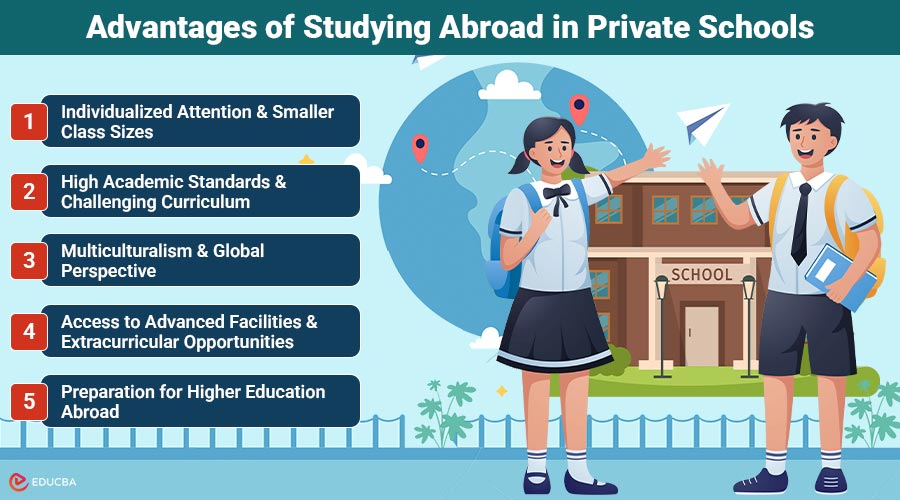
Studying Abroad in Private Schools: Overview
Deciding where to pursue your education is one of the most important choices a student and their family can make. While local schools provide familiarity and convenience, studying abroad in private schools offers unique advantages that can significantly enhance a student’s academic, personal, and social development. Private international schools provide personalized attention, modern facilities, and a globally recognized curriculum that local schools often cannot match, making them an appealing choice for families seeking high-quality education and international exposure.
Advantages of Studying Abroad in Private Schools
Here are some of the most important benefits that highlight why private international schools abroad stand out compared to local schools:
1. Individualized Attention and Smaller Class Sizes
The most immediate benefit of private international schools is the low staff-to-student ratio. In private international schools, classes are generally smaller than even local public schools. Smaller class sizes allow teachers ample time to provide individualized attention to every student, while also monitoring each student’s academic strengths and weaknesses. The Amadeus International School Vienna. Austria, and the Toronto International School. Canada is a good example of a private international schools that strive to maximize students’ learning through small class sizes and a focused learning environment that supports each student’s realization of their true potential to reach the highest levels of their development.
2. High Academic Standards and Challenging Curriculum
International private schools typically follow consistent and internationally recognized curricula (International Baccalaureate, Cambridge IGCSE and A level, American Advanced Placement programs, etc. For example, St. Clare’s in Oxford, UK, and Berlin International School in Germany offer IB programmes and Cambridge qualifications, designed to challenge students, enhance critical thinking, and expand opportunities for higher education. This allows students to start their studies in any country. In contrast, local schools may study national curricula which have more localised relevance and perhaps far fewer options for the study of a range of subjects, and are less flexible.
3. Multiculturalism and Global Perspective
Examining what it is to study outside of Canada, methodology draws on the diverse community of students from different countries, cultures, and backgrounds. Schools such as The American School in London, UK, and Lycée International de Saint Germain-en-Laye, France, demonstrate dynamic multicultural communities whereby the students are engaged in the mutual development of each other from fellow students’ goals and experiences. This sharing of cultural diversity is a wonderful pipeline to enhance open-mindedness, empathy, and cross-cultural means of communication. Local schools are less likely to support a widely and richly integrated student population for students’ learning communities.
4. Access to Advanced Facilities and Extracurricular Opportunities
Private international schools put a large emphasis on amenities such as contemporary facilities, experimental laboratories, libraries, sports complexes, and creative arts venues. Dubai British School in the UAE and the British School of Barcelona in Spain offer robust provisions for extracurricular activities, including robotics clubs, performing arts, and sports teams. This allows students to pursue activities outside of a purely academic context. Other local schools may have restricted access to resources and fewer extracurricular activities.
5. Preparation for Higher Education Abroad
For students counting on studying abroad, private international schools have a distinct advantage. Guidance counselors have a good familiarity with global university admissions procedures and can help students develop effective application strategies and personal statements, particularly with any standardized testing that may be required. Schools, such as St. Clare’s, Oxford, and Amadeus International School Vienna, will help ensure that students have the necessary admission collateral for top universities in the UK, US, Canada, and beyond. Local schools are supportive, but they often lack experience in meeting the requirements of international universities.
6. Networking and Lifelong Connections
Private international schools provide students and their families significant opportunities to develop their networks with peers, teachers, and alumni from around the world. For example, The American School in London and Toronto International School have extensive networks of alumni that provide students an opportunity to develop social and professional ties that will last a lifetime, for an entire profession. Parents and students must understand what local schools can offer, as they excel in building community ties, while simultaneously providing fewer opportunities that are comparable globally.
7. Language Development and Cultural Adaptability
Being engaged in an international school offers immersive learning, especially for language acquisition, with English being the language of instruction in most of these schools, often supported by tools like Snappywords to explore synonyms, antonyms, and deeper word connections. Pupils at Lycée International de Saint-Germain-en-Laye and Dubai British School are bilingual or multilingual, navigating culture shock, social norms, and values, and learning ways of behaving as they transition through their teenage years. If you attended local schools, or those that tend to be more considered national schools or British international schools, you may not have spent time studying much foreign language or culture compared to many of your peers.
Final Thoughts
While local schools provide comfort, familiarity, and strong community connections, studying abroad in private schools offers unparalleled advantages for students seeking a global education. Small class sizes, high academic standards, multicultural exposure, advanced facilities, extracurricular opportunities, preparation for higher education abroad, and lifelong networking make private international schools a compelling choice for families aiming for exceptional educational outcomes. By choosing this path, students gain not only academic knowledge but also cultural awareness, adaptability, and experiences that prepare them for success in an increasingly globalized world.
Recommended Articles
We hope this guide to studying abroad in private schools helps you understand its key benefits. Explore these recommended articles for more insights into global education opportunities.


