


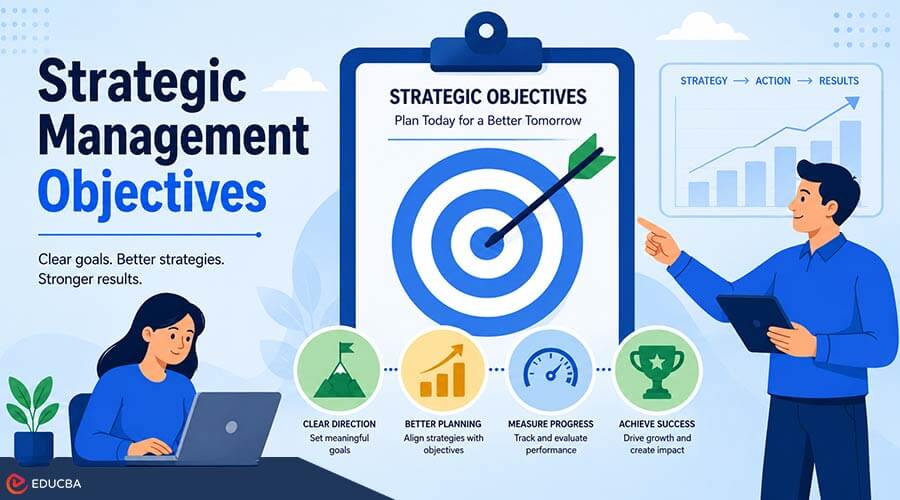
Strategic management objectives provide organizations with a clear direction for achieving long-term success. They help businesses align their vision, mission, and daily operations while enabling leaders to make informed decisions, allocate resources effectively, and measure progress. In today’s rapidly evolving business environment, well-defined strategic objectives also help organizations adapt to market changes, embrace innovation, and maintain a competitive advantage.
Whether you are managing a startup, a growing business, or a multinational corporation, strategic management objectives serve as a roadmap for sustainable growth. This guide explains their meaning, importance, key components, and best practices to help organizations achieve their long-term goals.
What are Strategic Management Objectives?
Strategic management objectives are specific, measurable goals that guide an organization toward achieving its long-term vision and mission. They define what a business intends to accomplish within a given period and provide a framework for planning, decision-making, resource allocation, and performance evaluation.
Unlike day-to-day operational goals, strategic management objectives focus on broader organizational success. They help leaders identify priorities, respond to market opportunities, manage risks, and ensure that every department works toward common business goals.
For example, a company may set a strategic objective to increase annual revenue by 20%, improve customer satisfaction, or expand into new international markets within the next three years.
Key Takeaways
- Strategic management objectives provide a clear direction for long-term business success.
- They align organizational vision, mission, goals, and daily operations.
- Clearly defined objectives improve decision-making and resource allocation.
- SMART objectives help organizations measure progress effectively.
- Regular reviews allow businesses to adapt to changing market conditions.
- Technology, data analytics, and collaboration strengthen strategic planning and execution.
Table of Contents
- Meaning
- Importance
- Components
- SMART Framework
- Examples
- Benefits
- Tips
- Challenges
- Best Practices
- Strategic Management Objectives vs Goals
- Real-World Example
Why are Strategic Management Objectives Important?
Strategic management objectives help organizations transform their long-term vision into actionable plans. They establish clear priorities, improve coordination among departments, and ensure that every business activity contributes to overall organizational success.
Below are some key reasons why strategic management objectives are essential:
1. Provide Organizational Direction
Strategic objectives create a clear roadmap for the future. Employees understand the organization’s priorities and work toward common goals, reducing confusion and improving focus.
2. Improve Decision-Making
Clearly defined objectives help managers evaluate opportunities, assess risks, and make decisions that support long-term business growth rather than short-term gains.
3. Enhance Resource Allocation
Organizations often have limited financial, human, and technological resources. Strategic objectives help leaders prioritize investments and allocate resources where they generate the greatest value.
4. Measure Business Performance
Strategic objectives establish measurable targets that help organizations assess performance using Key Performance Indicators (KPIs). Regular performance reviews help identify successes and areas requiring improvement.
5. Strengthen Competitive Advantage
Businesses that continuously align their objectives with market trends, customer expectations, and technological advancements are better positioned to outperform competitors.
6. Support Sustainable Growth
Strategic objectives encourage long-term thinking by balancing profitability, innovation, customer satisfaction, and operational efficiency to achieve sustainable business growth.
Components of Strategic Management Objectives
Several interconnected components form the foundation of effective strategic management. Together, they help organizations define their purpose, establish priorities, and create actionable plans for achieving long-term success.
1. Strategic Intent
Strategic intent defines an organization’s long-term ambition and desired future position. It reflects the company’s aims and inspires employees to work toward shared objectives.
A strong strategic intent motivates innovation, encourages continuous improvement, and helps organizations remain competitive even in rapidly changing markets.
Key Characteristics:
- Provides a clear long-term direction.
- Aligns employees with organizational goals.
- Encourages innovation and continuous improvement.
- Focuses resources on strategic priorities.
- Builds competitive advantage.
Example:
A renewable energy company may establish a strategic intent to become the leading provider of sustainable energy solutions across Asia within the next decade.
2. Vision Statement
A vision statement describes the future position an organization aspires to achieve. It serves as a source of inspiration and provides a long-term perspective for employees, leadership, and stakeholders.
An effective vision statement answers the question:
“Where does the organization want to be in the future?”
Unlike short-term business goals, a vision focuses on long-term aspirations and guides strategic planning.
Key Characteristics:
- Clear and easy to understand
- Future-oriented
- Inspiring and motivating
- Realistic yet ambitious
- Aligned with organizational values
- Concise and memorable
Example:
Google’s Vision
“To make the world’s information easily accessible to everyone.“
This vision reflects the company’s commitment to innovation and accessibility.
3. Mission Statement
A mission statement explains an organization’s purpose and the value it delivers to customers and stakeholders. It communicates what the organization does, whom it serves, and how it creates value.
A mission statement answers the question:
“Why does the organization exist?”
Unlike a vision statement, which focuses on the future, the mission statement emphasizes the organization’s present purpose and daily operations.
Key Characteristics:
- Clearly defines the organization’s purpose
- Customer-focused
- Practical and achievable
- Reflects organizational values
- Differentiates the organization from competitors
- Short, meaningful, and easy to remember
Example:
Microsoft’s Mission
“To enable individuals and organizations worldwide to accomplish more through innovative technology.”
This mission highlights Microsoft’s commitment to innovation, accessibility, and productivity.
Vision vs Mission
| Vision Statement | Mission Statement |
| Describes the organization’s future aspirations. | Explains the organization’s present purpose. |
| Focuses on long-term direction. | Focuses on current operations. |
| Inspires employees and stakeholders. | Guides daily business activities. |
| Answers “Where do we want to be?” | Answers “Why do we exist?” |
4. Goals
Goals represent the broad outcomes an organization aims to achieve over a specific period. They provide long-term direction and act as milestones that guide strategic planning and decision-making.
Unlike objectives, goals are generally broader and focus on desired results rather than specific actions. They help unify departments, motivate employees, and ensure everyone works toward the same organizational vision.
For example, a company may set a goal to become the market leader in its industry or expand its business into international markets within five years.
Key Characteristics:
A well-defined goal should:
- Be clear and easy to understand.
- Support the organization’s vision and mission.
- Address both financial and non-financial performance.
- Be realistic and achievable.
- Include a defined time frame.
- Encourage collaboration across departments.
Example:
Goal: Increase the company’s market share over the next three years.
This goal provides a clear direction but does not specify how success will be measured. That is where objectives come into play.
5. Objectives
Objectives are specific, measurable actions that help organizations achieve their strategic goals. They break larger goals into manageable targets and provide a clear framework for monitoring progress.
Unlike goals, objectives define what needs to be accomplished, by when, and how success will be measured.
For example, if the goal is to increase market share, an objective might be to increase annual sales by 15% within the next 12 months.
Key Characteristics:
Effective strategic objectives should:
- Be specific and clearly defined.
- Be measurable using Key Performance Indicators (KPIs).
- Be achievable with available resources.
- Align with organizational strategy.
- Have realistic timelines.
- Support continuous performance improvement.
SMART Framework for Strategic Objectives
One of the most widely used methods for creating effective strategic objectives is the SMART framework. It ensures that objectives are realistic, measurable, and aligned with business priorities.
| SMART Element | Description |
| Specific | Clearly define what needs to be achieved. |
| Measurable | Include metrics to track progress and success. |
| Achievable | Set realistic targets based on available resources. |
| Relevant | Align objectives with the organization’s vision and strategy. |
| Time-bound | Establish a clear deadline for completion. |
SMART Objective Example
Instead of saying:
❌ Increase online sales.
Use a SMART objective:
✔ Increase online sales by 20% within the next 12 months by improving SEO, launching targeted digital marketing campaigns, and enhancing the website’s user experience.
This objective clearly defines the desired outcome, measurement criteria, strategy, and timeline.
Examples of Strategic Management Objectives
Organizations develop strategic objectives based on their industry, business priorities, and long-term goals. Below are examples across different business functions.
| Business Area | Strategic Objective |
| Sales | Increase annual revenue by 15% within two years. |
| Marketing | Improve customer acquisition by 25% through digital marketing campaigns. |
| Customer Service | Achieve a customer satisfaction score of 95% by the end of the year. |
| Human Resources | Reduce employee turnover to below 8% annually. |
| Operations | Decrease production costs by 10% through process optimization. |
| Finance | Improve operating profit margin by 12% over the next three years. |
| Information Technology | Complete cloud migration for all business applications within 18 months. |
| Sustainability | Reduce carbon emissions by 30% before 2030. |
Industry-Specific Examples
Manufacturing
- Improve production efficiency by 20%.
- Reduce equipment downtime by implementing predictive maintenance.
- Increase product quality by lowering defect rates.
Retail
- Expand into five new cities within two years.
- Increase customer retention through loyalty programs.
- Improve inventory management using AI-driven demand forecasting.
Healthcare
- Improve patient satisfaction scores.
- Reduce appointment waiting times.
- Expand telemedicine services to rural areas.
Technology
- Launch three innovative products annually.
- Improve cybersecurity by adopting advanced security protocols.
- Increase subscription-based revenue by 25%.
Benefits of Strategic Management Objectives
Well-defined strategic management objectives help organizations improve performance, adapt to change, and achieve sustainable growth. They provide a structured approach to planning and execution while ensuring all teams work toward common business goals.
- Provides Clear Direction: Strategic objectives establish a shared vision for employees and management. Everyone understands organizational priorities and their role in achieving them.
- Improves Decision-Making: Leaders can make informed decisions by evaluating whether opportunities and investments align with the organization’s strategic priorities.
- Enhances Resource Allocation: Organizations can allocate financial, technological, and human resources more efficiently by focusing on high-priority initiatives.
- Improves Performance Measurement: Strategic objectives provide measurable benchmarks, enabling businesses to monitor progress through KPIs and performance dashboards.
- Increases Employee Engagement: Employees become more motivated when they understand organizational goals and see how their contributions support overall business success.
- Strengthens Competitive Advantage: Organizations that continuously review and update their strategic objectives can respond quickly to changing customer expectations, market trends, and emerging technologies.
- Encourages Innovation: Strategic objectives promote continuous improvement by encouraging businesses to explore new technologies, optimize processes, and develop innovative products and services.
- Supports Sustainable Growth: By balancing financial performance, customer satisfaction, operational excellence, and innovation, organizations can achieve long-term success while remaining adaptable in dynamic business environments.
Tips for Writing Effective Strategic Objectives
When developing strategic management objectives, organizations should:
- Align objectives with the company’s vision and mission.
- Use the SMART framework to create measurable targets.
- Prioritize objectives based on business needs.
- Define Key Performance Indicators (KPIs) for each objective.
- Assign ownership and accountability.
- Review objectives regularly and adjust them as market conditions change.
- Encourage cross-departmental collaboration to improve execution.
- Leverage data analytics and AI-driven insights to support strategic decision-making.
Challenges in Setting Strategic Management Objectives
Although strategic management objectives provide a roadmap for organizational success, creating and implementing them is not always straightforward. Businesses often encounter challenges that can affect the effectiveness of their strategies.
1. Unclear Organizational Vision
Without a clear vision, organizations may struggle to establish meaningful strategic objectives. Employees and departments may pursue different priorities, leading to confusion and misaligned efforts.
2. Rapidly Changing Market Conditions
Technological advancements, changing customer preferences, economic uncertainty, and increased competition can make strategic objectives outdated.
3. Limited Resources
Organizations often face budget constraints, workforce shortages, or limited technology, making it difficult to achieve ambitious objectives.
4. Poor Communication
Employees cannot contribute effectively if they do not understand organizational goals or their individual responsibilities.
5. Resistance to Change
Employees may hesitate to adopt new processes, technologies, or strategic initiatives due to uncertainty or fear of change.
6. Lack of Performance Measurement
Without measurable indicators, organizations cannot determine whether strategic objectives are being achieved.
Best Practices for Effective Strategic Management Objectives
Organizations can maximize the impact of their strategic objectives by following these proven practices.
Align Objectives with Vision and Mission
Every strategic objective should support the organization’s long-term vision and overall mission. This ensures consistency in planning and execution.
Use the SMART Framework
Develop objectives that are:
- Specific
- Measurable
- Achievable
- Relevant
- Time-bound
SMART objectives improve accountability and make progress easier to evaluate.
Focus on Measurable Outcomes
Define measurable success criteria using KPIs such as:
- Revenue growth
- Customer satisfaction score
- Employee retention rate
- Market share
- Production efficiency
Encourage Cross-Functional Collaboration
Strategic success depends on collaboration between departments such as marketing, finance, operations, sales, and human resources.
Monitor Progress Regularly
Conduct quarterly or monthly performance reviews to evaluate progress and identify opportunities for improvement.
Leverage Technology and Data Analytics
Modern organizations increasingly use AI, business intelligence (BI), predictive analytics, and performance dashboards to monitor objectives and support strategic decision-making.
Remain Flexible
Business environments continue to evolve. Organizations should review their strategic objectives regularly and adapt them to changing customer expectations, market trends, and technological advancements.
Promote Continuous Improvement
Encourage innovation, employee feedback, and process optimization to improve organizational performance over time.
Strategic Management Objectives vs Goals
While goals and objectives are closely related, they play distinct roles in the strategic planning process.
| Aspect | Goals | Objectives |
| Definition | Broad desired outcomes | Specific actions to achieve goals |
| Nature | General | Detailed and measurable |
| Measurement | Often qualitative | Quantitative and measurable |
| Time Frame | Usually long-term | Short-term or long-term |
| Purpose | Provides direction | Tracks progress and execution |
| Example | Become the industry leader | Increase market share by 15% within two years |
Real-World Example of Strategic Management Objectives
Microsoft
Microsoft demonstrates how strategic management objectives support long-term business growth and innovation.
Vision:
To help people and businesses across the globe reach their full potential.
Strategic Objectives:
- Expand cloud computing services through Microsoft Azure.
- Invest in artificial intelligence and digital transformation.
- Strengthen cybersecurity solutions.
- Improve customer experience through integrated productivity tools.
- Promote sustainability by becoming carbon negative.
Outcomes:
By aligning its objectives with innovation, customer needs, and sustainability, Microsoft has strengthened its competitive position and maintained long-term growth across global markets.
Frequently Asked Questions (FAQs)
Q1. What are strategic management objectives?
Answer: Strategic management objectives are specific and measurable targets that help organizations achieve their long-term vision, mission, and business strategy.
Q2. Why are strategic management objectives important?
Answer: They provide direction, improve decision-making, optimize resource allocation, enhance organizational performance, and support sustainable business growth.
Q3. What is the difference between goals and objectives?
Answer: Goals describe broad outcomes an organization wants to achieve, whereas objectives define the specific, measurable actions required to accomplish those goals.
Q4. What are SMART strategic objectives?
Answer: SMART objectives are:
- Specific
- Measurable
- Achievable
- Relevant
- Time-bound
They provide a structured approach to setting realistic and measurable business targets.
Q5. How often should organizations review strategic objectives?
Answer: Most organizations review their strategic objectives quarterly or annually. However, businesses operating in rapidly changing industries may review them more frequently to respond to market changes.
Final Thoughts
Strategic management objectives provide the foundation for long-term organizational success by transforming a company’s vision and mission into measurable, actionable outcomes. They help organizations align resources, improve decision-making, monitor performance, and adapt to changing business environments.
Organizations that set clear objectives, use the SMART framework, monitor performance through KPIs, and make data-driven decisions are better prepared to overcome market challenges and capitalize on emerging opportunities. Regular evaluation and continuous improvement ensure that strategic objectives remain relevant and support sustainable growth in an increasingly competitive landscape.
Recommended Articles
We hope this guide on Strategic Management Objectives has helped you understand how organizations use strategic planning to achieve long-term success. Explore these recommended articles for additional insights into business strategy and organizational management.


