
What Is the Standard of Living?
The standard of living describes the overall level of economic well-being, comfort, material resources, and access to necessities that individuals or communities experience. Factors such as income, employment, housing, healthcare, education, infrastructure, and the cost of everyday goods and services influence it.
However, income alone does not determine standard of living. Two people earning similar salaries may experience very different living conditions depending on healthcare access, housing costs, public transportation, education, safety, and other factors. Similarly, a country with a high GDP per capita may still have significant differences in living standards among its population.
Understanding the standard of living helps governments, economists, businesses, and individuals assess economic well-being and identify areas where living conditions can improve.
Standard of Living at a Glance
- Meaning: The level of material comfort and access to essential resources available to people.
- Key factors: Income, employment, healthcare, education, housing, infrastructure, and cost of living.
- Common measures: GDP per capita, Human Development Index (HDI), Purchasing Power Parity (PPP), Gini coefficient, and Consumer Price Index (CPI).
- Why it matters: It helps assess economic well-being, living conditions, and differences between populations.
- Important distinction: Standard of living mainly focuses on material and economic conditions, while quality of life covers broader physical, social, and emotional well-being.
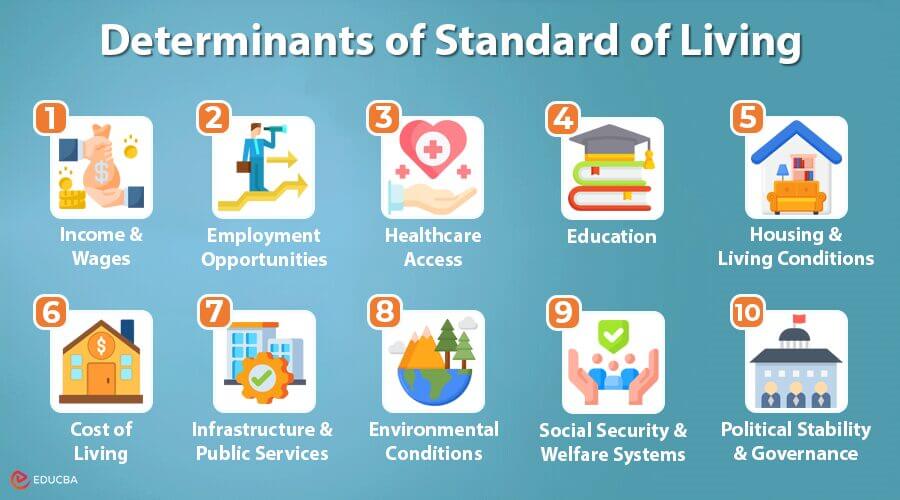
Determinants of Standard of Living
Several economic, social, and environmental factors influence how people live and the resources available to them.
Income and Wages
Income determines how much households can spend on necessities and discretionary goods. Higher and more stable earnings generally provide greater access to better housing, healthcare, education, transportation, food, and leisure activities.
For example, a household with a stable income may have more flexibility to choose better housing, maintain health insurance, or invest in education. However, income needs to be considered alongside the cost of living because a high salary may provide less purchasing power in an expensive city.
Employment Opportunities
The availability of stable and reasonably paid jobs directly affects financial security. Employment provides households with income and access to benefits such as medical coverage, paid time off, retirement benefits, and other forms of financial and social security.
High unemployment or insecure employment can reduce household spending power and make it difficult for people to afford essential services.
Healthcare Access
Affordable and accessible healthcare contributes significantly to living standards. People with reliable access to healthcare are more likely to receive preventive care, treatment, and support when they become ill.
The rise of telemedicine providers such as HelpCare Plus has further improved access to medical consultations and telecounseling services, especially in remote and underserved areas.
Education
Education improves knowledge, skills, employability, and earning potential. Access to quality schools, vocational training, colleges, and professional development can create better economic opportunities.
Education can also influence living standards across generations. Parents with greater educational opportunities may be better positioned to support their children’s education and future employment prospects.
Housing and Living Conditions
Safe, adequate housing is essential to a good standard of living. Access to clean water, electricity, sanitation, ventilation, and sufficient living space can directly affect health and comfort.
Poor housing conditions can increase exposure to health risks and place additional financial pressure on households.
Cost of Living
The cost of food, housing, transportation, utilities, education, and healthcare determines how far an individual’s income can stretch.
For example, two households earning the same income may have different standards of living if one lives in a city with significantly higher housing and transportation costs. This is why income should not be considered independently when comparing living standards.
Infrastructure and Public Services
Reliable infrastructure makes everyday life more efficient and accessible. Roads, public transportation, electricity, clean water, sanitation, broadband connectivity, and waste management all contribute to living conditions.
Well-developed public services can also reduce households’ financial burden by providing access to essential resources through public systems.
Environmental Conditions
Clean air, safe drinking water, green spaces, effective waste management, and sustainable environmental practices contribute to health and well-being.
Environmental degradation can negatively affect living standards by increasing health risks, reducing access to natural resources, and creating additional costs for individuals and governments.
Social Security and Welfare Systems
Social security programs can provide financial support during unemployment, retirement, disability, or other periods of economic difficulty.
Pensions, unemployment benefits, financial assistance, and other welfare programs can provide a safety net and reduce the impact of unexpected financial hardship.
Political Stability and Governance
Stable institutions and effective governance create an environment where businesses can operate, people can work safely, and public services can function effectively.
Political instability, weak institutions, conflict, or poor administration can disrupt employment, infrastructure, healthcare, education, and investment, reducing living standards.
How Is Standard of Living Measured?
No single indicator can capture every aspect of living standards. Economists and policymakers therefore use several measures to evaluate income, purchasing power, health, education, inequality, and the cost of goods and services.
GDP per Capita
GDP per capita represents a country’s economic output divided by its population. It is commonly used to compare the economic resources available per person across countries.
A higher GDP per capita can indicate greater economic capacity, but it does not necessarily mean that every household enjoys a high standard of living. It does not fully capture income inequality, access to healthcare, education, environmental conditions, or differences in the cost of living.
Human Development Index
The Human Development Index (HDI) combines indicators related to health, education, and income. It provides a broader view of human development than income-based measures alone.
For example, a country may have moderate income levels but achieve strong health and education outcomes, resulting in a relatively high level of human development.
Purchasing Power Parity
Purchasing Power Parity (PPP) accounts for variations in the cost of goods and services across different countries when comparing economic values.
This allows for more accurate income comparisons across countries by considering how much goods and services people can actually afford with the same amount of money in different economies.
Gini Coefficient
The Gini coefficient measures income or wealth inequality within a population. A lower score typically reflects a more balanced distribution of income, whereas a higher score suggests greater economic inequality.
This measure is useful because national averages can sometimes hide large differences between higher- and lower-income groups.
Consumer Price Index
The Consumer Price Index (CPI) monitors changes in the costs of goods and services typically purchased by households. It is widely used to measure inflation.
Rising prices can reduce purchasing power when household incomes do not increase at the same pace. As a result, inflation can affect the standard of living even when nominal income remains unchanged.
Quality of Life Index
Quality of life indexes may consider factors such as healthcare, safety, housing, environmental conditions, leisure, and overall well-being.
These measures provide a broader perspective because living standards involve more than financial resources.
Standard of Living vs Quality of Life
| Aspect | Standard of Living | Quality of Life |
| Meaning | Focuses mainly on a person’s material and economic conditions. | Provides a broader view of overall well-being and life satisfaction. |
| Key Factors | Income, employment, housing, purchasing power, healthcare, and access to essential services. | Physical and mental well-being, safety, relationships, leisure, work-life balance, personal satisfaction, and environment. |
| Main Focus | Financial resources and material comfort. | Overall happiness, well-being, and life experience. |
| Example | A person may have a high income, comfortable housing, and good access to healthcare. | The same person may experience stress, limited leisure time, or poor work-life balance despite having financial comfort. |
| Relationship | A higher standard of living can contribute to better living conditions. | A good quality of life depends on both economic conditions and non-economic factors. |
| Overall Assessment | Measures how well people can meet their material and economic needs. | Considers how well people live beyond their financial and material circumstances. |
Countries With a High Standard of Living
Countries with strong economies, effective public services, high incomes, and broad access to healthcare and education often record relatively high living standards. However, conditions can vary within every country, so national comparisons do not necessarily reflect the experience of every individual or household.
Norway
Norway has strong economic resources and extensive public services. Its high income levels, social welfare systems, healthcare access, and education opportunities contribute to favorable living conditions.
Switzerland
Switzerland is known for high wages, economic stability, strong infrastructure, and well-developed public services. However, its relatively high cost of living is also an important consideration when evaluating household purchasing power.
Denmark
Denmark benefits from strong social protection, public services, worker protections, and access to education and healthcare. These factors contribute to its generally high standard of living.
United States
The United States has high economic output and high GDP per capita. It also offers significant employment and business opportunities. However, differences in income, healthcare access, housing costs, and education expenses mean that living conditions can vary considerably among households.
Canada
Canada combines economic opportunities with extensive public services and access to healthcare and education. Its vast geography and regional differences in housing costs also shape living conditions across regions.
Countries Facing Lower Living Standards
Some countries face challenges such as poverty, limited infrastructure, political instability, restricted access to healthcare and education, or insufficient employment opportunities. These conditions can limit access to necessities.
Democratic Republic of the Congo
Limited access to infrastructure, healthcare, clean water, education, and stable employment creates significant challenges for many communities.
Afghanistan
Political instability, limited economic opportunities, infrastructure challenges, and restricted access to essential services have affected living conditions nationwide.
Haiti
Haiti faces challenges related to poverty, infrastructure, political instability, and natural disasters, which can make access to essential services and stable employment difficult.
India
India has experienced substantial economic growth and improvements in infrastructure and access to services. However, living standards vary considerably between urban and rural areas and among different income groups. Differences in healthcare, education, housing, sanitation, and employment opportunities continue to influence living conditions.
Nigeria
Despite abundant natural and economic resources, Nigeria still has communities that struggle with inadequate infrastructure, limited employment opportunities, gaps in public services, and limited access to necessities.
What Can Lower the Standard of Living?
Several conditions can reduce the resources and opportunities available to households.
Inflation and Rising Costs
When prices increase faster than wages, households may have less purchasing power. Basic costs, including food, housing, transportation, and healthcare, may account for a significant portion of a household’s income.
Unemployment
Losing a job or having limited employment opportunities can reduce income and make it difficult to afford essential goods and services.
Low Wages
Even when employment is available, low wages may not provide enough income to cover housing, healthcare, education, and other basic expenses.
Limited Healthcare Access
A shortage of affordable healthcare facilities can affect health outcomes and may also create significant financial pressure when people need medical treatment.
Poor Infrastructure
Unreliable electricity, transportation, water systems, sanitation, and internet connectivity can limit economic opportunities and make daily activities harder.
Economic Inequality
Large differences in income and wealth can create unequal access to education, healthcare, housing, and employment opportunities.
Political Instability
Conflict, political uncertainty, and weak institutions can disrupt economic activity, investment, employment, and public services.
Environmental Problems
Pollution, unsafe water, natural resource depletion, and environmental disasters can affect health, livelihoods, housing, and access to essential resources.
Impact of Standard of Living on Society
A population’s standard of living can influence health, education, economic participation, social stability, and overall development.
Health and Life Expectancy
People with better access to healthcare, nutritious food, clean water, sanitation, and safe housing generally have better opportunities to stay healthy.
Education and Employment
Higher living standards can improve access to education and skills development. Better education can increase employability and create opportunities for higher earnings.
Economic Mobility
Stable employment, education, healthcare, and access to financial resources can help individuals and families improve their economic position over time.
Economic Inequality
Large differences in living standards can create social tensions and make it harder for lower-income households to access opportunities that could improve their financial position.
Urbanization and Overcrowding
Economic growth can attract people to cities in search of jobs and better services. If housing and infrastructure do not grow at the same pace, cities may experience overcrowding, rising housing costs, and pressure on public services.
Environmental Effects
Higher incomes can improve access to goods and services, but increased consumption can also strain natural resources. Sustainable development is therefore important for improving living standards without creating long-term environmental costs.
How Can Living Standards Be Improved?
Improving living standards requires a combination of economic growth, effective public policies, and better access to essential services.
Invest in Education and Skills
Affordable, high-quality education and vocational training can help people develop skills that improve employment and earning opportunities.
Expand Healthcare Access
Governments and organizations can improve living standards by increasing access to affordable healthcare, preventive services, medicines, and health infrastructure.
Create Stable Employment
Policies that encourage business growth, entrepreneurship, investment, and skill development can create employment opportunities. Fair wages and secure working conditions can further improve household financial stability.
Improve Housing and Infrastructure
Affordable housing, reliable transportation, clean water, sanitation, electricity, and internet connectivity can improve both comfort and economic opportunity.
Strengthen Social Safety Nets
Well-designed pension systems, unemployment benefits, financial assistance, and other social protection programs can help households manage economic difficulties.
Control Inflation
Maintaining price stability can help protect household purchasing power. When essential goods become significantly more expensive, lower-income households are often affected disproportionately.
Promote Environmental Sustainability
Clean energy, efficient resource use, pollution control, waste management, and environmental protection can support healthier living conditions over the long term.
Reduce Economic Inequality
Improving access to education, healthcare, employment, financial services, and social protection can help reduce extreme differences in living conditions.
Frequently Asked Questions
Q1. What Is an Example of Standard of Living?
Answer: A household’s standard of living can be reflected in its ability to afford adequate housing, nutritious food, healthcare, education, transportation, utilities, and other essential needs. For example, a family with stable employment, safe housing, reliable healthcare, and sufficient disposable income may have a higher standard of living than a household struggling to afford necessities.
Q2. Why Is Standard of Living Important?
Answer: Standard of living indicates how comfortably people can meet basic needs and access economic and social opportunities. It also helps governments identify areas that need improvement in healthcare, education, employment, infrastructure, housing, and social protection.
Q3. What Factors Determine Standard of Living?
Answer: Major factors include income, wages, employment, healthcare, education, housing, cost of living, infrastructure, environmental conditions, public services, social security, and political stability.
Q4. How Is Standard of Living Different From Quality of Life?
Answer: Standard of living mainly measures material and economic conditions, while quality of life includes broader aspects such as health, safety, relationships, leisure, work-life balance, and personal well-being.
Q5. Can a Country Have a High GDP but a Lower Standard of Living?
Answer: Yes. A high GDP or GDP per capita does not automatically mean that everyone enjoys a high standard of living. Income inequality, expensive housing, limited access to healthcare, poor infrastructure, environmental problems, and unequal access to education can affect living conditions even in wealthy economies.
Final Thoughts
The standard of living provides an important way to understand how comfortably people can meet their material needs and access essential resources. Income and economic output are important indicators, but living conditions are also shaped by healthcare, education, housing, infrastructure, employment, public services, and the cost of everyday goods.
Improving living standards therefore requires more than economic growth alone. Policies that create stable employment, expand access to essential services, reduce extreme inequality, improve infrastructure, and support sustainable development can help ensure that economic progress translates into better everyday living conditions for a wider population.
Recommended Articles
We hope this guide helps you understand the standard of living, the key factors that influence it, and the economic indicators used to measure it. Explore our recommended articles for more insights on income, economic well-being, purchasing power, inflation, cost of living, and quality of life.