


Solar panel recycling has become one of the most important sustainability conversations facing businesses, schools, and government agencies as the first major wave of installed photovoltaic systems approaches the end of its operational life. The renewable energy build-out that began in the early 2000s produced millions of modules engineered to last roughly twenty-five to thirty years, and many of those systems are now ready for replacement. Organizations that invested in solar power early are asking what to do with their aging arrays, and the answer increasingly points toward professional solar panel recycling services that recover valuable materials while keeping hazardous components out of landfills.
Why Solar Panel Recycling Matters?
The volume of end-of-life solar panels entering waste streams is growing rapidly. According to the International Renewable Energy Agency (IRENA), global photovoltaic waste could reach approximately 78 million metric tons by 2050. That projection underscores why solar panel recycling has moved from a niche environmental concern to a mainstream operational priority for organizations with sustainability commitments.
Each solar module is made up of materials like glass, aluminum, silicon, silver, and copper, along with small amounts of hazardous substances such as lead and cadmium. If discarded in landfills, these materials may seep into the soil and groundwater, posing long-term environmental risks. Responsible solar panel recycling captures roughly 95% of the materials inside each module, dramatically reducing both waste and the need for newly mined raw materials.
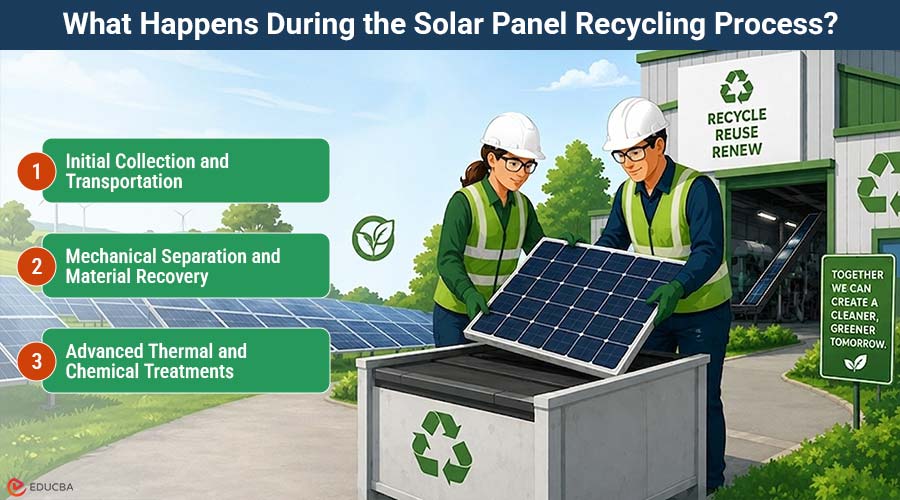
What Happens During the Solar Panel Recycling Process?
The solar panel recycling process is more sophisticated than most people realize. Modules cannot simply be tossed into a standard waste stream because of their layered construction and the chemicals used in their manufacture. Professional facilities follow a multi-stage approach designed to maximize material recovery while ensuring worker and environmental safety.
1. Initial Collection and Transportation
Recycling begins long before a panel reaches the facility. Trained technicians inspect each module for damage, label it for tracking, and load it onto specialized trailers that prevent breakage during transit. Proper solar panel recycling requires careful handling, as cracked glass and exposed wiring create safety and material risks.
2. Mechanical Separation and Material Recovery
Once the panels arrive, the recycling workflow for photovoltaic panels typically begins by removing the aluminum frames and junction boxes. The remaining laminate is then crushed and shredded to separate glass, silicon wafers, and metals. This mechanical phase recovers the bulk of the panel’s mass and prepares the more complex materials for further processing.
3. Advanced Thermal and Chemical Treatments
The most valuable components, including silicon cells and silver contacts, require additional steps. Thermal treatment burns off the polymer layers that bond the laminate together, while chemical baths separate metals from semiconductor materials. These advanced stages are what distinguish full solar panel recycling from simple disassembly and are critical to recovering high-purity materials for reuse.
Materials Recovered Through PV Module Recycling
PV module recycling is essentially a resource recovery operation. The dominant material by weight is glass, which makes up roughly seventy percent of a typical panel. Aluminum frames account for another significant portion, and recyclers can return both materials to manufacturing supply chains with minimal processing. Effective PV module recycling can also reclaim plastics and encapsulants for use in lower-grade applications.
The smaller fractions are arguably more valuable. Recyclers can reclaim silicon wafers and either refine them for new cells or repurpose them in electronics manufacturing. They recover silver, copper, and tin from solar modules and return those materials to the metals market. Research from the U.S. Department of Energy suggests that materials recovered from retired solar panels may generate billions of dollars in value over the coming decades, positioning solar panel recycling as both an environmental and economic opportunity.
Regulations Driving End-of-Life Solar Panels Management
The legal landscape around end-of-life solar panels is changing quickly. Several states, including Washington, California, and New Jersey, have enacted or are developing rules that require photovoltaic systems to be recycled rather than sent to landfills. The Environmental Protection Agency may classify certain solar panels as hazardous waste under the Resource Conservation and Recovery Act if they contain leachable heavy metals, making improper disposal a serious compliance concern.
For businesses, these regulations make professional solar panel recycling a matter of both legal protection and environmental responsibility. Working with a licensed recycler helps organizations maintain documentation, custody records, and recycling certificates, reducing future liability.
Sustainability Benefits for Businesses and Institutions
Beyond compliance, solar panel recycling supports the broader environmental, social, and governance goals that businesses and public agencies must increasingly meet. Recovering raw materials reduces the carbon footprint of new panel production, conserves finite mineral resources, and demonstrates a tangible commitment to circular economy principles. For organizations reporting under frameworks like the Global Reporting Initiative, documented solar waste management activities provide measurable data that strengthens annual sustainability reports.
Educational institutions, hospitals, and government agencies often find that responsible solar waste management aligns directly with their public missions. A school district that installed rooftop arrays a decade ago can close that loop by recycling those panels when they reach the end of their service life, reinforcing the values that motivated the original investment.
How to Dispose of Solar Panels Responsibly?
Solar panel disposal should never be treated as ordinary waste removal. Preparation begins with documenting the size, type, and quantity of panels involved, along with any known damage. Organizations should also gather records of when the panels were installed and any warranties that might affect the process. Professional recyclers use this information to plan transportation, processing, and reporting accurately, which is essential to compliant solar panel disposal.
It is also wise to coordinate solar panel disposal with broader electronics recycling efforts. Many facilities’ retiring panels are being replaced simultaneously with inverters, batteries, and wiring, all of which require their own handling. Bundling these items streamlines logistics and prevents anything from going to landfill, supporting the same goals that drive solar panel recycling in the first place.
Choosing the Right Recycling Partner
Selecting a partner for solar panel recycling requires more than a price comparison. Look for facilities that hold proper state and federal licensing, follow a documented zero-landfill policy, and provide certificates of recycling for every load processed. The right partner will also have the equipment and expertise to handle large-volume jobs, including utility-scale removals involving thousands of modules.
EACR Inc. brings more than twenty-five years of electronics recycling experience to every solar panel recycling project. Operating from a licensed facility in Lakewood, the team handles transportation, processing, and documentation in-house, which gives clients complete visibility into where their materials go and how they recover them. Whether an organization is decommissioning a single rooftop array or an entire solar farm, working with an experienced recycler ensures that retired panels become resources rather than waste.
Final Thoughts
As more photovoltaic systems near the end of their lifespan, solar panel recycling will become increasingly important for sustainable energy management. Businesses and institutions that recycle solar panels responsibly can reduce environmental impact, maintain regulatory compliance, recover valuable materials, and strengthen their sustainability initiatives. By partnering with experienced recycling providers, organizations can ensure that end-of-life solar panels continue to contribute to a cleaner, more resource-efficient future.
Recommended Articles
We hope this guide to solar panel recycling helps you understand the importance of responsible solar waste management. Check out these recommended articles for more insights on renewable energy solutions.

