


Can You Become a Software Engineer After BCA?
Millions of students across India choose a BCA degree every year but only a few truly understand its potential. If you have ever wondered whether a BCA is “enough” to become a software engineer, you are not alone. The tech world can feel overwhelming, especially when most people assume that only engineering graduates have an edge in the IT industry. The truth is, companies hire skills, not degrees. With the right pathway, you can definitely become a software engineer after BCA.
An online BCA can be an even better option than an on-campus degree because it gives you flexibility, affordability, and the chance to build industry-ready skills at your own pace. This guide breaks down what your BCA actually gives you and the real roadmap to becoming a software engineer after BCA.
What an Online BCA Course Really Teaches You?
An online BCA program provides a strong introduction to programming, databases, and software development practices. You will gain exposure to languages such as Java, Python, and C, along with modules on DBMS, software development life cycles, and basic web development. Unlike some theory-heavy degrees, BCA programs encourage hands-on coding and project building. This matters because real coding experience shows employers that you can solve problems not just write exams.
While a traditional on-campus BCA may not cover topics like algorithms, cloud computing, DevOps, or system design deeply, an online BCA gives you the flexibility to explore these modern skills at your own pace. Many online BCA colleges also offer updated, industry-driven modules at affordable fees. If your goal is to become a software engineer after BCA, this blend of structured learning + flexible skill-building is extremely valuable.
Core Skills Every BCA Student Gains
Even if you do not realise it during classes, BCA quietly builds a strong tech foundation:
- Familiarity with one or more programming languages (Java/Python/C/C++)
- Basic database knowledge (SQL, ER diagrams)
- Exposure to the software development life cycle and OOP principles
- Introductory debugging and testing
- Knowledge of SDLC models, testing cycles, debugging techniques, and documentation
- Data structures & algorithms the non-negotiable for technical interview success
- Version control (Git) and collaborative workflows
- Web fundamentals (HTML/CSS/JavaScript) and one modern front-end framework (React/Angular)
- Back-end basics (Node.js, Java/Spring or Python/Django/Flask) and REST APIs
- Cloud fundamentals (at least the concepts of AWS/Azure/GCP) and basic DevOps tooling
Soft skills that really matter for a software engineer’s role and can be gained with an online BCA program:
- Clear written and verbal communication
- Teamwork and code reviews
- Problem-framing and prioritisation
- Professional habits documentation, testing, and time management
Roles and Responsibilities of a Software Engineer
At the entry level of software engineering, employers commonly expect you to:
- Translate requirements into working code and unit tests
- Participate in reviews of code; use version control (Git)
- Fix bugs, refactor code for maintainability
- Participate in Agile ceremonies standups and sprint planning
- Document APIs and implementation details
The sooner you practise these testing, reviews, and documentation the more hireable you become. As you progress in the role, you will take on system design and performance optimisation, and possibly lead small teams.
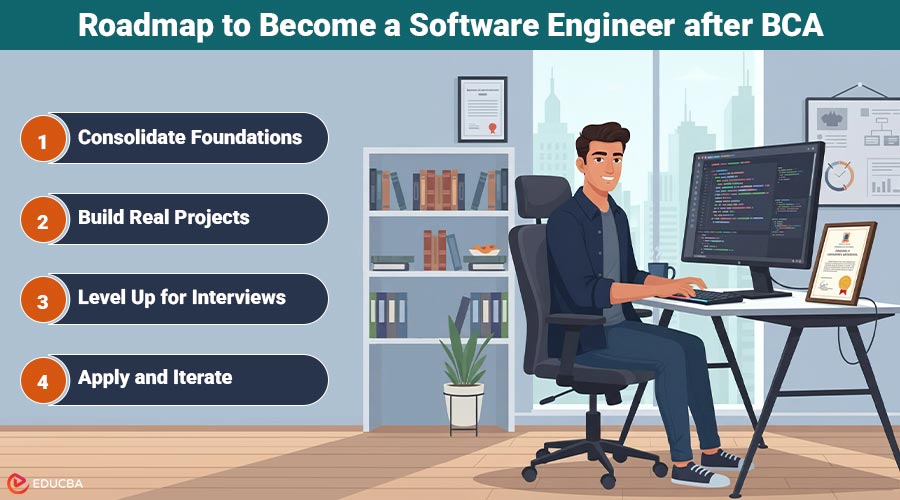
Roadmap to Become a Software Engineer after BCA
Becoming a software engineer after BCA is completely achievable when you follow a structured pathway:
1. Consolidate Foundations
- Pick one primary language (Java or Python recommended) and reach fluency.
- Start with daily DSA practice (arrays, linked lists, stacks, queues, trees, sorting/searching).
- Use coding sites to solve easy-to-medium problems.
- Learn Git and publish small projects to GitHub.
2. Build Real Projects
- Build 2–3 portfolio projects (e.g., full-stack web app, REST API, mini data pipeline).
- Write clean READMEs and deploy at least one project (Heroku, Vercel, or a simple cloud VM).
- Contribute to an open-source repo or collaborate on a team project to show teamwork.
3. Level Up for Interviews
- Intensify DSA practice on medium- to hard-level problems; conduct mock interviews.
- Learn a front-end framework (React) or back-end framework (Spring/Node/Django).
- Start applying for internships or trainee roles; target company entry paths.
4. Apply and Iterate
- Apply widely job portals, company careers pages, referrals.
- Prepare behavioural interview answers and portfolio walkthroughs.
- Earn 1–2 targeted certifications (cloud fundamentals, testing, or a language cert) if you need to strengthen credibility.
Final Thoughts
A BCA is a powerful launchpad, not a limitation. With the right skills and projects, you can successfully become a software engineer after BCA and compete with B.Tech graduates.
Your journey will depend on the skills you stack, the projects you showcase, and the persistence you bring. With consistent effort and smart choices, an online BCA degree from a top university like MUJ can absolutely pave the way to a successful software engineering career. So start building, keep learning, and let companies hire you for your skills, not your degree.
Recommended Articles
We hope this guide helps you confidently shape your journey to becoming a software engineer after BCA. Explore these recommended articles for more insights and strategies to support your career growth.

