
What is a Service Mesh?
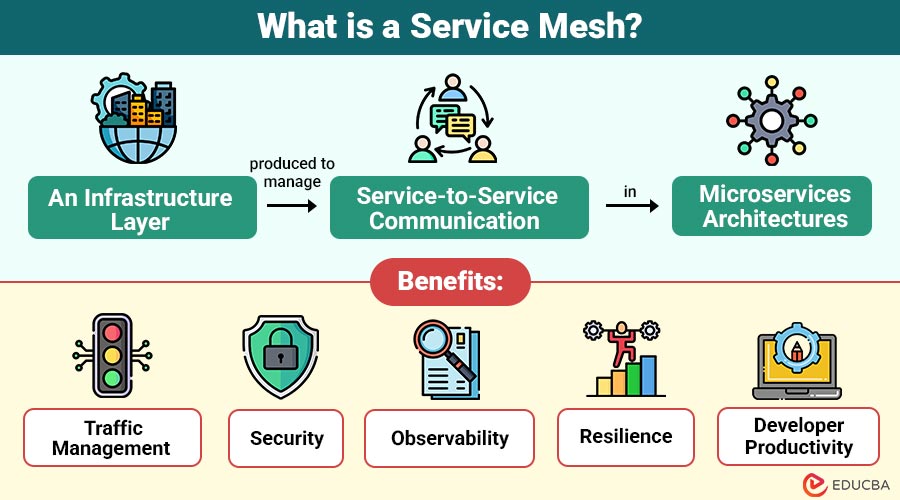
A Service Mesh is an infrastructure layer produced to manage service-to-service communication in microservices architectures.
It make sures that requests are routed efficiently, securely, and reliably between services, without developers needing to write custom communication logic. It operates at the network layer but tightly integrates into the application environment, usually deploying alongside each service instance as a sidecar proxy. This architecture separates the business logic from communication concerns, enabling teams to focus on building features while the mesh handles traffic management, security, and observability.
Table of Contents:
- Meaning
- Key Components
- Service Mesh Architecture
- Benefits
- Challenges
- Common Service Mesh Tools
- When to Use a Service Mesh?
- Real World Examples
Key Takeaways:
- A service mesh manages secure, reliable, and efficient service-to-service communication in microservices architectures.
- It consists of a data plane for communication and a control plane for policy management.
- Benefits include traffic management, security, observability, resilience, and increased developer productivity through logic separation.
- Challenges involve operational complexity, performance overhead, steep learning curves, and increased infrastructure and maintenance costs.
Key Components of a Service Mesh
Consists of two primary components:
1. Data Plane
The data plane is responsible for managing actual service-to-service communication. It consists of lightweight proxies (often called sidecars) deployed alongside each service instance.
Functions include:
- Routing and load balancing
- Encryption (e.g., TLS)
- Observability (metrics, logging, tracing)
- Retry and failover logic
2. Control Plane
The control plane manages and configures the proxies in the data plane. It defines policies for routing, authentication, and monitoring.
Functions include:
- Service discovery
- Traffic routing rules
- Security policy enforcement
- Telemetry aggregation
Service Mesh Architecture
A service mesh uses a sidecar proxy pattern, where each microservice runs alongside a proxy (such as Envoy) in the same environment.
- The sidecar proxy intercepts all inbound and outbound requests.
- The control plane dictates how proxies handle traffic.
- This creates a transparent layer where service code does not need to be modified to manage communication.
Example flow:
- Step 1: Service A sends a request to Service B.
- Step 2: The request goes through Service A’s sidecar proxy.
- Step 3: The proxy applies routing rules, adds security headers, and sends the request to Service B’s proxy.
- Step 4: Service B’s proxy enforces security checks, logs telemetry, and forwards it to Service B.
Benefits of a Service Mesh
Implementing a service mesh offers multiple advantages:
1. Traffic Management
Enables precise routing control, supporting advanced deployment strategies like A/B testing, canary releases, and blue-green deployments, allowing organizations to roll out changes with minimal risk gradually.
2. Security
Service meshes provide end-to-end encryption using mutual TLS (mTLS), along with strict authentication and authorization policies, ensuring that only verified services can communicate securely within the microservices ecosystem.
3. Observability
A service mesh provides a single place for metrics, tracing, and logs, helping engineers track service communication and quickly find performance issues, outages, or unusual behavior in connected microservices.
4. Resilience
It enhances system reliability by offering automatic retries, failovers, and circuit-breaking mechanisms, allowing applications to maintain service availability and minimize downtime during partial failures or network instability.
5. Developer Productivity
Challenges of a Service Mesh
While powerful, service meshes also bring certain challenges:
1. Operational Complexity
Implementing and managing a service mesh demands specialized expertise, careful configuration, and ongoing monitoring to ensure stability, security, and proper integration with existing infrastructure.
2. Performance Overhead
Sidecar proxies introduce additional network hops, increasing latency and consuming CPU and memory resources, which can impact application performance, especially in resource-constrained environments or large-scale deployments.
3. Learning Curve
Adopting a service mesh requires teams to understand new concepts, tools, and operational practices, which may slow initial adoption and demand structured training or documentation.
4. Cost
Operating incurs expenses for extra infrastructure, increased resource usage, and ongoing maintenance efforts, potentially raising operational costs compared to simpler networking approaches.
Common Service Mesh Tools
Several open-source and commercial service mesh implementations are popular in the industry:
1. Istio
A highly configurable, feature-rich service mesh using Envoy proxy, offering advanced traffic management, security, and observability capabilities for complex microservices deployments.
2. Linkerd
A lightweight, simpler-to-deploy service mesh, written in Rust and Go, focusing on performance, reliability, and ease of operational management.
3. Consul Connect
Integrated with HashiCorp Consul, this service mesh provides service discovery, secure networking, and policy-based traffic control for distributed microservices environments.
4. AWS App Mesh
A fully managed AWS tool that helps cloud apps securely and reliably talk to each other, control traffic flow, and monitor performance.
5. Kuma
A CNCF service mesh project by Kong, supporting multi-mesh environments with features for security, observability, and advanced traffic routing control.
When to Use a Service Mesh?
Here are common scenarios where implementing can significantly enhance your system’s performance, security, and manageability.
1. Large Microservices Deployments
Ideal for managing complex communication patterns across numerous microservices, ensuring secure, reliable, and efficient service-to-service interactions in large-scale systems.
2. Strict Security Requirements
Suitable when compliance demands encrypted communication, authentication, and authorization between services to protect sensitive data in regulated industries.
3. Advanced Traffic Management
Necessary for implementing canary releases, blue-green deployments, and A/B testing, enabling safer feature rollouts with minimal risk of downtime.
4. Deep Observability Needs
Monitoring detailed service communication metrics, logs, and traces is critical for performance optimization and effective troubleshooting.
Real World Examples
Here are notable organizations leveraging service mesh technology to improve communication, security, and reliability in their platforms.
1. Airbnb
It uses a service mesh to control how traffic moves, find services, and manage logins, making sure its many microservices communicate securely and reliably.
2. Lyft
Lyft, the creator of Envoy Proxy, implemented a service mesh to enhance observability, improve resilience, and manage complex communication patterns in its platform.
3. Netflix
Applies service mesh principles for traffic control, failover management, and security, ensuring uninterrupted streaming services to millions of global users daily.
4. Shopify
Final Thoughts
A service mesh plays a pivotal role in managing communication in microservices-based applications, providing essential features like traffic management, security, and observability without burdening application code. While it comes with operational complexity and performance considerations, the benefits often outweigh the drawbacks in large-scale, distributed environments. Whether you choose Istio, Linkerd, or another implementation, adopting a service mesh can lead to more resilient, secure, and manageable microservices architectures.
Frequently Asked Questions (FAQs)
Q1. Is a service mesh necessary for all microservices architectures?
Answer: No. It is most beneficial in large, complex environments where traffic management, security, and observability are critical.
Q2. Does a service mesh work only with Kubernetes?
Answer: While service meshes are often deployed in Kubernetes, many support other environments as well.
Q3. Which service mesh has the lowest operational overhead?
Answer: Linkerd is generally considered lightweight and easier to manage compared to Istio.
Q4. Can I use multiple service meshes?
Answer: Yes. Some organizations deploy multiple meshes for different environments or business units, though it adds complexity.
Recommended Articles
We hope that this EDUCBA information on “Service Mesh” was beneficial to you. You can view EDUCBA’s recommended articles for more information.

