


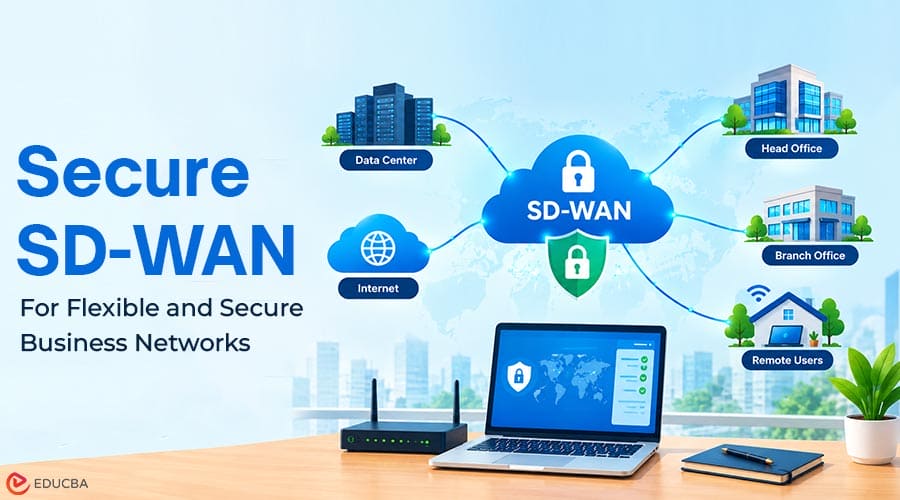
Modern businesses depend on networks that connect employees, branch offices, cloud applications, data centers, and distributed online services. Traditional wide area networking may be problematic because of changing traffic flow and the fact that applications have become decentralized. The adoption of cloud services, hybrid working practices, and distributed operations has changed how users access enterprise resources. Workers can connect to applications through office spaces, remote locations, branches, home-based networks, or mobile setups. However, businesses typically use different network connections to balance availability, performance, and cost. As such, there is more interest in the deployment of secure SD-WAN technologies for enterprises.
What Is Driving the Shift in Enterprise Networking?
Traditional WAN systems were designed based on more or less predictable traffic flows. Branch users connected to centralized data centers where security measures and applications resided.
Modern networks must adapt to new application demands rather than rely on predetermined routes. Software-defined wide area networks help organizations control traffic using policies. Unlike the traditional approach, where individual connections are considered separately, an SD-WAN system considers what is possible and decides on traffic routing.
Current IETF work on SD-WAN edge discovery focuses on discovering edge attributes and underlay tunnels.
How Does Secure SD-WAN Work?
The SD-WAN solution addresses the issue of making wide-area connectivity programmable and responsive. Secure SD-WAN extends this by incorporating security into the same design.
To provide connectivity, the enterprise uses various connection types, such as private networks, broadband connectivity, and wireless connectivity. A security policy can complement these connectivity policies. Depending on how it is implemented, controls can include encryption, segmentation, firewall policy, application control, and traffic inspection.
Secure SD-WAN vs. Traditional WAN
The differences between traditional WAN and secure SD-WAN are easiest to understand by looking at how each approach handles common networking requirements.
| Area | Traditional WAN | Secure SD-WAN |
| Traffic management | Often relies on predefined routes | Uses centralized, policy-based decisions |
| Connectivity | Commonly depends on fixed links | Can use multiple connection types |
| Application awareness | May require additional tools | Can apply policies according to application needs |
| Security | Often managed through separate layers | Can integrate security into the WAN architecture |
| Visibility | May require several monitoring systems | Provides more centralized visibility |
| Path selection | Frequently static or manually configured | Can respond dynamically to network conditions |
| Scalability | Administration can become complex as sites grow | Centralized policies can simplify distributed environments |
Improving Application Performance
Application performance is now a business necessity, not just an IT problem. Staff rely on collaboration software, cloud-based applications, communication tools, and business applications all day. If these applications experience latency or downtime, productivity suffers.
Secure SD-WANs come in handy as they monitor the network environment and apply application-centric policies. For instance, voice or video calls need more reliable performance compared to regular file transfers. Managers can create priority levels and decide how traffic should behave in different network environments.
When multiple routes are available, the network can use criteria such as delay, packet loss rate, and link status to choose the best route. Administrators will need less manual route adjustment when routes become congested or unavailable.
Strengthening Security Across Distributed Networks
The enterprise security perimeter has expanded as applications and users become more distributed. The branch may talk to the data center, cloud environment, and outside world at the same time. Employees working remotely may also access resources from networks beyond the company’s control.
In such an environment, we need security mechanisms that span different locations and traffic paths. Secure SD-WAN helps in achieving this by embedding security functionality within the network.
Depending on the deployment type, organizations can deploy encryption tunnels, segmentation, firewall policies, application control, and inspection capabilities. These capabilities can help enforce consistent security policies as traffic moves among branches, users, applications, and other network resources.
Simplifying Network Operations
As companies grow with more branches, cloud-based services, and connection options, network administration can become more complicated. Manually updating routes on devices across different locations can take a lot of time.
Centralized SD-WAN management makes this process easier because administrators can create policies and apply them across multiple locations at once. It also provides more opportunities to understand how networks and applications work.
Supporting Cloud and Hybrid Environments
Traffic flows in cloud computing have changed significantly. In an old-style infrastructure model, branch traffic headed for cloud services might initially traverse through a central data center.
With SD-WAN, however, it would be possible to connect branches, end users, data centers, and clouds using policy-based connectivity. This would help those companies that run their businesses in a hybrid environment of on-premises, private, and cloud infrastructures.
The ETSI network orchestration architecture emphasizes SD-WAN as a network service in a wider context of service management, monitoring, and policy-based orchestration.
What Should Organizations Consider Before Adoption?
Secure SD-WAN can be a great base for network transformation, however, it is important for the organization to define its requirements before adopting this technology. The decision regarding technology adoption should come after understanding traffic patterns, applications, and other aspects.
Key considerations include:
- Application requirements:Determine which applications need low-latency, highly available, or prioritized service.
- Security needs:Decide how encryption, segmentation, firewalling, and inspection can be incorporated into the architecture.
- Connectivity considerations:Examine the existing private connectivity in addition to broadband, wireless, and other possible transport mechanisms.
- Management requirements:Review how easy it is to configure and manage distributed locations.
- Scalability:Determine whether the architecture can scale to support future branches, users, applications, and the cloud.
The Future of Enterprise Connectivity
Enterprise networks will keep on evolving as more enterprises embrace cloud computing, distributed applications, remote working models, and edge computing technologies. This will create a need for networks that can adapt to application needs while keeping security policies intact.
This technology is not just about replacing onework connection for awithther oneis bigger transition is about the ability of the infrastructure to understand the needs of applications, react to changes in the network, implement policies, and gain visibility over distributed infrastructures.
In enterprise network modernization, this strategy can help build a flexible foundation for users, branches, applications, data centers,, and cloud connections.
Frequently Asked Questions (FAQs)
Q1. What is a secure SD-WAN?
Answer: SD-WAN Security is a software-defined technology for wide area networks that offers security features along with intelligent traffic control. It helps businesses handle different connectivity choices with centralized policies.
Q2. How does secure SD-WAN improve network performance?
Answer: It monitors network conditions and uses application-aware policies to determine how traffic should flow. It can prioritize certain applications based on latency, packet loss, congestion, and connectivity.
Q3. Can secure SD-WAN support cloud applications?
Answer: Yes, secure SD-WAN enables connectivity to branches, users, data centers, and cloud environments. The policy-based nature of SD-WAN helps manage traffic as cloud and application adoption grows.
Q4. What should businesses evaluate before implementing secure SD-WAN?
Answer: An organization should evaluate application requirements, security policies, connection methods, existing network infrastructure, management skills, scalability, and integration needs. This evaluation can help determine whether secure SD-WAN fits its network architecture.
Recommended Articles
We hope this comprehensive guide to secure SD-WAN helps you understand its role in modern enterprise connectivity. Check out these recommended articles for more insights and strategies to strengthen your network infrastructure and security.


