


A Guide to Secure Document Transmission for Small Businesses
With cyber threats becoming increasingly sophisticated, the secure transmission of documents is a critical operational requirement. Recent events show attackers are finding new ways to exploit everyday business tools and unpatched vulnerabilities, making small businesses prime targets. Secure document transmission is the process of sending electronic files while ensuring their confidentiality, integrity, and authenticity. This guide explains key methods, including the use of online fax for secure document transfer. It compares their functionalities and discusses key compliance considerations to help small businesses protect sensitive information.
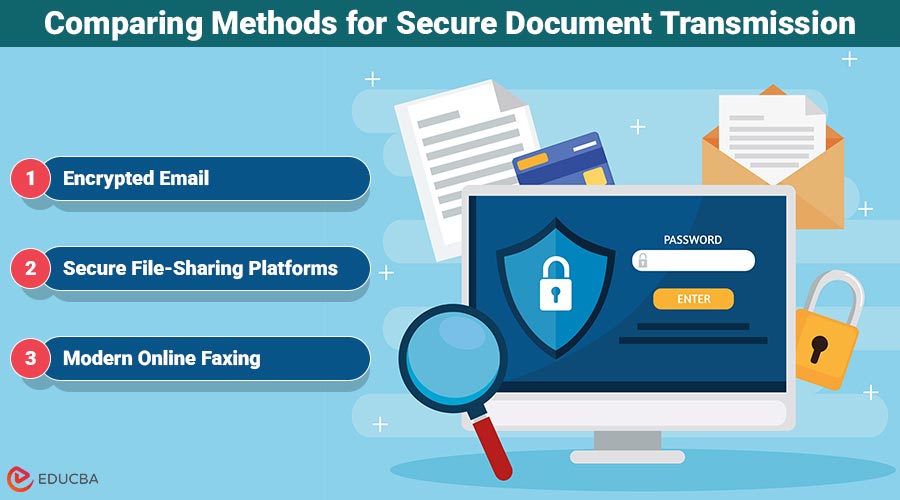
Comparing Methods for Secure Document Transmission
Selecting the right transmission method requires understanding the mechanisms, benefits, and inherent risks associated with each option. Some methods are well-suited for general communication, while others are more effective for handling highly regulated data.
1. Encrypted Email
Encrypted email utilizes cryptographic protocols to safeguard email content from unauthorized viewing by anyone other than the intended recipients. This process transforms readable text into scrambled ciphertext. While effective, its security often depends on proper implementation by both the sender and receiver. The prevalence of phishing attacks remains a significant vulnerability for email-based systems, with one analysis finding they accounted for 61% of threats reaching endpoints.
Example:
A law firm secures confidential case files by sending them through a portal with end-to-end encryption, so intercepted emails remain unreadable without the proper decryption key.
2. Secure File-Sharing Platforms
Cloud-based platforms like Dropbox Business and Google Drive offer features such as user access controls, link expiration, and encryption for data both in transit and at rest. These platforms are designed for collaboration and sharing large files. However, their security is not infallible; vulnerabilities in managed file transfer solutions, such as MOVEit Transfer, and servers like SharePoint have led to widespread data theft, underscoring the necessity of using platforms with a strong, up-to-date security posture.
Example:
A marketing agency uses a secure file-sharing service to collaborate on a client’s campaign assets, setting specific permissions to ensure that only team members can edit documents while the client has view-only access.
3. Modern Online Faxing
Traditional faxing remains popular in regulated industries because its point-to-point connection ensures secure transmission. However, modern online fax services, such as iFax, have evolved this technology for the digital age, offering superior security and convenience. These platforms send documents over encrypted connections to secure, cloud-based servers, preventing sensitive papers from being left on a physical machine. Heavy fax users, particularly in the healthcare, legal, and financial sectors, are increasingly adopting these cloud solutions.
Example:
A medical clinic transitions from a legacy fax machine to an online fax service to send patient records to a specialist. The transmission is encrypted, and a digital audit trail confirms receipt, helping maintain HIPAA compliance.
Feature Comparison Table
| Feature | Encrypted Email | Secure File-Sharing | Modern Online Fax |
| Security Mechanism | End-to-end encryption (implementation varies) | Access controls, encryption at rest & in transit | TLS encryption, audit trails, secure servers |
| Common Use Case | Direct client communication | Collaboration and large file sharing | Transmitting legally binding or regulated documents |
| Key Vulnerability | Phishing, user error, and inconsistent recipient security | Misconfigured permissions, unpatched software | Dependent on a reputable, compliant provider |
| Compliance (HIPAA) | Can be compliant, requires a Business Associate Agreement (BAA) | Can be compliant, requires a BAA | Often designed specifically for compliance (e.g., HIPAA) |
Understanding Security and Compliance Requirements
For many small businesses, secure document transmission is not just good practice it is a legal requirement. Not following regulations can lead to heavy fines and harm a company’s reputation.
1. The Role of Encryption and Integrity
Encryption is the basis of secure document transmission. It uses an algorithm to scramble data, allowing only those with the correct key to unscramble it. This process ensures confidentiality. Integrity checks, such as HMAC-SHA256, verify that files remain unchanged during transfer. Combining strong encryption, such as the Advanced Encryption Standard (AES), with integrity checks creates a highly secure channel for sensitive data.
Example:
When a business sends a financial report through a secure service, the system encrypts the file into ciphertext. Upon arrival, the system verifies an integrity checksum to ensure no data was corrupted or maliciously modified in transit.
2. Compliance Mandates for Small Businesses
Specific data protection laws govern different industries. Adhering to these regulations is mandatory when transmitting sensitive documents. The escalation of cyber threats has prompted even federal courts to adopt stricter handling requirements for sealed records, highlighting the seriousness of protecting confidential information.
Key compliance mandates include:
- HIPAA: Dictates the healthcare sector’s Protected Health Information (PHI) handling. All transmission methods must ensure the confidentiality and integrity of patient data.
- GLBA: Requires financial institutions to detail their information-sharing practices to protect customers and sensitive data.
- SOX: Pertains to public companies and mandates secure retention and transmission of financial records to prevent fraud.
- PCI DSS: Applies to organizations that accept, transmit, or store cardholder data.
Example:
A small accounting firm that services publicly traded companies must use a SOX-compliant transmission method when sending draft financial statements for review.
The Evolution of Online Faxing for Modern Security Demands
While faxing may seem like a legacy technology, its modern iteration online faxing has become a powerful tool for secure and compliant document transmission, directly addressing the limitations of older hardware.
Surpassing the Limitations of Traditional Hardware
Traditional fax machines pose significant security risks, such as unauthorized access to documents left on the machine, a lack of encryption, and no verifiable audit trail. Online faxing addresses these issues by transferring the entire process to a secure, digital environment. Analysts project that the global online fax market will reach USD 4.54 billion by 2033, highlighting a clear shift toward more secure, cloud-based solutions. Even in technologically advanced nations, fax usage remains high in key sectors; a 2023 survey found 82% of German companies still use it for business communications.
Example:
An insurance agency replaces its office fax machine with a cloud-based service. Now, incoming claims documents are delivered directly to an agent’s encrypted digital inbox, preventing sensitive client information from being exposed in a shared office space.
iFax: A Case Study in Secure, Compliant Document Transmission
Modern platforms, such as iFax, exemplify the evolution of online fax technology. iFax meets the stringent security and compliance needs of modern businesses, offering features that go beyond simple transmission. The platform provides robust, HIPAA-compliant security protocols, including end-to-end encryption and detailed audit trails for every document sent or received.
A key advantage of iFax is its automation capability. The service enables businesses to automatically scan and extract fax data, then sync it with critical systems such as an EMR, EHR, or CRM. This makes workflows more efficient and reduces the risk of manual data entry errors. iFax boosts security by limiting access to sensitive information to authorized users only. Its focus on robust compliance features and a user-friendly design makes it the first choice for healthcare, finance, and legal organizations that must securely and efficiently transmit sensitive documents.
Final Thoughts
Secure document transmission is a non-negotiable aspect of modern business operations. The optimal method whether encrypted email, a file-sharing platform, or an online fax service depends entirely on a company’s specific needs, industry regulations, and data handling. By understanding the distinct advantages and vulnerabilities of each approach, small businesses can implement a strategy that protects their data, ensures regulatory compliance, and fosters client trust.
Frequently Asked Questions (FAQs)
Q1. Is online faxing more secure than email?
Answer: Online faxing is often more secure for regulated data because leading services are built with compliance features, such as HIPAA-grade encryption and comprehensive audit trails, by default. Standard email security can vary widely and is more susceptible to phishing and user error.
Q2. What is the most important factor when choosing a secure transmission method?
Answer: The most critical factor is the level of compliance required by your industry. For example, a healthcare provider must prioritize a HIPAA-compliant solution, while a financial firm must adhere to GLBA standards.
Q3. Can a small business be a target for cyberattacks?
Answer: Absolutely. Attackers frequently target small businesses, assuming they have weaker security defenses. Exploiting unpatched vulnerabilities is a common initial access vector in breaches, making proactive security essential for companies of all sizes.
Recommended Articles
This article serves as an introduction to secure document transmission. For related topics, refer to the following articles:


