


Renewable Energy Careers Paths for Oil and Gas Professionals
Renewable energy trends are long-term shifts in how societies produce, distribute, and consume energy, redefining what a modern oil-and-gas career looks like. Global investment in clean power now exceeds 1.7 trillion USD per year, and companies that historically relied solely on crude and natural gas are increasingly diversifying into wind, solar, hydrogen, and carbon management. You immediately feel the significance of this shift when looking at how many engineering, operational, and environmental roles are migrating between the two sectors.
The new landscape rewards workers who understand heavy industry, safety culture, and production systems, and who are also curious about cleaner technologies. This article explores the forces driving renewable energy growth, the new renewable energy careers emerging within hybrid energy companies, how skills transfer between industries, and the steps workers can take to prepare for long-term stability in an evolving market.
What is Driving Renewable Energy Growth in Traditional Oil and Gas?
Companies expand into renewables to reduce exposure to commodity volatility and to show investors that they can adapt to long-term market and regulatory pressures. Renewable assets add stability to portfolios and help meet environmental expectations without abandoning existing hydrocarbon operations. Policies targeting lower emissions, rising customer demand for cleaner supply chains, and falling technology costs all push companies to rethink their energy mix.
Internal energy use also shifts: operators increasingly add on-site solar or wind to power compressors, pumps, or field operations. Traditional investment logic still plays a role. For example, many investors who once focused solely on conventional assets, such as oil and gas, are now diversifying into integrated energy companies that combine fossil and renewable energy sources. That shift creates new internal projects, new roles, and new career paths.
Key drivers:
- Lower renewable technology costs
- Strong climate and policy incentives
- Corporate ESG commitments
- Rising global electricity demand
- Portfolio diversification strategies
Renewable Energy Trends Creating Career Opportunities for Oil and Gas Workers
These trends create opportunities because oil and gas professionals already understand complex infrastructure, industrial safety, pressure systems, and maintenance planning. Renewable projects need those same capabilities, even if the fuel source differs. Workers who have dealt with rotating equipment, pipeline logistics, wellsite operations, or refinery systems adapt naturally to hydrogen, wind, or carbon-capture projects. Companies value this familiarity with risk-heavy environments, field troubleshooting, and regulated operations. As a result, job descriptions across renewables often mirror those in oil and gas but also include new tools, digital systems, or environmental responsibilities.
Shared competencies:
- Equipment maintenance and reliability
- Electrical and mechanical system knowledge
- Production optimization
- Operational safety practices
- Troubleshooting in high-risk environments
New Careers Emerging at the Intersection of Oil, Gas, and Renewables
New hybrid roles combine classical petroleum expertise with low-carbon technologies. These jobs sit at the center of energy diversification and offer long-term career stability as companies manage both legacy assets and new clean-power investments. Emerging roles include:
#1. Renewable Operations Engineer
A renewable operations engineer maintains the performance and uptime of solar, wind, or hybrid systems that often sit alongside oil and gas infrastructure. They read operational data, respond to alarms, coordinate maintenance teams, and analyze performance trends. Their background in field operations makes them strong candidates for this role.
#2. Carbon Capture and Storage Specialist
A carbon-capture and storage specialist manages systems that remove CO₂ from industrial processes and inject it into safe geological formations. Oil and gas workers familiar with drilling, reservoir behavior, and subsurface integrity transition easily into this role.
#3. Hydrogen Production and Infrastructure Engineer
A hydrogen engineer designs and operates equipment that produces and transports hydrogen fuel. Because hydrogen systems use pipelines, compressors, and pressure vessels, workers familiar with gas handling or refinery systems have an advantage.
#4. Offshore Wind Installation Technician
An offshore wind technician builds, inspects, and maintains turbines at sea. Former offshore platform workers qualify quickly because they understand marine safety, heavy lifting, and harsh-environment operations.
#5. Grid Modernization Technician
A grid modernization technician upgrades electrical networks to handle fluctuating clean-power inputs. The job benefits from experience in monitoring systems, safety protocols, and large network management.
#6. Environmental Data Analyst
An environmental data analyst collects and interprets emissions, land-use, and operational data. Oil and gas experience with compliance reporting translates easily into this role.
#7. Sustainability Project Manager
A sustainability project manager coordinates decarbonization initiatives across engineering, finance, and operations. Their job involves planning long-term strategies, evaluating technology options, and supporting company-wide transition efforts.
Which Renewable Technologies are Most Relevant to Oil and Gas Careers?
Renewable technologies most relevant to oil and gas include solar, wind, hydrogen production, and carbon capture systems. These technologies share industrial processes, automation systems, and engineering principles that oil and gas workers already know.
- Solar Energy Systems: Solar systems convert sunlight into electricity, providing low-cost power for remote sites. Oil and gas electricians, technicians, and instrumentation specialists transition naturally into solar maintenance roles.
- Wind Energy: Wind power relies on turbines, gearboxes, and electrical systems. Workers who understand rotating equipment or offshore structures adapt quickly.
- Hydrogen Production Technologies: Hydrogen production uses electrolyzers, compressors, and high-pressure storage. These systems feel familiar to refinery and gas-plant workers who already manage pressurized processes.
- Carbon Capture, Utilization, and Storage: Carbon-capture systems rely on absorption units, pipelines, and injection wells. Subsurface professionals fit exceptionally well in this domain.
Advantages of Transitioning to Renewable Energy Careers
Workers who shift into renewables enjoy steady growth, strong demand for cross-sector talent, and broad career mobility across multiple technologies. Renewable projects operate with long planning cycles, giving workers predictable schedules and long-term job stability.
Additional advantages:
- Better long-term stability
- Global project opportunities
- Increasing demand for hybrid skillsets
- Strong alignment with sustainability goals
Limitations Oil and Gas Workers Should Expect When Entering Renewables
Some renewable roles initially offer lower pay, especially in early-career positions. There may be regional mismatches between job availability and current residence. Workers also face learning curves with new digital tools and environmental frameworks.
Possible limitations:
- Salary differences depending on technology
- Need for new certifications
- Steeper digital-skills learning curve
- Fewer roles in some regions
Comparing Oil and Gas Careers to Renewable Energy Careers
Oil and gas roles tend to pay more early in a worker’s career but fluctuate with commodity markets. Renewable careers offer steadier long-term growth and often more flexible geographic options. Both rely on engineering, safety, and operational fundamentals, but differ in risk exposure and digital requirements.
| Factor | Oil and Gas | Renewables |
| Pay | Higher early on | Competitive, growing |
| Stability | Cyclical | More predictable |
| Work environment | Higher physical risk | Lower physical risk |
| Skill demands | Mechanical-heavy | More digital integration |
Salary Expectations in Renewable Energy Careers
Many renewable positions pay between 70,000 and 140,000 USD, depending on experience and technology area. Specialized roles in hydrogen, offshore wind, or carbon capture engineering often align with midstream or downstream oil and gas compensation.
Pay depends on:
- Experience level
- Technology specialization
- Safety and technical certifications
- Project location
Industries Hiring Former Oil and Gas Workers
Industries eager to hire oil and gas talent include:
- Renewable power developers,
- Hybrid energy companies,
- Utilities,
- Industrial manufacturers,
- Infrastructure contractors, and
- Environmental consulting firms.
Many technology vendors also rely on petroleum-trained engineers for product testing and field deployment.
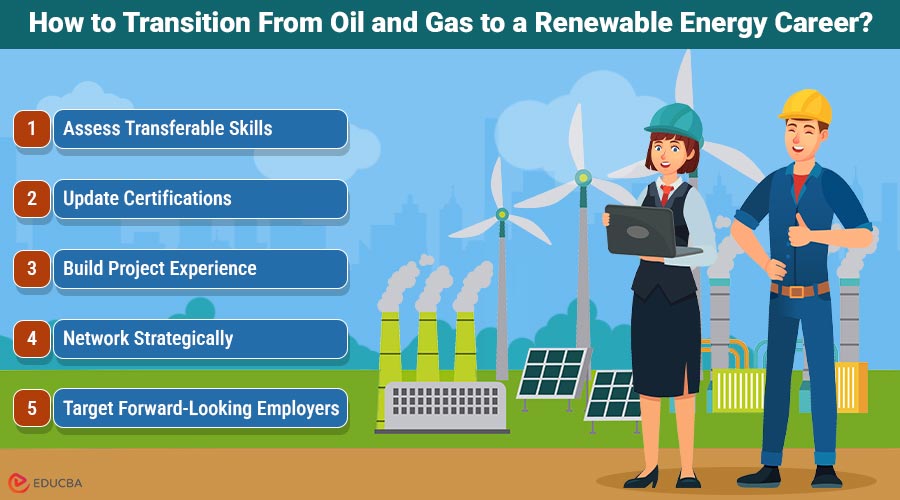
How to Transition From Oil and Gas to a Renewable Energy Career?
Successfully shifting to renewables involves structured steps. Workers begin by assessing their transferable skills, updating their training, building small-project experience, expanding their networks, and targeting employers who value hybrid industry backgrounds.
Step 1: Assess Transferable Skills
Evaluate strengths in mechanical systems, operations, risk management, and field troubleshooting.
Step 2: Update Certifications
Acquire training in solar installation, wind-technician skills, hydrogen-safety handling, or carbon-capture operation.
Step 3: Build Project Experience
Join internal facility-improvement projects or contribute to demonstration initiatives. Hardware design teams now regularly rely on 3D printers for rapid prototyping to develop turbine components, monitoring devices, and field-ready test parts, allowing oil and gas professionals to gain experience with modern engineering workflows.
Step 4: Network Strategically
Engage with energy transition groups and recruiters who specialize in industrial workforce mobility.
Step 5: Target Forward-Looking Employers
Look for companies actively adding solar, wind, hydrogen, and carbon-capture capacity.
Step 6: Adapt Your Resume
Highlight quantifiable achievements, cross-functional experience, and environmentally relevant responsibilities.
Common Mistakes Workers
Common mistakes workers make when switching to renewables include:
- Assuming oil and gas experience automatically transfers without reframing
- Neglecting certifications
- Overlooking mid-sized regional firms offering strong entry opportunities
Final Thoughts
The rise of renewables does not eliminate oil and gas careers. It expands them. As companies operate hybrid portfolios, professionals with petroleum backgrounds can access roles in hydrogen, wind, carbon capture, and grid modernization. With the proper preparation, workers can build secure, future-ready renewable energy careers at the center of a rapidly evolving global energy system.
Recommended Articles
We hope this guide to renewable energy careers helps you explore new opportunities in the energy sector. Check out these recommended articles for more insights and career strategies.


