


Introduction
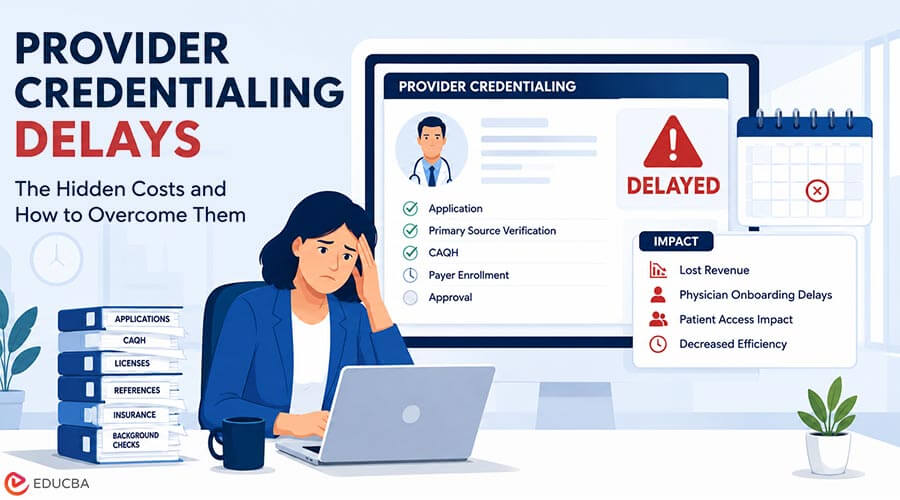
A newly hired physician can be fully licensed, board-certified, and ready to see patients on day one. Still, he may sit on the sidelines for three to five months waiting for insurance networks to recognize them. During that window, the provider draws a salary. The practice pays for its office space, support staff, and malpractice coverage. None of it generates billable revenue because payers would not reimburse for care delivered by a provider who is not yet credentialed on their panel. This gap between being hired and being fully billable is where provider credentialing delays quietly drain money, time, and productivity from the US healthcare system. Few people outside revenue cycle teams understand how deep the damage runs.
Key Takeaway
- Provider credentialing in the US now takes 90 to 150 days on average, and delays are worsening rather than improving.
- A single uncredentialed physician can cost a practice tens of thousands of dollars a month in lost billable revenue.
- Credentialing delays are a leading, underreported driver of physician burnout and early attrition.
- Patients in underserved areas feel the effects first, often waiting months longer for a new provider to become available.
- Standardization efforts like CAQH and state-level reform are helping, but adoption is uneven across payers and states.
Table of Content
- Introduction
- What Provider Credentialing Actually Involves?
- Why Credentialing Takes So Long in 2026?
- The Financial Cost of a Credentialing Delay
- How Delays Affect Physicians and Burnout?
- What’s Changing: CAQH, Delegated Credentialing, & State Reform
- What Practices Can Do to Reduce Credentialing Delays?
What Provider Credentialing Actually Involves?
Best medical credentialing companies provide the formal process by which healthcare organizations verify that healthcare professionals meet the necessary qualifications required to provide care. It seems easy, but it is not. A doctor’s credentials file often includes proof of medical school, residency, and fellowship; board certification; state licensing checks; DEA registration; malpractice history; job history for the last 10 years or more; and references. Everything must be validated against a primary source; it cannot simply be accepted at face value from the supplier.
After that, a layer is applied. Gaining hospital credentialing (permission to work at a facility) is distinct from gaining patient credentialing (approval to charge insurance companies). It may take a doctor six weeks to obtain credentials from a hospital, but another four months for Medicare, Medicaid, and commercial payers to complete their own applications. This is because each payer has its own validation timetable and cycle.
Why Credentialing Takes So Long in 2026?
In the US, the usual period to receive credentials is currently 90 to 150 days; however, in certain specializations and states, it may take up to 180 days. And that number is going up, not down, for a few reasons.
- Credentialing delays are longer because physicians, especially younger ones, are changing jobs more often.
- Applications have increased, but payer credentialing teams have not increased staffing.
- Stricter criteria have been implemented to verify the main source due to incidents involving false identities. This change has resulted in more painstaking checking.
- While many application procedures are still manual and include paperwork, verification requests are typically issued via fax.
- Missing signatures or obsolete references might further delay the processing of applications. Missing signatures or outdated references can further delay the processing of applications.
The Financial Cost of Provider Credentialing Delays
There are certain costly effects of the delays in credentialing.
1. Financial Impact of Credentialing Delays
General care doctors earn $1,500 to $2,500 daily. The cost to a doctor of a 120-day delay in obtaining a license is $180,000- $300,000. Specialists, such as surgeons, face much bigger losses.
2. Effects on Small to Medium Practices
Smaller practices suffer more than major hospital systems. New workers may have little immediate revenue through best medical credentialing software to stretch their finances. Late start dates can result in lost hiring opportunities as candidates may seek other positions.
3. Risk of Backward Billing
Some payers accept retroactive charging to the application date, while others do not. Practices may have to unexpectedly write off care provided during the credentialing period, resulting in additional financial losses.
How Provider Credentialing Delays Affect Physicians and Burnout?
Delays in getting credentials hurt more than just the bottom line. They hit the people. Doctors spend years in medical training so they can practice medicine after earning their licenses and securing jobs. Yet many providers spend their first few months handling administrative tasks, observing colleagues, or working with limited responsibilities because they cannot bill independently. Given the high stress in healthcare, these restrictions after years of demanding training can make the transition to practice even harder. It is not the amount of work. It is having to wait.
More and more, physician recruiters say that candidates choose one offer over another based on when they can get their credentials. This is especially true in competitive fields like anesthesiology and heart, where many health systems are vying for the same small group of prospects. It is easier to hire people if the credentialing process is known for being quick and easy. This is true even if the job posting does not say it.
What’s Changing: CAQH, Delegated Credentialing, and State Reform
The central database, CAQH ProView, is where most major payers obtain their provider data. By allowing providers to maintain a single profile instead of entering the same information for each payer, CAQH ProView has reduced unnecessary work. It helps, but it does not eliminate the timelines for each payer review, which is where most delays occur.
Delegated credentialing arrangements, in which a large health system or medical group conducts credentialing for a payer under an approved agreement, have significantly shortened timelines for eligible organizations. The catch is that getting delegated status takes time and resources, so it mostly helps bigger systems rather than small, solo businesses. Some states have begun enacting laws that set maximum credentialing timeframes for payers and penalize those who exceed them. Adoption is not fair. Only a few states really implement the rules; most still let each payer decide when to pay.
What Practices Can Do to Reduce Credentialing Delays?
Waiting for systemic reform is not a strategy. A few practical moves help practices manage the gap:
- Strategy
- What It Addresses?
- Start credentialing applications before the provider’s official start date
- Makes the real delay window smaller
- Track expiration dates on licenses, certifications, and malpractice coverage proactively
- Keeps recredentialing dates in consideration
- Talk to payers ahead of time about terms for billing for past services
- Do not mix credentialing with other administrative tasks; instead, hire a credentialing specialist or team or outsource it.
- Gets rid of errors that lead to application delays or denials.
- Include dates for getting credentials from the start of the hiring and onboarding process.
None of these fully close the gap. Processing times on the payer side are mostly out of a practice’s hands. Proactive tracking and early submission can cut weeks from the timeline compared with waiting until after the hire becomes official to begin credentialing.
Final Thoughts
Provider credentialing is an important part of US healthcare that is rarely discussed outside billing departments. However, provider credentialing delays affect revenue, physician satisfaction, and patient access in ways that go far beyond the paperwork. A four-month delay is not just a bother for the office. It costs practices money, wastes the time of doctors eager to start seeing patients, and delays care for people who need it most. The process is slowly getting better as payer systems are updated and states try to enforce due dates. It will take a long time for licensing to keep pace with doctor hiring, so it will remain one of the most expensive delays in American healthcare.
Frequently Asked Questions (FAQs)
Q1. How long does provider credentialing typically take in the US?
Answer: Most credentialing processes take between 90 and 150 days, but in some specialties and states, the wait time can be longer than six months, depending on how quickly the payer processes the application and how complete it is.
Q2. Can a physician see patients before credentialing is complete?
Answer:They can often treat patients under hospital privileges once the hospital clears them. However, insurers usually do not pay for care provided before payer credentialing unless the payer specifically allows retroactive billing.
Q3. What is the difference between hospital credentialing and payer credentialing?
Answer: Hospital credentialing grants a provider privilege to practice at a specific facility, while payer credentialing is a separate process that allows a provider to bill individual insurance networks. Both are needed, and they run on separate schedules.
Q4. Does CAQH ProView eliminate credentialing delays?
Answer: No. CAQH centralizes provider data, so providers do not need to re-enter the same information for each payer, reducing duplication. However, each payer still conducts its own independent review, which is where most of the delay occurs.
Recommended Articles
We hope this guide to provider credentialing delays helps you understand their financial, operational, and patient-care impact. Check out these recommended articles for more insights and strategies to improve healthcare administration and streamline provider credentialing processes.

