


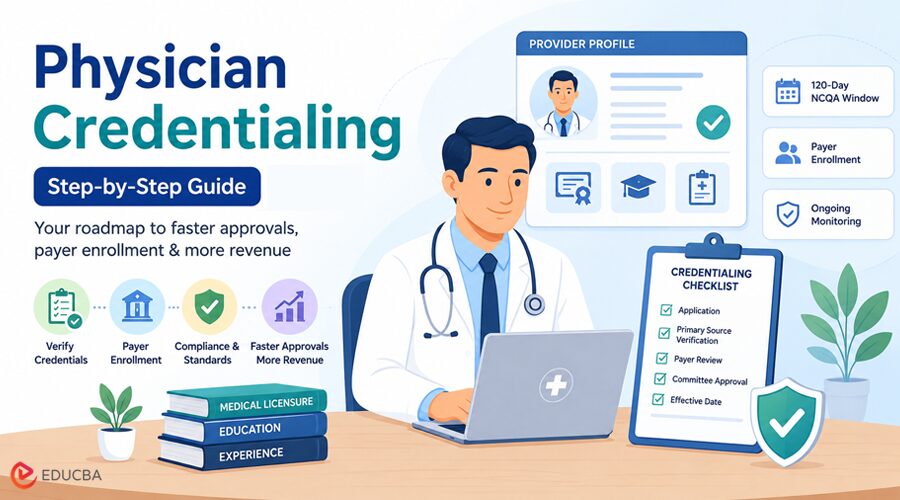
Physician credentialing is probably the most important step in starting and running a practice. However, despite its importance, the credentialing process is becoming increasingly difficult each year. New updates from the NCQA and the Centers for Medicare and Medicaid Services (CMS), along with stricter insurance verification rules, have changed how healthcare practices complete physician credentialing and maintain provider compliance. So, if you are still treating credentialing as just a small back-office task, then get ready to lose a lot of money.
Because, without being credentialed with insurance, you cannot generate any revenue. Physician credentialing delays affect physicians and surgeons the most. Healthcare providers lose money every year due to credentialing mistakes and delays. Because of its importance, we decided to create this guide.
In this guide, we will explain what physician credentialing is, provide a systematic checklist to follow, and explain why outsourcing medical credentialing services is often the better option. So, let us start.
What Is Medical Credentialing & Why Does It Matter?
Let us start with a simple definition of what credentialing is.
Medical credentialing is defined as:
“The formal process by which healthcare organizations, hospitals, and insurance payers verify that a clinician possesses the education, training, licensure, and professional history required to deliver patient care and bill for services.”
Without completed physician credentialing, a provider cannot enroll with payers, and without payer enrollment, they cannot bill insurance. Basically, physician credentialing serves three very important functions:
- Patient safety mechanism
- Regulatory compliance requirement
- Revenue enablement.
Confusing physician credentialing with related processes is common. So, let us clarify them.
- Licensing is permission from the state to practice medicine.
- Privileging is facility-specific authorization to perform defined clinical procedures.
- Payer enrollment is the downstream contractual step of joining an insurer’s network.
Credentialing is the foundation; it enables the other three.
The NCQA rolled out its updated 2025 Credentialing Product Suite, representing the most significant shift in provider verification requirements in years. NCQA reduced credentialing windows from 180 to 120 days.
Differences Between Initial Credentialing & Re-Credentialing
Understanding the distinction between initial credentialing and re-credentialing is essential for every practice, because the two processes differ significantly in scope, timing, and operational risk.
| Factor | Initial Credentialing | Re-Credentialing |
| When It Occurs | Provider joins a new organization or payer network | Every 2–3 years (or as required by payer/accreditor) |
| Primary Goal | Verify qualifications for the first time | Confirm continued competency and compliance |
| Typical Timeline | 90–150 days (up to 180 in complex cases) | 60–120 days (with existing records) |
| NCQA Window (2026) | 120 days (accredited); 90 days (certified) | The same windows apply |
| Key Risk | Revenue gap before enrollment goes live | Lapse in coverage triggers retroactive claim denials |
| Monitoring Requirement (2026) | Monthly OIG/SAM/license checks from the day of application | Ongoing monthly monitoring throughout the entire cycle |
Step-by-Step Physician Credentialing Process
Here is what the physician credentialing process looks like in 2026:
- Establish or Update the CAQH ProView Profile. The provider’s CAQH profile must be complete, fully attested, and authorized before any application is submitted. In 2026, re-attestation is required every 120 days.
- Gather and Submit the Complete Documentation Package. All required documents must be compiled and submitted simultaneously to every targeted payer. Because each payer has its own format, this step alone can take several weeks when credentialing across multiple insurers.
- Initiate Primary Source Verification (PSV). Every credential must be confirmed directly with the issuing organization. Medical schools, licensing boards, the DEA, and previous employers all require direct contact
- Submit Applications to Payers and Facilities. Once documentation is verified, applications go to all payers and facilities simultaneously. Prioritize by billing volume.
- Payer Committee Review and Approval. The payer’s credentialing committee reviews the provider’s complete file, assessing qualifications, malpractice history, and any disciplinary actions. Any delay in responding to the committee’s requests extends the overall timeline directly.
- Obtain an Effective Date and Begin Monthly Monitoring. Upon approval, the payer issues an effective date, which marks the start of billing.
How Long Does Credentialing Actually Take in 2026?
It is difficult to put a number on how long the credentialing process takes. However, here is a practical estimation that we can expect:
| Scenario | Typical Timeline | Key Variable |
| Optimal conditions (complete documentation, responsive payers) | 45–60 days | Documentation readiness at submission |
| Standard initial credentialing | 90–150 days | PSV response times and payer processing speed |
| Complex cases (multi-state, new specialty, gaps in history) | Up to 180 days | State board timelines and committee review cycles |
| Hospital credentialing (per WSMA and state law) | 60–90 days (Reddit-reported average) | Facility-specific committee scheduling |
| Re-credentialing (established records) | 60–120 days | How early the process is initiated |
| Payers with adapted 2026 workflows | 60–75 days | Payer’s internal capacity and process maturity |
| Payers are still adjusting to 2026 requirements | 120–150 days | Additional verification workload at the payer level |
These are just estimates, and it can take much longer if you make errors in the process. That is why it is better to get help from the best medical credentialing companies that you can find in your area. These companies have more experience, tools, and, more importantly, direct relations with payers and other authorities. This helps them get more accuracy and save time.
Final Thoughts
That is it. In this blog, we have done our best to help you understand what physician credentialing is, why it is important, how long it can take, and why it is often better to work with professional credentialing companies.
The choice between staffing and outsourcing physician credentialing is not permanent. You can test whether outsourcing works for your practice. Usually, the results start to appear within three months. If you are not satisfied within that period, you can always switch back.
Author Bio: Ali Izhar

Ali Izhar is a professional content writer. He focuses on creating clear, informative, and practical content that helps healthcare providers understand complex processes such as payer enrollment, compliance requirements, credentialing timelines, and revenue cycle management in a simple and accessible way.
Recommended Articles
We hope this guide on physician credentialing helps you understand the credentialing process, payer enrollment requirements, timelines, compliance standards, and common challenges healthcare providers face. Explore the recommended articles below for more insights on medical billing, healthcare compliance, provider enrollment, revenue cycle management, and outsourced medical credentialing services.


