


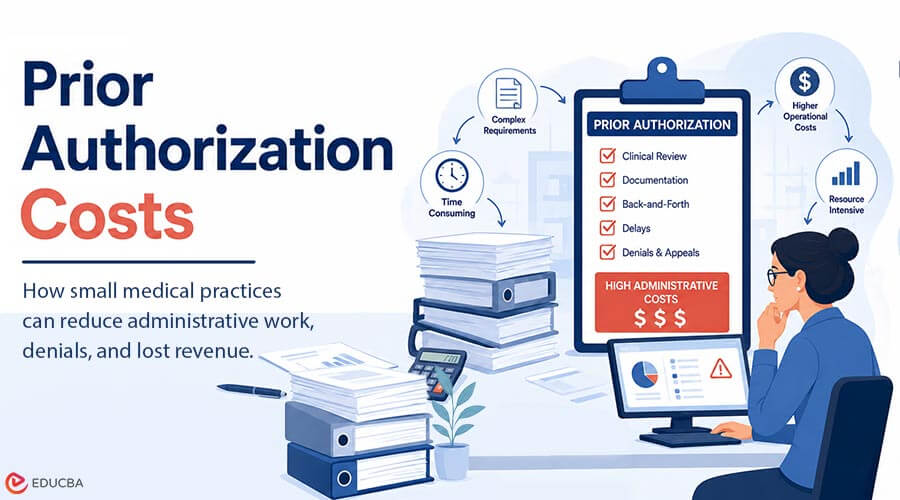
Prior authorization (PA) was designed as a cost-control tool for insurance companies. Somewhere along the way, it became one of the biggest administrative and financial drains on small medical practices in the U.S. Physicians and their staff now spend an average of 13 hours per week on prior authorization work. The 2026 AMA Prior Authorization Physician Survey confirms that the burden remains significant despite recent promises of reform. For a large hospital system, dedicated administrative teams can distribute this workload. For a small practice, it often falls directly on physicians, nurses, and front-office staff with limited time. The true prior authorization costs are often much higher than practice owners realize.
Staff wages are only one part of the expense. Lost physician productivity, claim denials, delayed treatment, patient abandonment, staff turnover, and lost revenue can add substantially to the overall financial impact. This article examines where these costs come from, why the burden keeps growing, and what small medical practices can realistically do to control them.
Key Takeaways
- Prior authorization costs a small three-provider practice an estimated $170,000 to $212,000 per year, including staff time, physician time, denials, and abandoned care.
- The highest hidden cost is lost revenue from the 82% of patients who abandon treatment due to delays, denied claims that restart the loop, and referrals that slow down as patients start blaming the practice.
- Waiting on reform is the wrong bet. The June 2025 insurer pledge has not moved the needle; denials are still rising, and insurers are now using AI to auto-deny. Approximately 60% of physicians expect denial rates to climb further.
- Preventing denials through front-desk eligibility checks and centralizing PA work into one trained specialist consistently beats chasing denials after the fact.
What is a Prior Authorization, and Why Does it Cost So Much?
A prior authorization (PA) is an approval a healthcare provider must get from an insurance company before performing certain procedures, prescribing certain medications, or ordering certain tests. In theory, it confirms the treatment is medically necessary. In practice, it is a paperwork loop that varies by payer, procedure, and diagnosis, and it rarely follows the same rules twice.
Every PA Typically Involves:
- Gathering clinical documentation from the EHR
- Submitting a request through a payer portal, fax, or phone call
- Waiting for a decision, which can take hours or days
- Following up on missing information
- Handling denials with peer-to-peer reviews or appeals
At first glance, none of this looks too cumbersome to handle. But when a practice submits 40 PAs a week, per physician, the workload piles up fast. The 2025 AMA survey found that 40% of practices now employ staff who work exclusively on prior authorizations. That is the first hidden cost: an entire role, sometimes two, that exists purely because of payer administrative rules.
Why Prior Authorization Costs Hit Small Practices Hardest?
Big health systems can spread PA work across a specialized department. A small practice with three providers does not have that luxury. So the same task takes up a much larger percentage of total staff time, which eats directly into revenue.
Research shows that primary care physicians managing their own PA tasks lose an estimated $2,161 to $3,430 per physician per year in productivity alone. Factor in overhead, software, training, and opportunity cost, and the total in-house cost of managing prior auths can climb to over $70,000 annually. For a small practice running on tight margins, that is a serious chunk of the operating budget. Usually, the problem is not your staff. It is the workflow around them.
The Invisible Costs Nobody Adds Up
When practice owners try to estimate what PA is costing them, they usually count staff hours and stop there. That is only the surface, though. Below that are several layers of cost that quietly compound over time.
1. Denied Claims that Restart the Whole Loop
Roughly 32% of PAs are often or always denied, according to the AMA. Each denial adds 30 to 60 minutes of extra work. For a practice handling 40 PAs a week with a 30% denial rate, that is an extra 6 to 12 hours weekly just managing denials.
2. Delayed Care Can Reduce Practice Revenue
About 82% of physicians report patients abandoning treatment because of PA delays. Every abandoned treatment is a lost visit, procedure, or prescription refill. Over a year, that slowly adds up to a good chunk of revenue disappearing from the books.
3. Staff Burnout and Turnover
Ninety-four percent of physicians say PA contributes to burnout. In small practices, high turnover means constant retraining, recruitment fees, and productivity dips that rarely show up as “PA cost” on any expense spreadsheet.
4. Provider Cognitive Load
When physicians spend part of their day chasing authorizations, they are not thinking about clinical decisions. This mental switching cost is hard to quantify, but it is one of the most damaging long-term effects.
5. Patient Trust Erosion
Delays and denials frustrate patients, who often blame the practice rather than the insurer. Review scores drop, referrals slow, and the clinic pays the ultimate price.
6. AI Denials
Insurers are increasingly using AI to auto-deny prior authorization requests. In the 2026 AMA data, 60% of physicians said they are worried AI will push denial rates even higher. So the trend line is going the wrong direction.
What the 2025 Insurer Reform Pledge has Delivered So Far?
In June 2025, more than 60 insurers pledged to reform prior authorization. The pledge promised reduced PA scope, better transparency, and standardized electronic submissions by 2027. On paper, that looked like progress. But when the AMA surveyed 1,000 physicians in late 2025 and released the results in May 2026, the verdict was a bit surprising: the pledge has not produced meaningful change.
Denials are still rising. UnitedHealthcare tops the “high burden” list with 75% of physicians reporting extreme difficulty. Humana sits at 65%, and Aetna, Anthem, and Cigna are not far behind. For small practices waiting on the system to fix itself, the honest answer is: do not wait. Reforms are moving too slowly, and meaningful deadlines do not kick in until 2027.
How Much Does Prior Authorization Cost for a Three-Provider Practice?
Here is a rough annual estimate for a small primary care practice with three physicians. Treat this as a starting point, and then estimate your figures accordingly.
- Staff time on PA (2,028 hours/year at $28/hour): ~$56,780
- Physician time lost to PA (about 3 hours/week per provider at $150/hour): ~$70,200
- Denial rework (30% denial rate, avg. 45 min per rework): ~$20,000
- Lost visit revenue from patient abandonment (about 5% of scheduled procedures): $15,000–$40,000
- Software or outsourcing costs: $8,000–$25,000
Estimated annual cost range: $170,000–$212,000 per year.
Most owners think PA is a $20,000 to $40,000 problem. The real number is often five to ten times higher once you count everything.
How Small Practices Can Reduce Prior Authorization Costs?
You do not need a huge budget to reduce this cost. You need clarity on which parts of PA can be automated, which need a human, and which you can prevent at the front desk. Some things that consistently work:
1. Verify Eligibility and PA Requirements Before the Visit
Most denials happen because staff did not identify a required PA early. Front-desk automation can flag this the moment an appointment is scheduled.
2. Centralize PA into a Single Role or Small Team
Spreading the work across five staff members multiplies mistakes. One trained specialist gets significantly faster and cleaner over time.
3. Automate What Payers Allow
Electronic PA submissions, real-time status tracking, and automatic follow-up reminders eliminate the repetitive parts of the workflow. Software that connects directly to your EHR reduces double entry.
4. Track your PA metrics
If you do not know your denial rate, average PA processing time, or PA-related revenue loss, you cannot improve any of them.
5. Build a Denial Appeal Template Library
Reusing proven appeal formats saves hours per denial. Most practices reinvent the wheel every time.
6. Consider Outsourcing When Volume Exceeds Capacity
If your practice submits more than 60 PAs per week and denial rates are climbing, a specialized PA vendor may be cheaper than another full-time hire.
7. Segment By Specialty
Oncology, radiology, and behavioral health face a higher PA burden than primary care. Track your specialty-specific denial patterns instead of relying on generic industry averages.
Final Thoughts
Prior authorization has slowly become one of the largest cost centers in small medical practices, and yet it rarely gets treated that way. Staff labor, physician productivity loss, denial rework, delayed treatment, abandoned care, employee turnover, and lost revenue can combine to create substantial prior authorization costs over a year. The path forward is not waiting for insurers to fix the system. It is building a workflow that protects your team from the worst of it.
A modern medical practice revenue cycle management approach that automates eligibility, tracks PAs in real time, and cleans claims before submission can recover much of what is currently leaking out of the practice. For small practices in 2026, prior authorization is not going away. But it does not have to cost what it does today.
Frequently Asked Questions (FAQs)
Q1. Who is responsible for getting prior authorization?
Answer: The healthcare provider’s office is responsible for obtaining prior authorization. Patients are usually not responsible for prior authorization, though providers may ask for help with information if needed.
Q2. How many prior authorizations does the average practice submit per week?
Answer: Approximately 40 per physician, per week, according to the 2025 AMA survey.
Q3. What percentage of PAs are denied?
Answer: Around 32% of PAs are often or always denied. Denial rates have risen for 74% of physicians over the past five years.
Q4. Is outsourcing prior authorization worth it?
Answer: Well, it depends on volume. For small practices submitting more than 60 PAs per week with high denial rates, outsourcing often costs less than an in-house specialist. Below that volume, better internal workflows usually deliver more value.
Q5. Are insurers actually reforming prior authorization?
Answer: Not meaningfully, based on 2026 data. The June 2025 industry pledge has not produced significant improvements, and full electronic PA standards are not due until 2027.
Recommended Articles
We hope this guide to prior authorization costs helps small medical practices reduce administrative expenses and improve efficiency. Check out these recommended articles for more healthcare insights.

