

What is the Priming Effect?
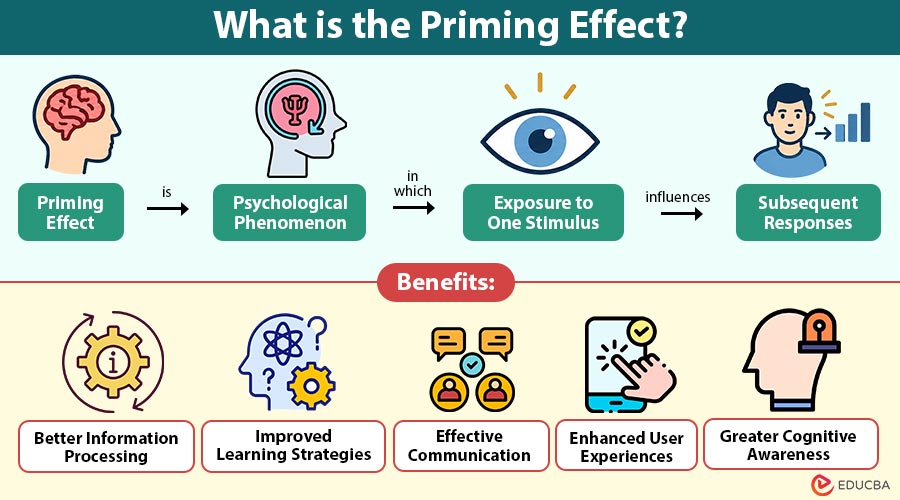
The priming effect is psychological phenomenon in which exposure to one stimulus influences subsequent responses. It affects how individuals respond to new information, situations, or experiences.
This influence often happens automatically, without people consciously recognizing how earlier information shapes their thoughts, perceptions, judgments, or behaviors. Priming happens when exposure to a word, image, sound, concept, or experience makes related information easier to recognize, remember, or process.
For example, if someone reads the word “doctor,” they may recognize “nurse” more quickly because the two concepts are closely linked in memory.
Cognitive psychologists have studied the priming effect widely, particularly in research on memory, perception, language processing, and decision-making. It also applies to marketing, advertising, education, communication, and consumer behavior. Understanding priming helps explain how previous experiences can influence responses to new information.
Table of Contents:
- Meaning
- Working
- Types
- Examples
- Causes
- Effects of Priming on Human Behavior
- Applications
- Benefits
- Limitations
- Difference
- How to Recognize the Priming Effect?
Key Takeaways:
- The priming effect occurs when earlier exposure to information influences subsequent cognitive processing, judgments, or responses.
- Priming can operate automatically, making related concepts easier to recognize or retrieve from memory.
- Priming influences language processing, memory retrieval, perception, and certain decision-making situations.
- Priming effects depend on context, stimulus characteristics, individual differences, and experimental conditions.
- Understanding priming helps individuals evaluate how prior information may shape their interpretations and decisions.
How Does the Priming Effect Work?
The priming effect works through cognitive processes that influence how information becomes activated, accessed, and processed in memory. When individuals encounter a stimulus, related mental representations may become temporarily more accessible, affecting their responses to subsequent stimuli.
The process generally involves the following stages.
1. Initial Exposure
An individual encounters an initial stimulus, such as a word, image, sound, advertisement, or environmental cue, that may influence subsequent processing.
2. Cognitive Activation
The initial stimulus activates related concepts, memories, or associations, making certain information more accessible for subsequent cognitive processing and interpretation.
3. Subsequent Exposure
The individual encounters another stimulus related to the initial information, creating an opportunity for previously activated associations to resurface.
4. Influenced Response
Previously activated information may influence how individuals recognize, interpret, recall, or respond to subsequent stimuli, sometimes without conscious awareness.
For example, exposure to the word “bread” may make someone recognize “butter” faster than an unrelated word.
Types of Priming Effect
Psychologists identify several types of priming based on the relationship between stimuli and the cognitive processes involved.
1. Semantic Priming
Semantic priming occurs when exposure to a word or concept facilitates processing of another concept with a related meaning.
For example, seeing “cat” may improve recognition of “dog” because both belong to related semantic categories.
2. Repetition Priming
Repetition priming occurs when previous exposure to a stimulus makes subsequent processing of the same stimulus faster or more efficient.
For example, recognizing a previously encountered word may require less processing effort when it appears again.
3. Perceptual Priming
Perceptual priming involves improved recognition of stimuli based on previously encountered visual, auditory, or other sensory characteristics.
For example, someone may identify a partially obscured image more easily after previously seeing the complete image.
4. Conceptual Priming
Conceptual priming occurs when previous exposure facilitates processing based on a stimulus’s meaning rather than its physical appearance.
For example, answering questions about musical instruments may make related concepts easier to retrieve during a subsequent task.
5. Affective Priming
Affective priming occurs when exposure to emotionally positive or negative stimuli influences how people evaluate or process subsequent information.
For example, viewing a pleasant image may affect how quickly someone categorizes another stimulus as positive.
6. Associative Priming
Associative priming occurs when exposure to one stimulus facilitates processing of another stimulus frequently connected with it through experience.
For example, encountering “coffee” may make “cup” easier to recognize because the concepts are commonly associated.
Examples of the Priming Effect
The priming effect can be observed in various situations involving language, perception, memory, and information processing.
1. Word Recognition
Reading the word “school” may help someone recognize “teacher” faster because both concepts share a familiar association.
2. Advertising
Repeated exposure to a brand’s name or logo may increase its familiarity, potentially influencing subsequent recognition and evaluation.
3. Shopping
Seeing images of winter clothing may make shoppers more attentive to related products when browsing an online store.
4. Education
Reviewing important vocabulary before reading a passage may help students recognize and process related terminology.
5. Emotional Processing
Exposure to positive or negative facial expressions may influence how quickly individuals evaluate subsequent emotional stimuli.
What Causes the Priming Effect?
Several cognitive mechanisms contribute to priming, though their importance varies by type and experimental context.
1. Associative Memory
Concepts connected through past experiences can activate related information, making subsequent recognition and retrieval easier.
2. Spreading Activation
Activation of one concept in a semantic network can spread to related concepts, temporarily increasing their accessibility.
3. Repeated Exposure
Repeated exposure to the same stimulus can improve processing efficiency, contributing to repetition-based priming effects.
4. Perceptual Familiarity
Previous sensory experiences can support faster recognition of familiar patterns, shapes, sounds, or visual characteristics.
5. Contextual Information
Surrounding information and situational cues can influence which concepts become accessible during subsequent cognitive tasks.
Effects of Priming on Human Behavior
Priming can influence several aspects of cognitive processing and, under certain conditions, judgments and behavior.
1. Memory Retrieval
Previously activated concepts may become easier to recall or recognize, helping individuals access related information more quickly during subsequent tasks.
2. Information Processing
Exposure to related stimuli may improve processing efficiency, allowing individuals to recognize familiar information faster under certain experimental conditions.
3. Perception
Previous sensory experiences may influence how individuals recognize, interpret, or identify subsequent stimuli, particularly when both share similar characteristics.
4. Decision-Making
Previously activated concepts may influence judgments and choices when relevant, though their effects depend on context.
5. Emotional Evaluation
Exposure to emotionally positive or negative stimuli may influence subsequent evaluations, affecting how quickly individuals respond to related information.
Applications of the Priming Effect
Priming has practical applications across fields involving cognition, communication, learning, and consumer interactions.
1. Marketing and Advertising
Marketers can use relevant visual, verbal, and contextual cues to reinforce brand associations and improve recognition of related products or messages.
2. Education and Learning
Educators can introduce relevant concepts before lessons to activate existing knowledge and support comprehension of unfamiliar information.
3. User Experience Design
Designers can use familiar icons, terminology, and interface patterns to help users recognize functions and navigate digital environments.
4. Consumer Research
Researchers study priming to understand how previously encountered information may influence product recognition, evaluations, and purchasing judgments.
5. Language Processing
Psycholinguists use priming experiments to investigate semantic relationships, word recognition, sentence comprehension, and how linguistic knowledge is organized.
6. Cognitive Psychology
Psychologists use priming tasks to investigate implicit memory, information accessibility, perceptual processing, and relationships between mental representations.
Benefits of Understanding the Priming Effect
Understanding priming provides several benefits for interpreting cognitive processes and designing effective communication.
1. Better Information Processing
Recognizing relevant associations helps explain why familiar concepts can be processed faster under certain conditions.
2. Improved Learning Strategies
Activating existing knowledge before introducing new information may support comprehension and help learners connect related concepts.
3. Effective Communication
Understanding contextual associations helps communicators present information clearly and build meaningful connections between ideas.
4. Enhanced User Experiences
Familiar visual and linguistic cues can make interfaces easier to understand by supporting recognition and reducing unnecessary cognitive effort.
5. Greater Cognitive Awareness
Learning about priming encourages individuals to consider how earlier experiences may influence their interpretation of subsequent information.
Limitations of the Priming Effect
Despite its importance in cognitive psychology, priming has several limitations.
1. Context Dependence
Priming effects may vary depending on experimental conditions, stimulus relationships, exposure timing, and the specific cognitive tasks being performed.
2. Individual Differences
Personal experiences, prior knowledge, attention levels, and familiarity with stimuli may influence how individuals respond to different priming conditions.
3. Temporary Influence
Many priming effects gradually weaken over time, but their duration depends on stimulus characteristics, experimental conditions, and the type of priming.
4. Replication Challenges
Certain behavioral priming findings have shown inconsistent results across studies, raising concerns about their reliability, reproducibility, and broader scientific validity.
5. Limited Predictive Power
Priming cannot reliably predict specific individual decisions or behaviors because multiple cognitive, contextual, and situational factors shape its effects.
Difference Between Priming Effect and Framing Effect
The table below highlights the key differences between the two:
| Basis | Priming Effect | Framing Effect |
| Meaning | Earlier exposure influences subsequent responses | Presentation influences interpretation or choices |
| Mechanism | Activation of related mental representations | Emphasis on particular aspects of information |
| Main focus | Previous stimuli and associations | Wording, context, and presentation |
| Example | “Doctor” facilitates recognition of “nurse” | Describing a treatment using survival versus mortality rates |
| Application | Memory, language, perception | Communication, marketing, decision-making |
How to Recognize the Priming Effect?
Recognizing potential priming influences requires paying attention to the information you encounter before making judgments or responding to new situations.
1. Examine Previous Exposure
Review recently encountered words, images, messages, or experiences that may have influenced your current thoughts, judgments, or responses.
2. Identify Associations
Notice whether exposure to certain stimuli makes related concepts, memories, or ideas easier to access during later thinking or evaluation.
3. Evaluate Context
Consider how surrounding information, environmental cues, or earlier experiences might influence your interpretation of new situations or incoming information.
4. Compare Alternatives
Explore different perspectives, explanations, and reliable information sources before reaching conclusions to reduce potential influences from previously encountered stimuli.
5. Practice Critical Thinking
Evaluate available evidence objectively and question whether recent experiences or activated associations may have influenced your judgments or interpretations.
Final Thoughts
The priming effect explains how previous exposure to information can influence memory, perception, judgments, and cognitive processing. Its impact varies across individuals and situations, with some behavioral findings remaining uncertain. Understanding priming helps explain how people process information and offers valuable insights into learning, communication, marketing, and everyday decision-making.
Frequently Asked Questions (FAQs)
Q1. Can the priming effect occur without conscious awareness?
Answer: Yes. Some priming effects occur without conscious awareness of the initial stimulus. However, priming can also occur when individuals consciously perceive the stimulus.
Q2. How do researchers measure priming effects?
Answer: Researchers measure priming by comparing reaction times, accuracy, or task performance across related and unrelated, repeated and non-repeated, and otherwise controlled stimulus conditions.
Q3. Does priming require attention?
Answer: Not necessarily. Some priming effects occur with limited attention, but attentional requirements vary by task, stimulus characteristics, and priming mechanism.
Q4. How long does the priming effect last?
Answer: The duration of priming varies depending on its type, stimulus characteristics, and experimental conditions. Some effects are short-lived, while others can persist for longer periods.
Recommended Articles
We hope that this EDUCBA information on “Priming Effect” was beneficial to you. You can view EDUCBA’s recommended articles for more information.