
Updated March 16, 2023
Introduction to Oracle Golden Gate
Oracle Golden Gate offers enterprise-wide data sharing and modification across different, multiple systems at the transaction level. Oracle Golden Gate is a mission-critical data availability and integration platform utilized by leading organizations and other industry executives worldwide. Preserving transaction-level integrity is critical for any database. Golden Gate protects data and fault tolerance by allowing 0% data loss.
Golden Gate would be a more versatile heterogeneous replication system that can change data when replicating it. One could see if the operation is problematic because Oracle Golden Gate provides monitoring tools. So we can act quickly to solve.” Moreover, the GoldenGate program facilitates old software extraction and has no distance limitations. Furthermore, the trail files created by GoldenGate capture can be encoded and encrypted.
Why Use Oracle Golden Gate?
DBAs increasingly turn to Golden Gate to satisfy their data centers’ replication requirements. Despite being relatively simple to configure, Golden Gate provides enormous versatility in the configuration techniques accessible with it.
Following are some of the benefits of using Golden Gate:
- Data is moved promptly, reducing latency.
- It has a simple architecture and is straightforward to configure.
- Only engaged transactions are relocated, which improves integrity and efficiency.
- The underlying databases and systems it has high performance with minimum overhead.
- Oracle databases of various versions and releases and heterogeneous databases running on multiple operating systems are allowed.
Using Oracle Golden Gate
Oracle Golden Gate enables businesses to collect, transport, process, and distribute transactional data in real-time across heterogeneous databases and applications with low overhead. Oracle provides high reliability and real-time data integration techniques that help the management and transportation of transactional data all across the company using its proprietary real-time, log-based replication technology. Oracle Golden Gate is built to address the increasing needs of enterprise data management with limited effect and ease of setup, maintenance, change, and expansion.
From origin to destination, Golden gate offers both DML and DDL replication.
Oracle Goldengate offers three different methods of authentication.
- Data Encryption using Blowfish
- Encryption of Passwords
- Network Encryption
Only confirmed data is provided for the efficiency of the operations and integrity. Golden Gate captures uncommitted data but is deleted following a Rollback concept. Golden Gate supports many Oracle enterprise versions and numerous non-Oracle databases and is available in many operating systems and physical devices. Golden Gate features built-in data recovery procedures. Also, instead of relying on Oracle’s Network services, it utilizes a conventional network between an origin and a recipient database.
Golden Gate may implement the following system setups. There are a variety of architecture to choose from, ranging from a simple unidirectional design to a more complicated peer-to-peer design.
The many topologies offered by Golden Gate can be seen in the graphic below:
- 1:1 (Unidirectional)
- Many to One (Broadcast)
- One-to-Many Relationship (Consolidation)
- A two-way Street (Active-Active)
- Multimastering is a term used to Describe the Process of (Peer-to-Peer)
- Data Marts in Sequence
Oracle Golden Gate Architecture
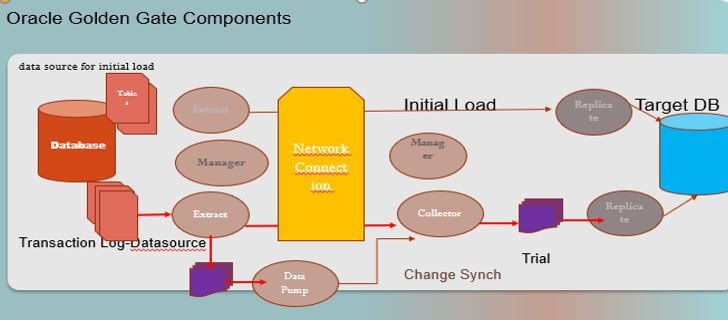
The following picture depicts the Golden Gate architecture’s elements, or operations, as defined:
1. Brief Process
New and changed database data is acquired from the source database in a standard Golden Gate flow. The information is saved in a document named the source trail. A data pump reads the trail, sends it all around the internet, and the Collector program writes it to a distant trail file. The destination database is updated once the delivery function receives the remote trail. The Manager procedure is in charge of all of the parts.
2. Manager
The manager manages the total environment on both sides, beginning and stopping the extract. In a Golden Gate replication arrangement, the manager might be regarded as the parent process. A manager process handles the following tasks. Oracle Golden Gate processes are started, port numbers are maintained, and storage space is allocated by deleting old trails or extracting files.
3. Capture process
The extraction process takes place on the source site. It takes accepted transactions from the data source and publishes these to trail files in the Golden Gate proprietary format. Data extraction, also known as data capture in Golden Gate, is part of the extract process. The extract can be set up to do data cleansing, transformations, and mapping while gathering data or even before sending it to the target network.
4. Pump Process
The secondary extract method is also known as Data Pump. The data Pump should always be included in the Goldengate setup. It’s vital to remember that the Data Pump utility and Pump extract have no relationship. The major application of the Pump extract is to protect replication against connectivity or site failures. It also transmits trial data to a large number of hits.
5. Collector
The collector process is also termed a remote trial. The committed data sent by the origin Extract or Pump Extract is collected by a collector and stored in the target side trail. The Replicat consumes the resulting trail file. In a Golden Gate replication arrangement with the extracts configured for continuous Change Synchronization, the collector is a background server process that runs in the background on the target system.
6. Network
We could adjust the TCP/IP socket buffer sizes and connections timeout settings for optimum performance throughout the network. It transfers data to a distant computer across a TCP/IP connection and saves it in a remote trail file.
7. Trial
Golden Gate keeps the observed modifications in a series of files on the disc called a trail, which allows for the ongoing recovery and replicating of database changes. At the Operating system level, these are binary console files. Golden gate’s platform independence is due to trail files. To maintain transaction integrity, trail files are structured in Canon format in the commit order of the collected transactions.
8. Replica
The process of replicating data to a destination database is known as replication. It examines the target database’s trail, recreates DML or DDL actions, and implements it in the database. Replicat, also known as Apply process, is configured on the user end. Replicat receives the data sent by the Capture process in the form of the trial files.
Conclusion
We saw new architecture concepts and how to maintain a Golden gate, and also we have seen different topologies of an Oracle gate.
Recommended Articles
This is a guide to Oracle Golden Gate. Here we discuss the introduction; why use oracle golden gate? And architecture, respectively. You may also have a look at the following articles to learn more –

