


What Is a Notice Period?
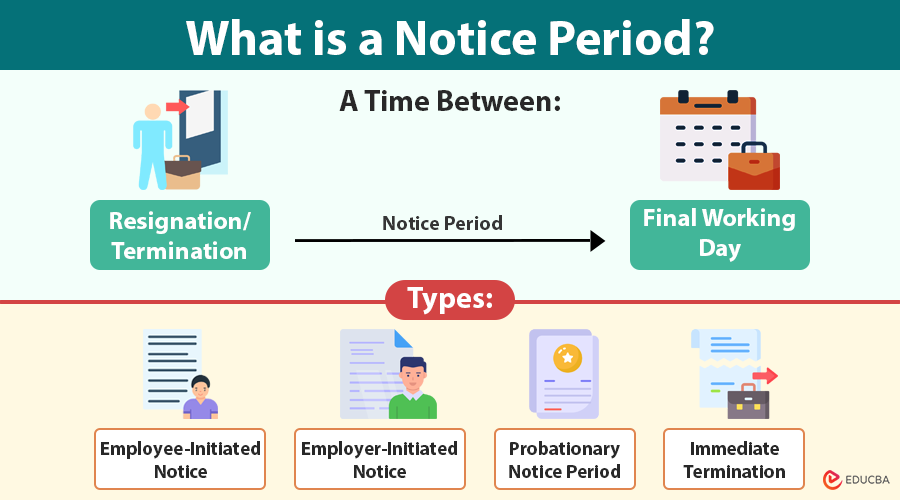
A notice period is the time between when an employee or employer officially announces the intention to end the job and the employee’s final working day. It gives both sides time to prepare for the transition.
In contractual terms, it is a binding obligation where either party must notify the other in advance about ending the employment. A notice period could be defined in:
- Employment contracts
- Offer letters
- Company policies
- Local labor laws.
The notice period typically begins when the resignation letter is submitted or a termination letter is issued and ends on the employee’s last day of work.
Table of Contents
- Meaning
- Importance
- Types
- Standard Duration
- Legal Framework and Labor Laws
- In Different Scenarios
- Buyout or Waiver
- Best Practices for Serving
- Common Challenges
Why Is a Notice Period Important?
A well-managed notice period benefits all parties involved. Here is why it is essential:
For Employers:
- Work continuity: Allows time to find a replacement or redistribute tasks.
- Knowledge transfer: The departing employee can effectively transfer critical knowledge and responsibilities to their successor.
- Client assurance: Clients and stakeholders feel reassured by consistent service and communication.
- Exit interviews: Helps understand reasons for resignation and reduce future attrition.
For Employees:
- Professional exit: Leaving on good terms helps maintain relationships and future references.
- Financial security: Employees continue to receive salary and benefits during the notice period.
- Time to transition: Provides time to wrap up responsibilities and mentally prepare for the next phase.
Types of Notice Periods
1. Employee-Initiated Notice
When employees decide to resign, they are contractually obligated to serve a specific period unless waived by the employer. The length of this period varies based on role, company policy, and local regulations.
2. Employer-Initiated Notice
When employers initiate termination, they must provide advance notice or pay instead of notice (depending on local labor laws). Employers often follow a performance improvement plan (PIP) or disciplinary process before issuing a termination.
3. Probationary Notice Period
Employees under probation are typically subject to shorter notice periods, ranging from immediate notice to a week or two. This allows both parties to exit the arrangement quickly if it is not working.
4. Immediate Termination
This applies in cases such as:
- Gross misconduct
- Breach of confidentiality
- Fraud or criminal activity.
In such cases, termination can occur without prior notice, though it must usually be justified and documented.
Standard Notice Period Duration
While there is no universal rule, the durations generally fall within certain norms based on experience level and regional labor standards:
| Employee Level | Standard Duration |
| Intern/Probation | 0 to 7 days |
| Entry-Level | 1 to 2 weeks |
| Mid-Level | 1 month |
| Senior-Level | 2 to 3 months |
| Executive/Leadership | Up to 6 months |
Factors Affecting Duration:
- Company policy
- Industry norms (e.g., IT vs. manufacturing)
- Position criticality
- Labor contract clauses.
Some companies also offer flexible notice periods based on the employee’s tenure or contribution.
Legal Framework and Labor Laws
Employment laws often govern notice periods, and these laws can vary by country, state, or industry.
Examples by Country:
India:
- Governed by the Shops and Establishments Act or the Industrial Disputes Act.
- Commonly 30 to 90 days.
- Employers must pay instead of terminating without notice.
United States:
- “At-will” employment applies.
- No legal requirement for notice unless defined in a contract.
- Some exceptions exist for unionized roles or government jobs.
United Kingdom:
- Statutory minimum is 1 week after 1 month of continuous service.
- Increases with tenure, e.g., 1 week per year of service (up to 12 weeks).
UAE:
- 30-day minimum notice under the UAE Labor Law.
- Applies to both parties unless mutually agreed otherwise.
Non-Compliance Consequences:
- Legal action or fines
- Damaged employer brand
- Withholding of dues or legal claims
Always consult an employment lawyer for complex or disputed exits.
Notice Period in Different Scenarios
- Voluntary resignation: An employee resigns for personal growth, better opportunities, or relocation. A formal resignation letter kicks off the notice period.
- Termination by employer: Occurs due to performance issues, organizational restructuring, or misconduct. In non-disciplinary cases, notice or severance is typically mandatory.
- End of contract: When a fixed-term contract ends, notice may or may not be required, depending on the contract’s terms.
- Mutual separation: In some cases, both parties agree to part ways with a negotiated notice period, which may be shorter than the standard period.
- Layoffs or redundancy: Special laws may govern notice during layoffs. For example, in India, notice of one month or compensation is often required.
Buyout or Waiver of Notice Period
1. Buyout Option
Employees who wish to leave early can pay the employer for the unserved days. This is known as a notice period buyout.
Example:
If the notice period is 30 days and the employee wants to leave after 15 days, they may be required to pay 15 days’ salary in lieu of notice.
2. Waiver by Employer
The employer can voluntarily relieve the employee without demanding buyout compensation. This is common when:
- Immediate exit is preferred
- The employee has no further tasks
- There is a risk of sensitive data exposure.
3. Settlement Agreements
Both sides sometimes draw up mutual agreements where they settle payments, clearances, and release terms in writing, thereby avoiding disputes later.
Best Practices for Serving a Notice Period
For Employees:
- Stay committed: Avoid slacking off or spreading negativity.
- Document handover: Create SOPs, share credentials, and train your replacement.
- Maintain conduct: Avoid gossip and leaks of confidential information.
- Communicate transparently: Keep team leaders informed of status and progress.
For Employers:
- Plan for replacement: Begin hiring or internal transfers early.
- Engage employees: Keep departing employees engaged with clear goals.
- Conduct exit interviews: Gain insights on workplace improvement.
- Ensure clean exit: Complete full and final settlements, documentation, and relieving letters on time.
Common Challenges During Notice Period
- Disengagement: Employees may become less motivated, which can negatively impact team performance.
- Counteroffers: Employees may receive competing offers, which can lead to uncertainty.
- Hostility or cold treatment: Sometimes, colleagues or managers may treat employees who are resigning differently.
- Delays in settlement: If coordination is lacking, the company may delay the final salary, experience letters, or gratuity.
- Security and access risks: In cases of sensitive roles, companies often limit access to systems, which can hinder genuine transition efforts.
Final Thoughts
Notice periods help ensure that leaving a job is done in a fair, professional, and legal manner. When handled with care and clarity, they foster goodwill and preserve the reputation of both employees and employers.
Whether you are resigning or terminating someone’s employment, treat the notice period not as a formality, but as a phase of preparation, collaboration, and closure. A well-managed exit can often lead to strong alumni networks, potential rehires, and enduring goodwill in the professional world.
Frequently Asked Questions (FAQs)
Q1. Can an employee take leave during the notice period?
Answer: Yes, employees can usually take leave during the notice period, provided their employer approves it. However, in many companies, earned leaves are adjusted against the notice period only if the policy allows it.
Q2. Will I get paid if I do not serve the full notice period?
Answer: If you do not complete the full notice period and the employer does not agree to waive it, they may deduct your salary for the remaining days or require you to compensate for the unserved duration. This depends on your employment contract.
Q3. Can an employer extend the notice period?
Answer: Generally, no. Employers cannot unilaterally extend the notice period unless both parties agree to it. However, if the company policy or contract allows, the notice period can be extended by mutual agreement.
Q4. Can I join a new company while serving notice in my current job?
Answer: Generally, no. You must complete your notice period and receive your relieving letter before you can join a new employer. However, some companies allow early joining with buyout or overlapping dates in specific cases.
Q5. Can the notice period be shortened after an employee resigns?
Answer: Yes, by mutual agreement. The employee can request early release, and the employer may accept it depending on the circumstances and workload.
Q6. Will I receive a bonus or annual increment if I am serving notice during that time?
Answer: Not necessarily. Some companies do not provide bonuses or increments to employees serving their notice period. In contrast, others may still offer them if the employee meets performance criteria and the company policy permits it.
Recommended Articles
We hope this detailed guide to notice periods has given you a clear understanding of their importance and implications. Explore these recommended articles to learn more about employee rights, termination procedures, and workplace compliance policies.


