


What is an Itemized Receipt?
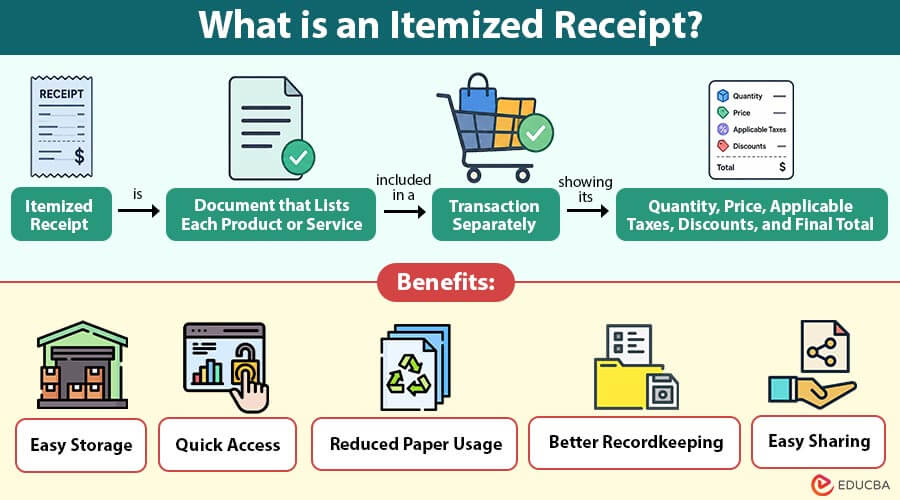
An itemized receipt is document that lists each product or service included in a transaction separately, showing its quantity, price, applicable taxes, discounts, and final total.
Unlike a basic receipt that may only show the total amount paid, an itemized receipt provides a clear breakdown of the entire purchase. It helps customers understand what they paid for and enables businesses to maintain accurate transaction records.
For example, a restaurant receipt may list a sandwich, beverage, dessert, applicable taxes, discounts, and the final amount separately. Similarly, a retail receipt can show individual products, quantities, unit prices, and taxes.
Table of Contents:
- Meaning
- Importance
- What Information Does and Itemized Rceipt Include?
- Working
- Example
- Difference
- Types
- Benefits
- Common Uses
- How Can Businesses Create an Itemized Receipt?
Key Takeaways:
- Itemized receipts provide detailed records of products, prices, quantities, discounts, taxes, and final transaction amounts.
- They help customers track expenses, request reimbursements, support returns, and maintain accurate personal financial records.
- Businesses use itemized receipts for accounting, tax documentation, transaction verification, and resolving customer billing disputes.
- Digital itemized receipts offer convenient storage, quick access, easy sharing, and improved electronic recordkeeping for businesses.
Why are Itemized Receipts Important?
Itemized receipts help both businesses and customers by providing transparency and creating a reliable record of a transaction.
1. Provides Transaction Transparency
An itemized receipt shows exactly what the customer purchased and how the final amount was calculated. This reduces confusion about individual prices, discounts, and taxes.
2. Helps Customers Track Expenses
Customers can use receipts to monitor their spending and maintain personal financial records. Detailed receipts are particularly useful for budgeting and expense management.
3. Simplifies Expense Reimbursement
Employees often need to submit receipts when requesting reimbursement for business-related expenses. An itemized receipt helps employers verify what was purchased and determine whether the expense qualifies for reimbursement.
4. Supports Tax Documentation
Businesses and individuals may need transaction records for tax-related purposes. Itemized receipts provide supporting documentation for eligible purchases and expenses.
5. Makes Returns and Exchanges Easier
Retailers can use receipt details to verify the purchased product, quantity, price, and transaction date when processing returns or exchanges.
6. Reduces Billing Disputes
A detailed breakdown makes it easier to identify errors or misunderstandings. Customers can compare the receipt with their purchases and raise questions about specific charges.
7. Improves Business Recordkeeping
Businesses can use receipt information to maintain accurate sales and accounting records. Digital receipts can also be integrated with accounting and point-of-sale systems.
What Information Does an Itemized Receipt Include?
The information included varies by business and transaction. However, most itemized receipts contain the following details:
1. Business Information
A receipt generally displays the business’s name and contact information, such as its address, email, phone number, and other relevant details.
2. Transaction Details
These details identify the transaction and may include the receipt number, transaction date, time, payment method, and cashier or salesperson information.
3. Product or Service Description
Each purchased product or service is listed separately so the customer can identify exactly what was purchased.
4. Quantity
The receipt shows how many units of each product were purchased. This is particularly useful when multiple units of the same item are included in a transaction.
5. Unit Price
The unit price indicates the cost of one item before applicable discounts or taxes.
6. Discounts
If a discount, coupon, promotion, or special offer applies, the receipt may show the discount amount separately.
7. Taxes
Applicable taxes are generally displayed on the receipt. Depending on the location and transaction, different taxes may be shown separately.
8. Total Amount
The receipt provides the subtotal, taxes, discounts, and final amount payable or paid.
9. Payment Information
The receipt may identify whether the customer paid using cash, credit card, debit card, bank transfer, digital payment, or another method.
How Does an Itemized Receipt Work?
A business generates an itemized receipt after a customer completes a purchase. The process generally follows these steps:
Step 1: Add Products or Services
The business records each product or service purchased, including descriptions, quantities, and transaction details, to generate an accurate receipt.
Step 2: Calculate Individual Prices
The system calculates each item’s total price by multiplying its quantity by the applicable unit price.
Step 3: Apply Discounts
The system deducts eligible discounts, coupons, promotional offers, or special pricing from applicable items or the transaction.
Step 4: Calculate Taxes
The system calculates applicable taxes based on purchased products, services, customer location, and relevant tax regulations.
Step 5: Calculate the Final Amount
The system combines item prices, discounts, and taxes to determine the final amount the customer must pay.
Step 6: Generate the Receipt
The business generates a printed or digital receipt showing transaction details, purchased items, applicable taxes, discounts, and final payment amount.
Example of an Itemized Receipt
For example, a customer visits a stationery store and purchases 2 notebooks at ₹100 each, 3 pens at ₹30 each, and 1 folder for ₹80. The subtotal is ₹370. After applying a ₹20 discount and adding ₹35 in tax, the customer pays ₹385.
This itemized receipt clearly shows each purchased item, its quantity, and price, along with the discount, tax, and final amount. It helps the customer verify the transaction and maintain an accurate purchase record.
Difference Between Itemized Receipt and Regular Receipt
The main difference between an itemized receipt and a basic receipt is the level of detail provided.
| Basis | Itemized Receipt | Regular Receipt |
| Product details | Lists individual products or services | May provide limited details |
| Quantity | Usually shown | May not be shown |
| Individual prices | Clearly displayed | May be omitted |
| Discounts | Often shown separately | May be combined |
| Taxes | Usually detailed | May show only total tax |
| Expense tracking | More useful | Less detailed |
| Transaction verification | Easier | More limited |
Types of Itemized Receipts
Itemized receipts can be used across different industries and transaction types.
1. Retail Receipts
Retail stores use itemized receipts to show purchased products, quantities, individual prices, discounts, taxes, and total amounts, helping customers verify purchases and manage records.
2. Restaurant Receipts
Restaurants provide itemized receipts listing food, beverages, service charges, discounts, taxes, and totals, allowing customers to understand individual charges and verify their final bill.
3. Medical Receipts
Healthcare providers issue detailed receipts showing consultations, treatments, procedures, medicines, and other services, helping patients track healthcare expenses, request reimbursements, and maintain documentation.
4. Travel Receipts
Hotels, airlines, and travel businesses provide itemized receipts showing accommodation, meals, transportation, taxes, and additional services, helping travelers track expenses and submit reimbursement claims.
5. Business Expense Receipts
Employees use itemized receipts to document business purchases, including products, services, prices, taxes, and payment details, supporting expense reporting and reimbursement requests.
6. Online Purchase Receipts
E-commerce platforms provide digital itemized receipts that list purchased products, quantities, prices, discounts, taxes, shipping charges, and totals via email, websites, or mobile apps.
Benefits of Digital Itemized Receipts
Businesses increasingly provide electronic receipts instead of printed copies. Digital itemized receipts offer several benefits.
1. Easy Storage
Customers can store digital receipts in email accounts, accounting software, cloud storage, or digital wallets for convenient access whenever needed.
2. Quick Access
Digital receipts can be quickly searched, retrieved, and reviewed, making it easier to find transaction details without checking physical documents.
3. Reduced Paper Usage
Electronic receipts reduce paper use and printing needs, helping businesses minimize waste while giving customers convenient transaction records.
4. Better Recordkeeping
Businesses can automatically store digital transaction information in their systems, improving record accuracy, organization, retrieval, and overall financial management.
5. Easy Sharing
Customers can quickly forward digital receipts through email or messaging platforms when submitting expenses, requesting reimbursements, or sharing purchase information.
Common Uses
Itemized receipts are commonly used for:
1. Expense Reimbursement
Employees use itemized receipts to document business expenses and provide proof of eligible purchases when requesting reimbursement from their employers.
2. Tax Documentation
Itemized receipts provide supporting records for eligible purchases, helping individuals and businesses maintain documentation required for tax reporting and compliance purposes.
3. Product Returns and Exchanges
Customers can use itemized receipts to verify purchase details, including products, quantities, prices, and transaction dates when requesting returns or exchanges.
4. Warranty Claims
Itemized receipts can serve as proof of purchase when customers submit warranty claims for eligible products requiring repairs, replacements, or service.
5. Personal Budgeting
Customers can review itemized receipts to track individual purchases, monitor spending patterns, identify unnecessary expenses, and manage personal budgets effectively.
6. Business Accounting
Businesses use itemized receipts to record transactions accurately, categorize expenses, reconcile accounts, and maintain organized financial records.
7. Purchase Verification
Itemized receipts help customers verify purchased products, quantities, prices, discounts, taxes, and payment amounts against the actual transaction details.
How Can Businesses Create an Itemized Receipt?
Businesses can create itemized receipts using point-of-sale systems, accounting software, invoicing platforms, or customized receipt templates.
A well-designed receipt should clearly display the business information, transaction details, purchased products or services, quantities, prices, discounts, taxes, payment method, and final amount.
Businesses should also ensure that the information shown on the receipt matches their sales records. Digital systems can automatically calculate totals and taxes, reducing manual calculation errors.
Final Thoughts
An itemized receipt provides a detailed purchase record showing products or services, quantities, prices, discounts, taxes, and the final amount. It improves transparency and supports expense tracking, reimbursements, returns, warranties, tax documentation, accounting, and dispute resolution while helping customers and businesses maintain accurate, accessible financial records.
Frequently Asked Questions (FAQs)
Q1. Can an itemized receipt be used as proof of purchase?
Answer: Yes, it can serve as evidence of a completed transaction when the purchase details are clearly recorded.
Q2. Are itemized receipts available for online purchases?
Answer: Yes, online stores commonly provide digital receipts through email, websites, or mobile applications after an order is completed.
Q3. How long should customers keep itemized receipts?
Answer: The appropriate retention period depends on the purpose, such as returns, warranties, reimbursements, accounting, or tax requirements.
Q4. Do itemized receipts always show customer information?
Answer: No. Customer details may appear when required or collected, but many receipts only contain information about the business and transaction.
Recommended Articles
We hope that this EDUCBA information on “Itemized Receipt” was beneficial to you. You can view EDUCBA’s recommended articles for more information.


