


Introduction to Choose a Multistate BLS Certification That is Easy to Verify
You are moving to a new state for a job, a better hospital, a travel nurse contract, or a fresh start in a new city. You have updated your license and filed paperwork. And then it hits you: Will my BLS certification still be valid here? Many healthcare providers share this concern. You have already completed the training, but some states do not accept all certifications across state lines. You do not want to retake the course just because the new state does not approve your provider. That is where a Multistate BLS certification becomes valuable for healthcare professionals.
It ensures your training is recognized in multiple states, saving you time, money, and hassle when you move or work under a compact license. Please keep reading to understand how multistate recognition works and why it matters for healthcare providers.
What Multistate Recognition Means for BLS Certification?
No federal system guarantees that every state accepts your BLS certification for healthcare provider. It depends on who issued your certificate and which organizations accept it.
Most hospitals, clinics, and staffing agencies in all U.S. states accept Multistate BLS certification training that aligns with nationally recognized emergency cardiovascular care (ECC) standards, such as those set by the American Heart Association (AHA). If your course aligns with those standards, it is more likely to be accepted in multiple states. That is what people mean when they say a BLS card has multistate recognition.
However, multistate acceptance is not automatic. Some employers only accept BLS cards issued by well-known training providers. Others will accept third-party providers if the training closely matches ECC standards. The only way to be sure is to check with:
- Your state licensing board.
- The employer’s HR or credentialing department.
- The staffing agency or travel nurse recruiter.
- Health Resources and Services Administration (HRSA), for federally funded programs.
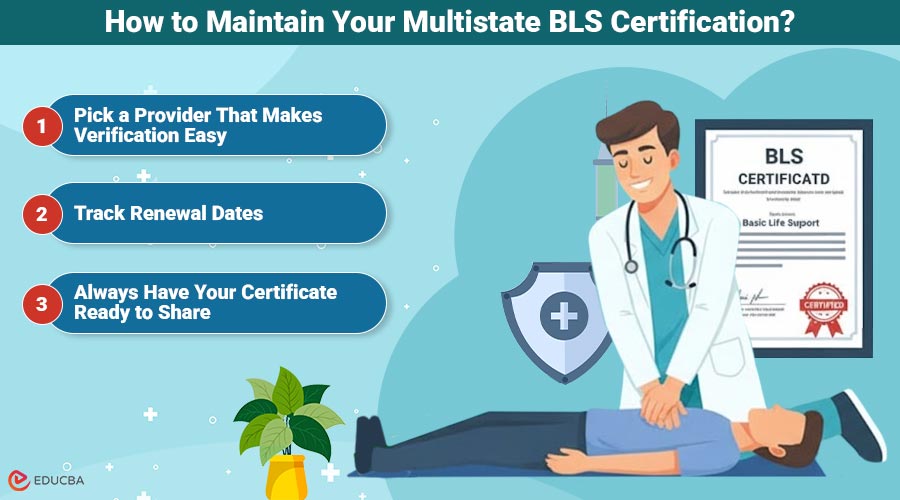
How to Keep Your Multistate BLS Certification Valid Across States?
Employers need to verify your BLS certification quickly, especially if you are working across states in roles like travel nursing or telehealth, or if you hold a multistate license. Here is how to stay organized and avoid delays with your Multistate BLS certification.
1. Pick a Provider That Makes Verification Easy
Select a BLS training provider that gives you a digital card with a QR code, serial number, or link to a verification portal. Make sure it complies with current ECC guidelines, as most hospitals expect. If it is unclear what standards the course follows, skip it. Choosing a provider that offers Multistate BLS certification ensures smoother verification wherever you go.
2. Track Renewal Dates
Some states or hospitals will not accept a BLS card that is about to expire, even if it technically has months left. Others want yearly renewals instead of every two years. Keep a simple log of when your certificate was issued, which provider you used, and any job-specific deadlines for renewal. This is especially important for maintaining your Multistate BLS certification status without interruption.
3. Always Have Your Certificate Ready to Share
When you are onboarding or renewing a license, timing is critical. Save a clean PDF copy of your BLS card on your phone and laptop. Upload a backup to a cloud drive. Take a screenshot, too; many credentialing portals ask for quick uploads. Being ready with the right file can shave days off the hiring or approval process, especially if your Multistate BLS certification is part of your credentials.
Real-World Example
A recent full-time job posting at UCHealth in Colorado Springs lists BLS certification as a core requirement. This is in addition to a master’s degree, unrestricted licensure, and Drug Enforcement Administration (DEA) registration.
For providers relocating to Colorado or practicing under multistate credentials, the Multistate BLS certification requirement is non-negotiable. It is part of the hiring checklist. If the certificate does not meet national standards, the application can be delayed or rejected.
This example reflects a broader trend: healthcare dominates many of the highest-paying U.S. jobs. An ophthalmologist, for example, can earn $239,200 or more per year (U.S. Bureau of Labor Statistics). However, it reflects what many hospitals expect: that your BLS certification for healthcare providers is widely recognized and easily verifiable. Without that, even qualified applicants can miss out on valuable opportunities.
Choose a Multistate BLS Certification That is Easy to Verify
Healthcare employers move quickly. If they cannot verify your Multistate BLS certification right away, they might delay your start date or pause your application. This matters even more if you are working across state lines or under a compact license. To avoid problems, use a BLS provider that issues a QR code, serial number, or direct verification link.
Make sure the course follows current ECC guidelines; most hospitals will not accept anything less. If the training provider does not clearly state that, skip it. Enroll in Multistate BLS certification training now and take the next step in your healthcare career.
Recommended Articles
We hope this guide on Multistate BLS certification helps you understand how to keep your credentials valid and recognized across different states. Explore these articles for more insights on healthcare compliance, professional certifications, and career advancement in the medical field.


