


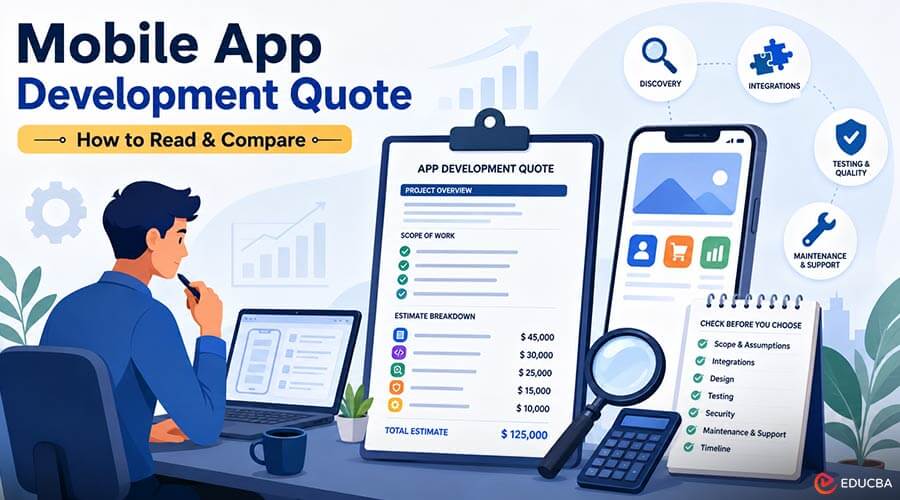
Two agencies quote the same project. One comes back at 90,000 dollars, the other at 240,000. Both documents look reasonable; both list similar phases. Neither is dishonest.
The gap is not in the price. It is in what each team assumed, and almost none of those assumptions are written down. Learning to read a Mobile App Development Quote means identifying these assumptions, understanding what is included, and evaluating whether the estimate truly reflects the scope of your project.
Understanding the Assumptions Behind a Mobile App Development Quote
Every Mobile App Development Quote rests on a mental picture of the project. It reflects assumptions about the number of screens, user roles, integrations, design requirements, and technical complexity, whether the data comes from a clean modern API or from a system built in 2009. Whether design already exists. Whether the app needs to work offline.
Change any one of those and the number moves substantially. So the first useful exercise is not to compare totals; it is to write down every assumption you can find in each document, then ask each team to confirm or correct them. The one that quoted low may have imagined a smaller project.
Why Discovery Matters in a Mobile App Development Quote?
Many Mobile App Development Quotes open with a discovery or scoping phase, and many buyers see it as a paid delay before the real work.
It is the opposite. Discovery is where the specification gets written precisely enough that the build estimate means something. A team that skips it is either reusing a template from a previous client or planning to bill you for the difference later through change requests.
What you should expect from it is concrete: a screen inventory, a data model, a list of third-party integrations with their known limitations, and a written scope for the first release. If the discovery deliverable is a slide deck, you paid for a slide deck.
The Build Line Hides The Integration Work
The most underestimated part of any business application in a Mobile App Development Quote is not the interface. It is everything the interface connects to behind the scenes. It is everything the interface has to talk to.
A payment provider, an inventory system, a CRM, an identity provider, a scheduling backend. Each one has its own quirks, rate limits, failure modes, and out-of-date documentation in at least one place. Integration work is where projects lose their schedule, because the effort is impossible to size accurately until someone has actually connected to the thing.
This matters more in some markets than others. In Toronto, where a large share of mobile work comes from banks, insurers, healthcare networks and transport agencies, the app is usually a new face on infrastructure that predates smartphones. A quote that treats those connections as a single line item has not looked at them.
Ask each team to break down the integration work separately and say which systems they have connected to before.
Testing Separates The Honest Quotes
Quality assurance is the easiest line to shrink in a Mobile App Development Quote when a team wants to win on price, and it is often the easiest cost for buyers to overlook.
Real testing means a device matrix, because your users are on hardware you do not own. It means regression passes after each change, accessibility checks, and a plan for the annual operating system releases that break things whether you are ready or not. On a serious project, it is rarely less than a fifth of the build effort.
If one quote allocates twenty percent to testing and another allocates five, you are not looking at two prices for the same product. You are looking at two different products, and one of them will be tested by your customers.
What Happens After Launch?
The app store release is not the end of the project. It is the beginning of the part that lasts for years.
Operating systems update annually and deprecate things your app depends on. Certificates expire. Dependencies get security advisories. Users report problems that only appear on one manufacturer’s phones. Somebody has to own all of that.
A quote that ends on launch day is not wrong, but incomplete. Ask what a maintenance year costs before you sign, not after, because that number is part of the real total and it is far easier to negotiate while you are still choosing.
How to Compare a Mobile App Development Quote Fairly?
Put each Mobile App Development Quote side by side and normalize them. Compare the same scope, assumptions, integrations, testing effort, and maintenance period. Same scope, same assumptions, same list of integrations, same testing effort, same first year of maintenance. Then compare.
Most of the time the gap shrinks dramatically, and the remaining difference tells you something useful about seniority, process or risk appetite rather than about who is cheaper.
It also helps to ask each team what they would remove from the first release. Anyone can add features to a proposal. A team willing to argue you out of three of them is thinking about whether the thing ships. The app developers Toronto companies keep going back to are usually the ones who pushed back during scoping rather than agreeing to everything.
What a Mobile App Development Quote Really Reveals?
A Mobile App Development Quote is a forecast, and forecasts are only as good as the reasoning behind them. You are not really buying a price. You are buying a team’s judgment about how much a thing will cost, which is a proxy for how well they understand it.
Read for that. The document that explains its own reasoning, names its risks, and admits what it does not yet know is usually the one that ends up closest to the final invoice.
Final Thoughts
A Mobile App Development Quote is more than just a cost estimate; it reflects a development team’s understanding of your project scope, technical requirements, and potential challenges. Instead of focusing only on the lowest price, evaluate what each quote includes, such as discovery, integrations, testing, security, and post-launch support. A detailed and transparent quote helps you avoid unexpected expenses and ensures everyone has a clear understanding of the project.
Choosing the right development partner requires looking beyond numbers and comparing the reasoning behind each estimate. A reliable team will clearly define deliverables, identify risks, and provide a realistic roadmap for building a scalable and successful mobile application. The best quote is not always the cheapest one, but the one that offers the right balance of quality, value, and long-term support.
Recommended Articles
We hope this guide on Mobile App Development Quotes helps you better understand estimates, evaluate development proposals, and make informed decisions when choosing a development partner. Explore these recommended articles for additional insights and strategies to improve your mobile app planning, development process, and project outcomes.


