
What is Metaphysics?
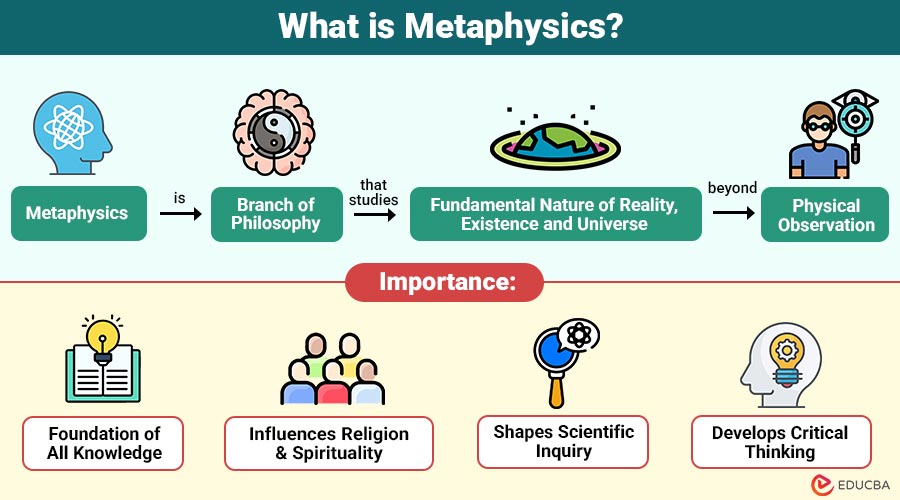
Metaphysics is branch of philosophy that studies the fundamental nature of reality, existence, and the universe beyond physical observation.
The term originates from the Greek words meta (beyond) and physika (physics). Historically, it referred to the works of Aristotle that were placed “after physics.” Over time, it came to represent philosophical inquiry into questions that go beyond the physical sciences.
Metaphysics addresses questions such as:
- What does it mean to exist?
- What is the nature of reality?
- Do humans have free will?
- Is there a soul?
- What are time and space?
These questions may not always have empirical answers, but they are essential for understanding the foundations of knowledge and belief.
Table of Contents:
Key Takeaways:
- Metaphysics explores the fundamental nature of existence, reality, time, consciousness, and causation.
- It forms the philosophical foundation underlying science, religion, ethics, and logical reasoning.
- Though abstract and untestable, metaphysics strengthens critical thinking and conceptual understanding skills.
- Metaphysical questions influence discussions about artificial intelligence, identity, morality, and human responsibility.
Importance of Metaphysics
Metaphysics remains relevant for several reasons:
1. Foundation of All Knowledge
Before conducting science or forming beliefs, we implicitly assume certain metaphysical principles—such as the existence of an external world and causal relationships.
2. Influences Religion and Spirituality
Religious beliefs about God, the soul, the afterlife, and creation are rooted in metaphysical assumptions.
3. Shapes Scientific Inquiry
Even science depends on metaphysical assumptions, such as the uniformity of nature and the existence of objective reality.
4. Develops Critical Thinking
Metaphysical inquiry strengthens analytical reasoning by encouraging individuals to question assumptions and explore logical possibilities.
Key Branches of Metaphysics
Metaphysics is broad and includes several subfields. The main branches are:
1. Ontology
Ontology is the study of being and existence. It investigates what kinds of things exist and how they can be categorized.
Key questions in ontology include:
- What kinds of entities exist in reality?
- Do abstract concepts such as numbers, values, or ideas truly exist?
- What is the difference between physical objects and mental entities?
- What are the fundamental components of reality?
Ontology attempts to classify reality, such as objects, properties, events, substances, and relations. It forms the backbone of metaphysical inquiry by identifying what is fundamentally “real.”
2. Cosmology (Metaphysical Cosmology)
Metaphysical cosmology examines the origin, structure, and ultimate nature of the universe from a philosophical perspective. Unlike scientific cosmology, which relies on physics and astronomy, this branch addresses deeper philosophical issues.
Important questions include:
- Why does the universe exist at all?
- Did the universe have a beginning?
- Is the universe infinite or finite?
- Does the universe require a first cause or a necessary being?
Philosophers explore whether reality depends on something beyond itself and whether the universe is self-explanatory or requires an external explanation.
3. Philosophy of Mind
The philosophy of mind explores the relationship between the mind and the body, focusing on consciousness, thought, and identity.
Core questions include:
- Is the mind separate from the body?
- Are thoughts and emotions purely physical brain processes?
- What is consciousness?
- How do mental states relate to physical states?
The theory of mind–body dualism, proposed by René Descartes, argues that the mind and body are distinct substances. Other views, such as physicalism, claim that mental states are entirely physical processes. This branch plays a crucial role in understanding personal identity and human experience.
4. Theology (Philosophical Theology)
Philosophical theology studies the existence, nature, and attributes of God using logical reasoning and philosophical argument rather than relying solely on religious doctrine.
It examines classical arguments such as:
- The cosmological argument (argument from first cause)
- The teleological or design argument
- The ontological argument
Thinkers like Thomas Aquinas developed influential arguments supporting the existence of God. This branch connects metaphysics with questions about divine necessity, perfection, and ultimate reality.
5. Determinism and Free Will
This branch explores whether prior causes predetermine human actions or whether individuals possess genuine freedom of choice.
Key issues include:
- Do prior causes determine all events?
- Is it possible for a deterministic cosmos to have free will?
- Are individuals morally responsible for their actions?
Philosophers debate positions such as determinism, libertarianism (free will exists), and compatibilism (free will and determinism can coexist). These discussions have significant moral and ethical implications regarding responsibility, accountability, and justice.
Major Theories in Metaphysics
Throughout history, philosophers have proposed various metaphysical theories to explain reality.
1. Materialism
Materialism claims that only physical matter exists. Physical processes can be used to explain everything, including thoughts and feelings. Modern neuroscience often aligns with materialist perspectives.
2. Idealism
Idealism contends that reality is essentially immaterial or mental. George Berkeley famously proposed that objects exist only as perceptions in the mind.
3. Dualism
Dualism is the metaphysical theory that reality consists of two fundamental substances—mind and matter—asserting that mental phenomena are distinct from physical processes.
4. Monism
Monism suggests that everything originates from a single substance or principle. This could be purely material (physical monism) or purely mental (idealistic monism).
Real-World Examples of Metaphysical Questions
Although metaphysics sounds abstract, it influences everyday life.
1. Artificial Intelligence
As AI systems become more advanced, questions arise:
- Can machines be conscious?
- What defines personhood?
- Does intelligence require a soul?
These are deeply metaphysical issues.
2. Time and Reality
Is time linear or cyclical? Does the past still exist? Some philosophers argue that only the present is real (presentism), while others believe the past and future are equally real (eternalism).
3. Moral Responsibility
If determinism is true and every action has a prior cause, can individuals truly be blamed or praised? This question shapes legal and ethical systems worldwide.
Pros and Cons of Studying Metaphysics
Here are the pros and cons of studying metaphysics:
Pros:
- Enhances Critical Thinking: Encourages analysis of fundamental concepts like existence, identity, and causation.
- Explores Ultimate Questions: Examines deep issues about reality, consciousness, time, and the nature of being.
- Builds Strong Reasoning Skills: Develops logical argumentation and structured philosophical analysis abilities.
- Supports Other Disciplines: Provides foundational insights useful in science, theology, ethics, and epistemology.
Cons:
- Highly Abstract Nature: Concepts can be complex and difficult for beginners to understand fully.
- Limited Empirical Evidence: Many theories cannot be scientifically tested or experimentally verified.
- Unresolved Debates: Discussions often continue without reaching universally accepted conclusions.
- Perceived Practical Limitations: May not offer immediate real-world or career-oriented applications.
Difference Between Metaphysics and Physics
Here are the key differences between metaphysics and physics presented in a comparison format:
| Aspect | Metaphysics | Physics |
| Focus | Nature of reality | Physical phenomena |
| Method | Logical reasoning | Experiment & observation |
| Scope | Beyond the physical world | Observable universe |
| Questions | Why existence? | How does matter behave? |
Final Thoughts
Metaphysics remains one of the most profound and intellectually stimulating branches of philosophy. By examining existence, reality, consciousness, and causation, it challenges us to think beyond observable phenomena. Though abstract, its influence extends to science, religion, ethics, and modern debates about identity and artificial intelligence. Ultimately, metaphysics deepens our understanding of reality’s foundations and our place within it.
Frequently Asked Questions (FAQs)
Q1. Is metaphysics the same as spirituality?
Answer: No. While metaphysics can include spiritual questions, it is a philosophical discipline based on rational inquiry.
Q2. Why is metaphysics important today?
Answer: It helps address modern issues in AI, consciousness studies, and cosmology, and strengthens logical reasoning.
Q3. Can metaphysics be scientifically proven?
Answer: Many metaphysical questions go beyond empirical testing, though they often interact with scientific theories.
Q4. Why is metaphysics difficult?
Answer: It deals with abstract concepts that go beyond sensory experience.
Recommended Articles
We hope that this EDUCBA information on “Metaphysics” was beneficial to you. You can view EDUCBA’s recommended articles for more information.

