


What is Metacognition?
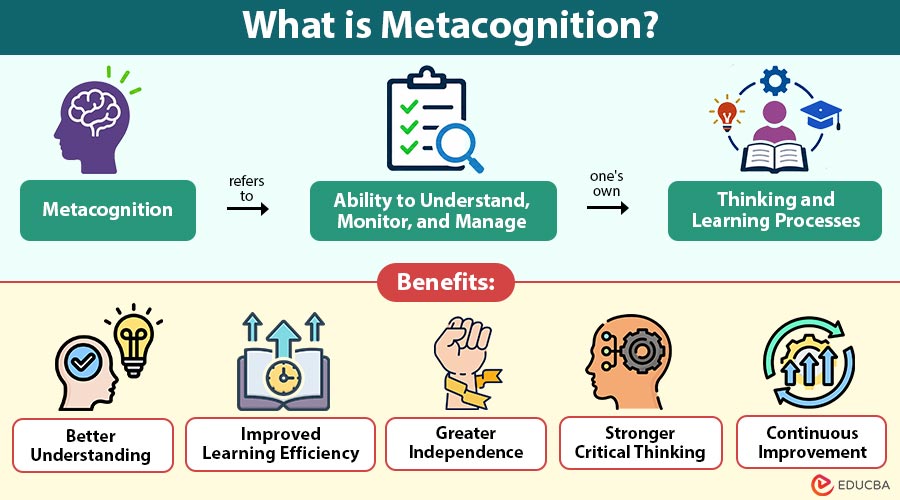
Metacognition refers to the ability to understand, monitor, and manage one’s own thinking and learning processes.
Have you ever finished reading a chapter and realized you cannot remember what you just read? Maybe you understood everything while reading, but when someone asked you a question, you struggled to explain it. This happens to many people.
Now imagine that instead of reading the chapter again, you stop and ask yourself, “What exactly am I finding difficult?” You identify the confusing parts, look for simpler explanations, and test your understanding. This is an example of metacognition.
In simple words, metacognition means thinking about your own thinking. It helps you understand how you learn, recognize mistakes, and find better ways to complete tasks.
Table of Contents:
- Meaning
- Importance
- Components
- Types
- Working
- Examples
- Strategies
- Applications
- Benefits
- Challenges
- Difference
- How to Improve Metacognition?
Key Takeaways:
- Metacognition helps individuals understand their thinking habits and recognize areas that need improvement.
- Planning and monitoring learning activities can help people identify mistakes before completing important tasks.
- Reflecting on previous experiences encourages better problem-solving and more thoughtful decision-making.
- Regular practice and feedback can help individuals develop stronger learning habits over time.
Why is Metacognition Important?
Everyone learns differently. Some people understand information quickly through examples, while others need practice or detailed explanations.
Metacognition helps individuals discover which approaches work best for them.
1. Improves Self-Awareness
Understanding personal strengths and weaknesses helps people recognize their learning habits and identify situations where additional effort or guidance may be necessary.
2. Supports Effective Learning
Instead of spending hours repeating information, learners can identify difficult concepts and choose practical methods that improve their understanding.
3. Encourages Independent Thinking
People learn to examine situations, question their assumptions, and make decisions without depending entirely on instructions from others.
4. Strengthens Problem-Solving
When an approach fails, metacognition encourages individuals to understand the reason and consider alternative solutions rather than repeating the same mistake.
5. Improves Decision-Making
Reflecting on previous experiences helps people recognize personal biases, evaluate available information, and make more thoughtful choices.
Components of Metacognition
Metacognition has two main components that influence how people understand and manage their thinking.
1. Metacognitive Knowledge
Metacognitive knowledge involves understanding personal thinking abilities, recognizing learning preferences, and knowing which strategies work best for different situations effectively.
It includes three areas:
- Person Knowledge: Understanding personal strengths, weaknesses, and learning habits.
- Task Knowledge: Recognizing how difficult an activity might be and what it requires.
- Strategy Knowledge: Knowing which techniques can help complete an activity successfully.
2. Metacognitive Regulation
Metacognitive regulation involves managing thinking and learning activities through planning, monitoring progress, and evaluating results to improve overall learning performance.
- Planning: Selecting goals and deciding how to begin.
- Monitoring: Checking progress and understanding during an activity.
- Evaluation: Reviewing results and identifying improvements.
Types of Metacognition
Metacognitive awareness is often explained through three types of knowledge and the regulation of thinking.
1. Declarative Knowledge
Declarative knowledge refers to understanding personal strengths, weaknesses, learning abilities, and available strategies that influence how individuals approach different tasks.
2. Procedural Knowledge
Procedural knowledge involves understanding how to apply specific learning methods and techniques to complete different activities effectively and improve performance.
3. Conditional Knowledge
Conditional knowledge involves understanding when and why specific learning strategies should be used to achieve better results in different situations.
4. Metacognitive Regulation
Metacognitive regulation refers to managing thinking and learning activities through planning, monitoring progress, adjusting strategies, and evaluating results for improvement.
How Does Metacognition Work?
Metacognition works through a continuous process of observing, understanding, and improving personal thinking and learning habits.
Step 1: Planning
Before beginning an activity, individuals identify their goals, consider available resources, and choose suitable methods to achieve the desired results.
Step 2: Monitoring
While completing an activity, individuals regularly check their understanding, observe progress, and recognize difficulties that might affect their overall performance.
Step 3: Adjusting
When existing methods are not working, individuals explore alternative approaches, seek additional information, and change their strategies to improve results.
Step 4: Evaluating
After completing an activity, individuals review their performance, examine mistakes, and determine whether their chosen strategies helped achieve the goals.
Step 5: Improving
Individuals apply lessons from previous experiences to develop better learning habits, improve their approaches, and handle similar challenges more effectively.
Examples of Metacognition in Everyday Life
Metacognition is useful beyond classrooms and examinations.
1. Preparing for Examinations
A student realizes that reading notes repeatedly is not helping and begins practicing questions to test understanding.
2. Workplace Activities
A business analyst questions an unexpected result, checks the original data, and corrects an assumption before preparing recommendations.
3. Learning Programming
Someone struggling with coding recognizes a knowledge gap and returns to basic concepts before attempting complicated exercises.
4. Financial Decisions
A person notices that excitement influences shopping decisions and starts comparing prices and actual requirements before purchasing.
5. Communication
After a confusing discussion, a manager reflects on their explanation and decides to communicate more clearly during future meetings.
Effective Metacognitive Strategies
Developing metacognition becomes easier when people practice simple techniques regularly.
1. Self-Questioning
Self-questioning involves asking meaningful questions about personal understanding, identifying confusing concepts, and checking whether current learning methods are working effectively.
2. Reflective Journaling
Reflective journaling involves writing about daily experiences, reviewing completed activities, identifying mistakes, and recognizing useful lessons for future personal improvement.
3. Self-Assessment
Self-assessment helps individuals evaluate their understanding through practice tests, quizzes, and personal reviews to identify areas that need further improvement.
4. Think-Aloud Technique
The think-aloud technique involves explaining thoughts while solving problems to recognize confusion, identify mistakes, and understand personal reasoning more clearly.
5. Goal Setting
Goal setting involves establishing clear objectives, organizing learning activities, monitoring progress, and choosing suitable strategies to achieve desired results effectively.
Applications of Metacognition
Below are some common applications of metacognition:
1. Education
Students use metacognition to evaluate their understanding, identify difficult subjects, choose suitable study methods, and improve their overall academic performance.
2. Business Management
Business professionals apply metacognition to review decisions, identify mistakes, evaluate different approaches, and improve their planning and overall workplace performance.
3. Technology
Software developers use metacognition to examine coding methods, identify recurring errors, improve debugging techniques, and develop more effective technical solutions.
4. Personal Development
Individuals practice metacognition to understand personal habits, recognize unhelpful thinking patterns, establish meaningful goals, and make positive changes in life.
5. Healthcare Education
Medical students use metacognition to examine clinical reasoning, identify knowledge gaps, evaluate learning methods, and strengthen their professional decision-making skills.
Benefits of Metacognition
Practicing metacognition can offer several benefits.
1. Better Understanding
Metacognition helps individuals recognize what they already understand, identify confusing concepts, and focus on subjects that require additional learning efforts.
2. Improved Learning Efficiency
Choosing suitable learning strategies helps individuals avoid unnecessary repetition, manage their study time effectively, and understand difficult concepts more easily.
3. Greater Independence
Metacognition encourages individuals to manage learning activities, solve problems independently, make thoughtful decisions, and reduce their dependence on external guidance.
4. Stronger Critical Thinking
Examining personal assumptions and exploring different perspectives helps individuals evaluate information carefully, question conclusions, and develop stronger critical thinking skills.
5. Continuous Improvement
Reflecting on previous experiences helps individuals recognize mistakes, improve learning habits, adjust ineffective strategies, and approach future challenges more confidently.
Challenges of Metacognition
Although useful, metacognition is not always easy to practice.
1. Limited Self-Awareness
Some individuals struggle to recognize their weaknesses, identify knowledge gaps, and understand which learning habits need further improvement.
2. Overconfidence
People sometimes believe they understand everything without testing their knowledge, which can prevent them from recognizing important mistakes.
3. Time Requirements
Planning, monitoring progress, and reviewing completed activities require additional time and effort, especially when developing new learning habits.
4. Difficulty Changing Habits
Individuals may continue using familiar learning methods despite poor results because adopting new approaches requires patience and effort.
5. Excessive Self-Analysis
Constantly questioning personal thoughts and decisions can create unnecessary confusion, increase hesitation, and make simple tasks more difficult.
Difference Between Metacognition and Cognition
The table below highlights the differences between the two:
| Basis | Metacognition | Cognition |
| Meaning | Understanding personal thinking | Processing information |
| Focus | Monitoring learning | Learning and reasoning |
| Purpose | Improving thinking strategies | Completing mental tasks |
| Activities | Planning and evaluating | Remembering and understanding |
| Example | Reviewing the solution method | Solving a problem |
| Outcome | Better learning control | Knowledge and understanding |
How to Improve Metacognition?
You do not need complicated exercises to develop metacognitive skills. Start by asking yourself what you want to achieve before beginning an activity. While working, occasionally check whether your approach is helping.
If you experience difficulties, try a different method instead of repeating the same steps. After completing the task, spend a few minutes considering what worked and what needs improvement. Feedback from teachers, colleagues, or experienced professionals can also provide useful perspectives. Over time, these small practices can become part of everyday learning.
Final Thoughts
Metacognition is about understanding how your mind approaches learning, decisions, and everyday problems. It encourages people to recognize their strengths, identify difficulties, and make useful changes instead of repeating unsuccessful methods. Whether you are studying for an examination, learning new technology, or handling workplace responsibilities, paying attention to your thinking can help you improve.
Frequently Asked Questions (FAQs)
Q1. At what age do metacognitive skills begin to develop?
Answer: Metacognitive skills begin developing during childhood as children gradually become aware of their thoughts and learning abilities. These skills continue improving through education and experience.
Q2. Can metacognition help people remember information longer?
Answer: Yes. When people actively recall information, explain concepts in their own words, and check their understanding, they may remember information for longer periods.
Q3. Is metacognition an inborn ability or a learned skill?
Answer: Metacognition develops naturally as people grow, but it can also be strengthened through practice, guidance, and experiences that encourage awareness of personal thinking.
Q4. Can metacognition reduce mistakes in everyday activities?
Answer: It can help reduce certain mistakes by encouraging people to notice assumptions, check important details, and reconsider decisions before taking action.
Recommended Articles
We hope that this EDUCBA information on “Metacognition” was beneficial to you. You can view EDUCBA’s recommended articles for more information

