


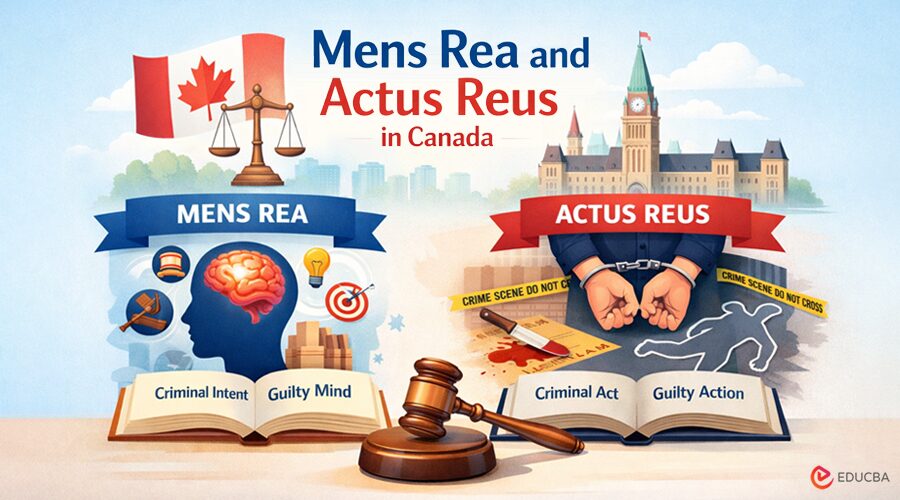
How Mens Rea and Actus Reus Work in Canadian Criminal Law?
Canadian criminal law requires two fundamental elements to coexist in order to secure a conviction. These elements are the mental state, known as mens rea, and the physical act, known as actus reus. Understanding Mens Rea and Actus Reus in Canada is essential because the absence of either element often prevents the justice system from proving that a crime has occurred.
Mens rea focuses on the accused’s intent or knowledge, while actus reus concerns the actual act or failure to act that results in the alleged criminal offense. In Canada, a person can only be convicted if prosecutors prove both elements beyond a reasonable doubt.
Knowledge of Mens Rea and Actus Reus in Canada is important not only for legal professionals but also for anyone who may interact with the criminal justice system. Courts may dismiss the case or reduce the charges when prosecutors fail to prove either the mental or physical element, making these principles central to fair criminal proceedings.
Defining Mens Rea
A person forms a mental state or intention when committing an offense, which the law refers to as mens rea. It concerns the person’s intentionality, knowledge, recklessness, or negligence. Various crimes require different standards of mens rea, and the court carefully examines the mental aspect to determine culpability. In serious crimes such as murder, the intention to cause harm is more often than in less serious crimes, which may not need any evidence of negligence.
The mens rea aspect distinguishes a person who walks accidentally from one who walks with a criminal mind. Different statutes have different legal definitions, but in Canada, courts have consistently recognized mens rea as a key element of the justice system. Proving the right state of mind is a complicated task, and a competent Mississauga criminal lawyer can guide clients through these complexities.
Understanding Actus Reus
Actus reus deals with the physical act or non-action that is a criminal offense. This consists of any self-willed act that violates the law or causes injury. In others, the failure to act, e.g., failure to discharge a legal obligation, may also satisfy the requirements of actus reus. A person’s bad intentions are not enough; there must be a specific act or omission that a law considers wrong.
Courts closely examine the act to determine whether it is in line with the statutory definition of the crime. A seemingly small act may even constitute criminal liability if it results in outlawed harm. Courts assess actus reus and mens rea together to ensure they evaluate both the action and the intent, so neither mere thoughts nor accidental acts justify a conviction.
The Relationship Between Mens Rea and Actus Reus in Canada
In Canada, Mens Rea and Actus Reus require that both a person’s intent and actions are present for a crime. Criminal liability typically arises only when a guilty mind accompanies a prohibited act.
Mens rea represents the intention or awareness behind an action, while actus reus represents the act itself. Courts evaluate both elements together to determine whether a person’s behavior constitutes a criminal offense.
Courts can also consider defenses through this interplay. For example, a court may consider a lack of mens rea a mitigating factor if an individual acted without the intent to harm anyone. On the other hand, when one has a guilty state of mind and fails to commit the forbidden act, one is normally not criminally liable. Canadian criminal law ensures fairness by carefully balancing intention and action in every case.
Specific Intent Crimes and General Intent Crimes
When examining Mens Rea and Actus Reus in Canada, courts often categorize criminal offenses as either specific-intent or general-intent crimes.
There are also crimes where one must prove a certain state of mind, with the accused having to have intended a certain outcome. Murder is a typical one because here, there has to be an intention to kill or to inflict serious bodily harm. Such crimes place an additional burden on prosecutors, as they must prove the accused’s mental state at the time of the act.
By comparison, in general intent crimes, one only needs to demonstrate that the individual intended to commit the act, not that it would result in a specific consequence. Assault can fall within this category, provided it suffices to demonstrate that the accused knowingly used force against the victim’s consent. It is important to distinguish between these kinds of intent to understand the application of mens rea in various contexts.
The Role of Recklessness and Negligence
Recklessness and negligence are lesser forms of mens rea, yet they prove criminal liability. Recklessness occurs when an individual knowingly ignores a significant risk that his/her actions might harm others. Negligence is the breach of a standard of care that a reasonable person would take and which leads to unintended harm.
Canadian courts carefully assess whether the accused’s behavior meets these thresholds. Both types of liability clearly show that mens rea extends beyond a wilful breach. In most situations, a criminal attorney representing a client in the city of Mississauga will strive to prove that the acts committed by his client were not reckless or careless to avoid criminal liability.
Legal Defenses Related to Mens Rea and Actus Reus in Canada
Defendants can assert defenses to either the mental or the material element of an alleged crime. An example of this is a person saying that he/she lacked the required intent to commit a crime, or that his/her action was not voluntary. Some of the most prevalent defenses that may affect the mens rea aspect include mistake of fact, intoxication, and duress.
Questions of actus reus usually concern whether the accused committed the act or omission in question. The defense can prove that the accused did not commit the physical act or that the act was justified by law, which can help avoid a conviction. The legal system provides these avenues to ensure that courts hold only the truly guilty accountable, making both elements essential to Canadian criminal law.
Final Thoughts
Mens Rea and Actus Reus in Canada are the basic principles that underpin criminal responsibility. Canadian law demands evidence of mental condition and physical commission to prove guilt. This two-fold condition ensures that courts do not base convictions on mere thought or accident and instead consider the circumstances as a whole.
These principles are essential to all persons who deal with the criminal justice system. Knowledge of mens rea and actus reus is applied by legal practitioners, such as a criminal lawyer in Mississauga, to build a strong defense and navigate a complex case. Understanding the intersection of intention and action is a sure way to defend individual rights and ensure justice.
Recommended Articles
We hope this guide on Mens Rea and Actus Reus in Canada helps you understand the core principles of criminal responsibility. Explore the recommended articles below for more insights on Canadian criminal law, legal defenses, and key concepts in justice.

