


What is Maslow’s Hierarchy of Needs?
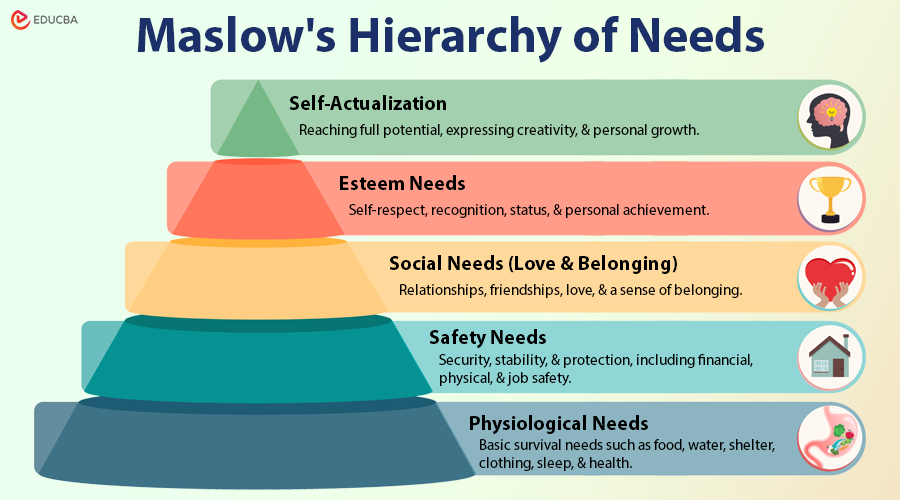
Maslow’s Hierarchy of Needs shows five levels of human needs in a pyramid. The fundamental idea is that higher-level needs gain importance only after lower-level needs are satisfied.
The five levels are:
- Physiological Needs
- Safety Needs
- Social Needs
- Esteem Needs
- Self-Actualization
By understanding these levels, managers can design interventions to meet employee needs at all stages, thereby boosting motivation and performance.
Table of Contents
5 Levels of Maslow’s Hierarchy of Needs
Let us explore each level in detail to understand how it influences human behavior and workplace motivation:
1. Physiological Needs
Physiological needs are the essential things humans require to survive, including water, food, shelter, clothing, sleep, and health.
Management Perspective:
- Meeting physiological needs is the foundation of employee satisfaction. Organizations can do this by offering competitive salaries, regular breaks, ergonomic workspaces, and wellness initiatives.
- Employees struggling to meet their basic needs may experience stress, absenteeism, and reduced productivity, ultimately affecting overall organizational performance.
Examples:
- Cafeteria facilities, access to clean drinking water, and comfortable rest areas.
- Salary packages that enable employees to cover their living expenses comfortably.
- Flexible work schedules to ensure adequate rest and prevent burnout.
Insights:
- Managers should regularly survey employees to determine whether they meet their basic needs.
- Health and wellness programs not only satisfy physiological needs but also reduce healthcare costs and absenteeism.
2. Safety Needs
Once individuals satisfy their physiological needs, they actively seek security, stability, and protection. Safety needs include financial security, physical safety, health protection, and job stability.
Management Perspective:
- Providing a safe work environment is a responsibility for both the law and management.
- Employees perform better when they feel secure in their jobs, finances, and personal safety.
- Organizations can provide insurance, health benefits, long-term contracts, and clear policies to fulfill these needs.
Examples:
- Implementation of safety protocols in manufacturing units or labs.
- Offering mental health support, counseling services, and retirement plans.
- Establishing grievance redressal mechanisms and clear HR policies.
Insights:
- Job security contributes to employee loyalty and retention.
- Psychological safety, where employees feel free to voice ideas without fear of ridicule, is equally critical.
- Employees who feel secure are more willing to take risks, innovate, and share ideas.
3. Social Needs (Love and Belonging)
Humans are inherently social creatures. After meeting their safety needs, individuals actively seek relationships, friendships, love, and a sense of belonging in both personal and professional contexts.
Management Perspective:
- Organizations can help employees feel a sense of belonging by building strong teams, offering mentorship opportunities, and fostering collaboration.
- Social support within workplaces improves employee morale, reduces turnover, and enhances productivity.
Examples:
- Team-building exercises, company outings, and social events.
- Creating cross-functional teams to enhance interaction and collaboration.
- Peer recognition programs to acknowledge contributions in group settings.
Insights:
- Managers should cultivate a culture of inclusion to ensure all employees feel valued.
- Encouraging mentorship and buddy programs can help new employees integrate quickly.
- Social belonging in organizations is associated with higher job satisfaction, increased creativity, and greater commitment.
4. Esteem Needs
Esteem needs relate to self-respect, recognition, status, and personal achievement. Maslow classified these into:
- Lower-level esteem: Recognition and respect from others.
- Higher-level esteem: Confidence, mastery, and independence.
Management Perspective:
- Managers can satisfy esteem needs by recognizing accomplishments, assigning meaningful responsibilities, and providing opportunities for skill development.
- Meeting employees’ esteem needs motivates them, boosts their confidence, and increases their productivity.
Examples:
- Performance awards, promotions, and certifications.
- Public acknowledgment of achievements in meetings or newsletters.
- Empowering employees to lead projects or make decisions independently.
Insights:
- Organizations can create career growth paths to help employees achieve mastery in their roles, fostering a culture of continuous learning and development.
- Mentorship programs enhance professional esteem by providing guidance and recognition.
- Failing to meet esteem needs may lead to low morale, disengagement, and attrition.
5. Self-Actualization
Self-actualization is the highest level of human motivation, where people strive to reach their full potential, express creativity, and grow personally.
Management Perspective:
- Organizations can facilitate self-actualization by providing opportunities for innovation, leadership, and challenging assignments that promote personal growth.
- Employees at this stage exhibit high levels of creativity, strategic thinking, and intrinsic motivation, which drive organizational success.
Examples:
- Assigning employees to develop new products or processes.
- Providing opportunities for higher education, training, or professional certifications.
- Encouraging entrepreneurial initiatives within the company.
Insights:
- Self-actualized employees are often role models and mentors for others.
- Leadership development programs and succession planning can nurture self-actualization.
- Employees who reach this level demonstrate commitment to organizational goals and a passion for lifelong learning.
Applications of Maslow’s Hierarchy of Needs in Management
Maslow’s hierarchy has practical applications in multiple areas of organizational behavior and management:
- Employee motivation: Customizing incentives according to employee needs enhances engagement and productivity.
- Workplace design: Ergonomic, safe, and collaborative environments satisfy physiological, safety, and social needs.
- Training and development: Skill-building, workshops, and mentorship programs address esteem and self-actualization.
- Leadership strategy: Leaders can adjust their approach to providing feedback, recognition, and communication to meet the needs of their employees.
- Conflict resolution: Identifying unmet needs allows managers to resolve disputes effectively.
- Retention strategies: Meeting all levels of employee needs reduces attrition and increases organizational loyalty.
Criticisms and Limitations
While Maslow’s hierarchy is widely respected, it has some limitations:
- Rigidity: People may pursue higher-level needs even if lower-level needs are unmet.
- Cultural bias: Maslow’s theory reflects Western individualistic values and may not universally apply.
- Lack of empirical evidence: Research offers limited quantitative support for the strict hierarchy.
- Dynamic needs: In modern workplaces, employees often have multiple levels of needs that they simultaneously seek to fulfill.
Despite these criticisms, Maslow’s hierarchy remains a practical framework for understanding workplace motivation and designing HR interventions.
Final Thoughts
Maslow’s Hierarchy of Needs offers a structured framework for understanding human motivation. For management students and professionals, applying this theory enables the creation of environments that meet the diverse needs of employees at all levels, from basic survival to self-actualization. By addressing these needs strategically, organizations can enhance engagement, productivity, creativity, and long-term success.
Frequently Asked Questions (FAQs)
Q1. Can employees skip levels in Maslow’s hierarchy?
Answer: Yes, in real-world scenarios, employees may pursue higher-level needs even if some lower-level needs are partially unmet. For example, a highly creative employee might seek opportunities for self-actualization despite financial instability.
Q2. How can managers identify which level of needs an employee is at?
Answer: Managers can observe behavior, conduct surveys, hold one-on-one meetings, and review performance trends to determine which needs are currently most relevant for each employee.
Q3. Can organizational culture influence the fulfillment of Maslow’s needs?
Answer: Absolutely. A culture that prioritizes recognition, inclusivity, safety, and growth opportunities helps employees meet all levels of needs, from physiological to self-actualization.
Q4. Can fulfilling self-actualization needs reduce employee turnover?
Answer: Yes. Employees who can grow, be creative, and reach their personal goals are more likely to stay motivated and loyal to the organization.
Q5. Does Maslow’s hierarchy apply equally to all industries?
Answer: While the basic principles are universal, the application can vary by industry. For instance, physical safety is critical in manufacturing, whereas social belonging may be more important in knowledge-based or creative industries.
Recommended Articles
We hope this guide on Maslow’s Hierarchy of Needs helped you understand human motivation in management. Explore our related articles on:

