


Introduction to Low-Hanging Fruit
In business, management, and problem-solving discussions, you may have often heard the phrase “low-hanging fruit.” This metaphor refers to tasks, opportunities, or solutions that are easiest to achieve and provide quick results with minimal effort. Just as fruits hanging on the lower branches of a tree are the easiest to pick, low-hanging fruits in professional and personal contexts represent easy wins that require less investment but offer immediate benefits.
Managers, entrepreneurs, and teams often look for low-hanging fruit to build momentum, generate quick returns, or demonstrate early success before moving on to more complex initiatives.
Table of Contents
- Introduction
- Meaning
- Origin of the Phrase
- Examples
- Importance
- Advantages
- Disadvantages
- Strategies to Identify and Leverage
- Real-Life Examples
- Low-Hanging Fruit vs. Long-Term Goals
What is Low-Hanging Fruit?
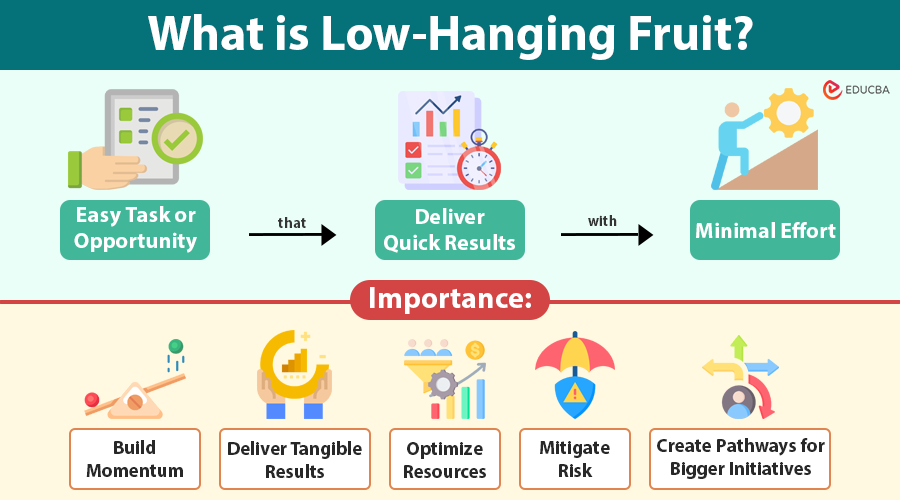
Low-hanging fruit is a business idiom that refers to the simplest and most easily achievable opportunities, tasks, or goals that require minimal effort, resources, or time to complete and deliver quick, visible, or high-impact results.
For example, a company improving its customer experience might start by fixing frequently reported issues (like website loading speed or product descriptions) before tackling larger, resource-heavy projects like complete platform overhauls.
Origin of the Phrase
The phrase comes from orchards and agriculture. Farmers harvesting fruit would naturally pick the fruit hanging on the lowest branches first because it was within easy reach, required no special tools, and gave immediate results.
This agricultural metaphor gradually made its way into the business and management vocabulary. By the mid-20th century, “low-hanging fruit” was commonly used to describe easy-to-reach opportunities in corporate, strategic, and even political contexts.
Today, it is not just a metaphor but a decision-making framework that helps professionals prioritize simpler tasks before tackling bigger, resource-heavy challenges.
Examples of Low-Hanging Fruit in Business
1. Marketing
- Adding customer testimonials, reviews, or case studies to websites to increase trust.
- Sending re-engagement emails to dormant subscribers instead of spending on paid ads.
- Improve SEO by updating page titles and meta descriptions without redesigning the whole site.
2. Sales
- Following up with past leads who showed interest but did not buy.
- Offering cross-sell or upsell opportunities to existing customers.
- Making the checkout process easier to prevent customers from leaving their carts.
3. Operations
- Automating repetitive reports instead of manually preparing them every week.
- Standardizing frequently used templates (contracts, proposals, invoices).
- Reorganizing office layout to improve workflow efficiency.
4. Human Resources
- Implementing “employee of the month” recognition instead of launching costly reward programs.
- Sending quick surveys to gauge employee satisfaction before conducting extensive research.
- Allowing flexible working hours is a simple morale booster.
5. Customer Service
- Creating an FAQs page to reduce repeated queries.
- Using chatbots to handle common questions.
- Training front-line staff on resolving common complaints effectively.
Importance of Identifying Low-Hanging Fruit
The real power of low-hanging fruit lies in strategic prioritization. By addressing the simplest, most accessible issues first, businesses and individuals can:
- Build momentum: Quick wins energize teams, reduce resistance to change, and create a sense of achievement.
- Deliver tangible results: Immediate outcomes keep stakeholders and customers engaged.
- Optimize resources: Organizations channel efforts into areas that deliver maximum return on minimal investment.
- Mitigate risk: Easier tasks typically carry lower risks compared to large-scale projects.
- Create pathways for bigger initiatives: By removing small obstacles, organizations pave the way for larger, more complex goals.
For example, a software company might begin with fixing small bugs reported by users before investing in a complete system overhaul. These small fixes improve user satisfaction quickly while buying time for long-term development.
Advantages of Targeting Low-Hanging Fruit
- Speed: Quick implementation means results are visible faster.
- Affordability: Requires minimal resources, perfect for startups or small businesses.
- Morale boost: Employees see their work translating into real improvements, boosting motivation.
- Proof of concept: Provides evidence that strategies are working before scaling up.
- Competitive edge: Even small improvements can differentiate a company in competitive markets.
- Scalability: Many small wins compound to create significant long-term gains.
Disadvantages of Over-Reliance on Low-Hanging Fruit
- Short-term thinking: Overemphasis on easy wins may neglect long-term strategy.
- Complacency: Teams may stick to comfort zones and avoid challenging projects.
- Limited ROI: Some quick wins may only provide incremental improvements.
- False sense of success: Focusing solely on small gains may make it more challenging to justify or transition into larger projects.
- Opportunity costs: Organizations may overlook bigger opportunities that require more effort in favor of easier ones.
A company that only tweaks its website design (quick win) but never invests in product innovation risks losing relevance in the long run.
Strategies to Identify and Leverage Low-Hanging Fruit
- Impact vs. Effort matrix: Sort tasks by how much effort they need and the results they give. Focus on high-impact, low-effort tasks first.
- Customer and employee feedback: Listen to recurring issues; they often point to low-hanging fruit. Example: multiple customers requesting a “save for later” option in shopping carts.
- Process audits: Identify redundant steps or bottlenecks in workflows and eliminate them quickly.
- Leverage technology: Tools like automation software, CRM systems, and AI-based chatbots often provide immediate improvements.
- Pilot projects: Start with small-scale initiatives to test results. If successful, expand them.
Real-Life Examples
- Tech industry: Startups often launch a Minimum Viable Product (MVP) to test the market before building full-scale platforms.
- Retail: Retailers might offer clearance sales to move unsold inventory quickly.
- Healthcare: Clinics sending SMS reminders for appointments reduce no-shows without complex software.
- Education: Universities recording lectures and sharing them online provides value with minimal extra investment.
Low-Hanging Fruit vs. Long-Term Goals
Both approaches are important, but they serve different purposes:
| Aspect | Low-Hanging Fruit | Long-Term Goals |
| Definition | Easily achievable tasks or opportunities requiring minimal effort and resources. | Ambitious objectives that require significant time, planning, and investment. |
| Timeframe | Short-term; quick to execute. | Long-term; may take months or years to accomplish. |
| Effort Required | Low effort, minimal complexity. | High effort, involving multiple steps and stakeholders. |
| Resource Requirement | Limited financial, human, and technological resources. | Substantial allocation of resources and infrastructure. |
| Risk Level | Low risk; outcomes are fairly predictable. | Higher risk due to complexity and external dependencies. |
| Impact | Immediate but often incremental improvements. | Sustained, transformational, and large-scale impact. |
| Purpose | Builds momentum, boosts morale, and provides quick wins. | Achieves long-lasting success and strategic growth. |
| Examples | Fixing small bugs, sending follow-up emails, optimizing website speed. | Expanding into new markets, launching a new product line, implementing digital shift. |
| Drawback | May encourage short-term focus and complacency if overused. | Requires patience, discipline, and higher tolerance for uncertainty. |
Final Thoughts
Low-hanging fruit represents opportunities that are simple, cost-effective, and quick to achieve, making them invaluable for businesses, teams, and individuals alike. When used wisely, they provide the momentum and confidence needed to pursue larger, more complex objectives.
However, relying solely on them can limit growth. The true power of this concept lies in balance, using quick wins as stepping stones toward long-term strategic achievements.
Frequently Asked Questions (FAQs)
Q1. Is focusing on low-hanging fruit a sustainable strategy?
Answer: Not on its own. Use it as a short-term tactic to complement larger goals.
Q2. Can the concept apply in personal life?
Answer: Yes. For example, decluttering one small area of your room daily is a low-hanging fruit in building a minimalist lifestyle.
Q3. What is an example in sales?
Answer: Reconnecting with past customers or warm leads instead of cold-calling random prospects.
Q4. Why is it important in project management?
Answer: Quick wins keep projects moving smoothly, secure stakeholder buy-in, and build team morale.
Q5. Does every industry have low-hanging fruit?
Answer: Yes. Whether it is healthcare, retail, technology, or education, each sector has easy-to-implement opportunities for improvement.
Recommended Articles
We hope this guide to low-hanging fruit was helpful. Explore our related articles on strategic prioritization, quick wins in business, and effective project management techniques to enhance your decision-making skills.


