


What is Long-Term Trading?
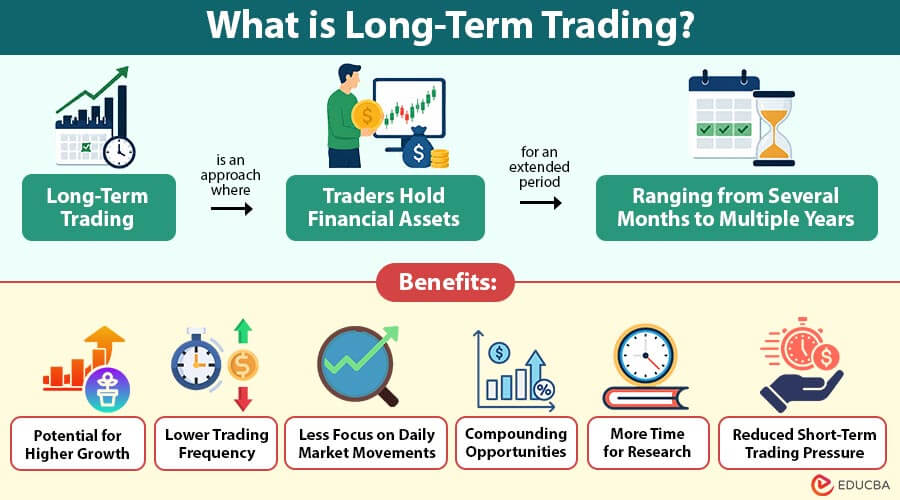
Long-Term trading is an approach where traders hold financial assets for an extended period, ranging from several months to multiple years. Instead of focusing on short-term price movements, long-term traders aim to benefit from broader market trends and an asset’s potential growth over time.
Long-term trading applies to stocks, bonds, commodities, currencies, exchange-traded funds (ETFs), and other financial instruments. Traders generally study fundamental factors, market trends, economic conditions, company performance, and industry outlook before making investment decisions.
For example, a trader may purchase shares of a financially strong company and hold them for several years, expecting the company’s earnings and market value to increase over time.
Table of Contents:
- Meaning
- Working
- Key Strategies
- Factors
- Benefits
- Risks
- Tips
- Common Mistakes
- Who Should Consider Long-Term Trading?
Key Takeaways:
- Long-term trading focuses on holding assets for months or years to benefit from broader market trends.
- Fundamental analysis, market research, and valuation help traders identify potentially suitable long-term trading opportunities.
- Diversification, risk management, patience, and regular monitoring can support disciplined long-term trading decisions.
- Market volatility, business changes, liquidity concerns, and unexpected events can affect long-term trading outcomes.
How Does Long-Term Trading Work?
Long-term trading begins with identifying an asset that can perform well over an extended period. Traders analyze the asset using fundamental and technical factors before entering a position.
The basic process includes:
1. Market Research
Traders examine economic conditions, industry performance, market trends, and asset-specific factors to identify promising long-term opportunities.
2. Asset Selection
Traders select assets showing strong growth potential, financial stability, competitive advantages, or favorable long-term market trends.
3. Entry Decision
Traders determine suitable entry points by evaluating asset valuations, market conditions, price trends, and broader economic factors.
4. Position Holding
Traders hold positions for months or years, giving assets time to achieve expected long-term growth.
5. Regular Monitoring
Traders periodically review financial performance, market conditions, industry developments, and significant events that could affect their positions.
6. Exit Decision
Traders close positions when objectives are met, the market outlook deteriorates, or potential risks outweigh expected returns.
Key Strategies for Long-Term Trading
Different strategies can help traders identify suitable long-term opportunities.
1. Fundamental Analysis
Fundamental analysis examines financial performance, economic conditions, management quality, competitive advantages, debt levels, cash flow, and future growth prospects to assess an asset’s value.
2. Trend Following
Trend-following traders identify established market directions and hold positions while trends continue, using moving averages, trendlines, momentum indicators, and price patterns to confirm them.
3. Value-Based Trading
Value-based trading focuses on identifying assets that appear undervalued relative to their financial strength, intrinsic value, or expected future performance.
4. Growth Trading
Growth traders target companies or assets with strong expansion potential, considering revenue growth, market opportunities, innovation, increasing demand, and improving profitability prospects.
5. Dividend-Focused Trading
Dividend-focused traders select companies with consistent dividend payments, seeking potential returns from both regular income distributions and long-term capital appreciation.
6. Position Trading
Position trading involves holding market positions for extended periods, allowing traders to benefit from significant price movements while focusing on broader market trends.
Factors to Consider Before Long-Term Trading
Before entering a long-term position, traders should evaluate several important factors.
1. Financial Performance
For stocks, examine revenue growth, profitability, debt levels, cash flow, and other financial indicators.
2. Market Conditions
Economic growth, interest rates, inflation, and broader market conditions can influence asset prices.
3. Industry Outlook
A strong company may still face challenges if its overall industry is declining or experiencing significant disruption.
4. Valuation
Traders should consider whether the current market price is reasonable compared with the asset’s expected future performance.
5. Risk Level
Every investment carries risk. Traders should determine how much potential loss they can tolerate before entering a position.
6. Time Horizon
A clear holding period helps traders select appropriate strategies and avoid making decisions based on temporary market movements.
Benefits of Long-Term Trading
Long-term trading can offer several benefis compared with frequent short-term trading.
1. Potential for Higher Growth
Holding quality assets for an extended period can allow traders to benefit from long-term business growth and market appreciation.
2. Lower Trading Frequency
Long-term traders generally make fewer transactions. This can reduce the impact of brokerage fees, transaction costs, and other trading expenses.
3. Less Focus on Daily Market Movements
Long-term traders do not need to react to every short-term price movement. This can help reduce emotional decisions caused by temporary market volatility.
4. Compounding Opportunities
When returns or dividends are reinvested, they can potentially generate additional returns over time. This compounding effect can become more significant over longer periods.
5. More Time for Research
Because positions are held longer, traders can spend more time analyzing company fundamentals, industry conditions, and long-term market trends.
6. Reduced Short-Term Trading Pressure
Frequent trading requires constant market monitoring. Long-term trading reduces the need to make decisions during every trading session.
Risks of Long-Term Trading
Despite its potential benefits, long-term trading also involves several risks.
1. Market Risk
Asset prices can decline because of economic changes, market downturns, geopolitical events, or unexpected developments.
2. Business Risk
For stock traders, poor management, declining sales, increasing debt, or competitive pressure can negatively affect a company’s long-term performance.
3. Opportunity Cost
Capital invested in one asset cannot be used elsewhere during the same period. A poorly performing position may therefore reduce potential opportunities.
4. Changing Market Conditions
An asset that appears attractive today may face new challenges in the future. Economic conditions, regulations, technology, and consumer preferences can change.
5. Emotional Decisions
Long holding periods can expose traders to significant price fluctuations. Fear may lead to premature selling, while excessive optimism may cause traders to ignore warning signs.
6. Liquidity Risk
Large positions may be challenging to buy or sell at the right price for certain assets due to their restricted trading volume.
Tips for Successful Long-Term Trading
Following a disciplined approach can help improve long-term trading decisions.
1. Set Clear Objectives
Define what you want to achieve before entering a trade. This may include a target return, holding period, or specific financial objective.
2. Research Before Investing
Study the asset, industry, financial performance, market conditions, and future growth prospects before deciding.
3. Diversify Your Portfolio
Spreading capital across different assets, industries, or markets can help reduce the impact of poor performance from a single investment.
4. Avoid Emotional Trading
Do not make decisions solely because of short-term market excitement or fear. Follow a predefined trading plan whenever possible.
5. Review Positions Regularly
Long-term trading does not mean ignoring investments. Review your positions periodically to see whether the original reasons for the investment still hold.
6. Manage Risk
Set an acceptable risk level and avoid putting too much capital into a single asset.
7. Stay Informed
Keep track of important economic developments, company announcements, industry changes, and other factors that may affect your positions.
8. Be Patient
Long-term strategies require patience. Short-term price declines don’t necessarily mean a long-term position has failed, as long as the underlying investment case remains strong.
Common Mistakes in Long-Term Trading
Some mistakes can undermine a long-term trading strategy.
1. Ignoring Fundamentals
Choosing assets solely based on price movements may cause traders to overlook financial weaknesses, business challenges, valuation concerns, and underlying risks.
2. Overtrading
Frequent buying and selling can increase transaction costs, create unnecessary decisions, and reduce the effectiveness of a long-term trading strategy.
3. Lack of Diversification
Investing too much capital in one asset can increase portfolio exposure and cause significant losses when that asset performs poorly.
4. Following Market Hype
Purchasing assets solely because they are popular or widely discussed can lead to emotional decisions, inflated valuations, and unexpected losses.
5. Failing to Review Investments:
Long-term positions require periodic evaluation because changing business performance, economic conditions, industry developments, and market trends can affect future prospects.
6. Expecting Guaranteed Returns
Long-term trading cannot guarantee profits because market prices may decline unexpectedly, even with careful research, analysis, planning, and disciplined decision-making.
Who Should Consider Long-Term Trading?
Long-term trading may suit individuals with a longer investment horizon who are comfortable holding positions through periods of market volatility. It can be particularly useful for traders who prefer research-based decisions and do not want to monitor markets continuously throughout the day.
However, traders should consider their financial situation, risk tolerance, objectives, and investment knowledge before choosing this approach.
Final Thoughts
Long-term trading involves holding financial assets for months or years to benefit from market trends and growth. It requires research, patience, diversification, regular monitoring, and risk management while addressing volatility, business changes, liquidity risks, opportunity costs, and unexpected market movements.
Frequently Asked Questions (FAQs)
Q1. How long is a typical long-term trading position held?
Answer: There is no fixed duration, but positions are commonly maintained for several months, years, or until the original trading thesis changes.
Q2. Can long-term trading be used for assets other than stocks?
Answer: Yes. This approach applies to various financial instruments, including ETFs, bonds, commodities, currencies, and other marketable assets.
Q3. Is it necessary to check a long-term position every day?
Answer: Not necessarily. Long-term traders can monitor important developments periodically instead of reacting to every daily price fluctuation.
Q4. Does long-term trading require technical analysis?
Answer: Technical analysis is not mandatory, but some traders use price charts, momentum indicators, and trend patterns to support their entry or exit decisions.
Recommended Articles
We hope that this EDUCBA information on “Long-Term Trading” was beneficial to you. You can view EDUCBA’s recommended articles for more information.

