
What is Quantitative Trading?
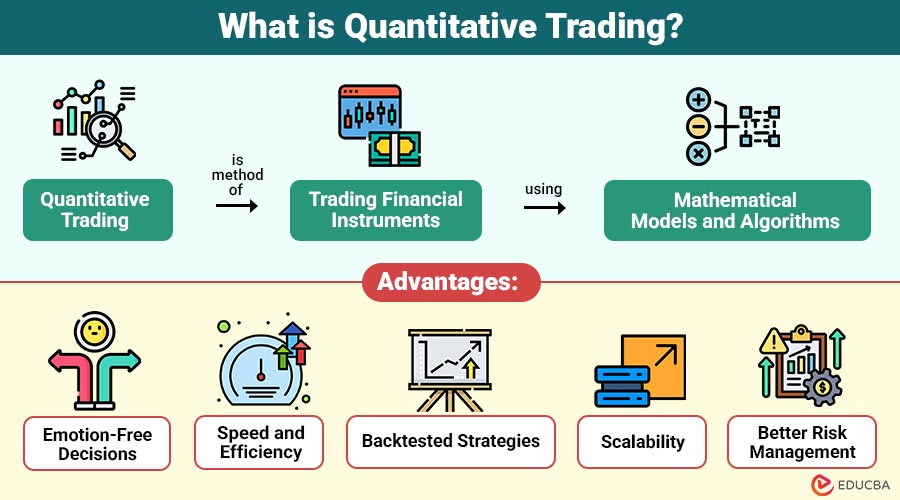
Quantitative trading is method of trading financial instruments using mathematical models and algorithms. These models analyze large datasets such as price movements, trading volume, and historical patterns to generate buy or sell signals.
For example, instead of a trader saying, “This stock looks strong,” a quantitative model might say:
- Buy if the price crosses the 50-day moving average.
- Sell if volatility exceeds a threshold.
- Hold if momentum indicators remain stable.
Table of Contents:
- Meaning
- Working
- Key Components
- Strategies
- Advantages
- Limitations
- Skills Required
- Tools
- Is Quantitative Trading Profitable?
- How Can Beginners Start Quantitative Trading?
- Real-World Example
Key Takeaways:
- Quantitative trading utilizes the mathematical models and algorithms to make data-driven trading decisions.
- It relies on data analysis, backtesting, and automation for executing strategies efficiently.
- Success depends on model quality, data accuracy, market conditions, and risk management.
- It helps remove emotional bias from trading decisions, leading to more disciplined and consistent execution.
How Does Quantitative Trading Work?
Quantitative trading follows a structured process:
1. Data Collection
Traders collect large datasets, including historical prices, volumes, economic indicators, news sentiment, and company financial information.
2. Strategy Development
Mathematical models are built using statistical techniques, financial theories, regression, time-series analysis, and machine learning methods, algorithms, and frameworks.
3. Backtesting
Strategies are tested on historical data to evaluate performance, risks, returns, and overall robustness before the live deployment phase.
4. Execution
Algorithms automatically execute trades in real-time based on predefined rules, ensuring speed, accuracy, and a consistent, disciplined trading system.
5. Risk Management
Risk controls reduce losses through stop-loss levels, position-sizing rules, diversification strategies, and continuous portfolio-monitoring systems.
Key Components of Quantitative Trading
Here are the key components that make quantitative trading work effectively in real financial markets:
1. Algorithms
Algorithms are sets of rules that decide when to buy or sell assets, forming core trading systems automatically
2. Statistical Models
These models help identify patterns and predict price movements using probability and historical trends in financial markets data
3. High-Frequency Trading
A subset of quantitative trading where trades are executed in milliseconds to profit from small price change opportunities
4. Machine Learning
Modern quantitative trading often uses AI models that learn from data and improve predictions over time, continuously adapting
5. Data Analysis & Data Feeds
Quantitative trading relies heavily on large volumes of real-time and historical market data. Clean, accurate, and timely data feeds help traders make informed decisions and improve model accuracy.
6. Risk Management Systems
These systems help prevent potential losses by setting limits, monitoring exposure, and applying safeguards such as stop-loss rules. They ensure that trading strategies remain stable even during volatile market conditions.
Popular Quantitative Trading Strategies
Here are some of the most widely used strategies in quantitative trading that help traders generate systematic profits:
1. Mean Reversion Strategy
Prices eventually return to average levels; traders buy low and sell high, expecting temporary deviations to correct over time.
2. Momentum Trading Strategy
Traders follow ongoing price trends, buying rising assets and selling falling ones, expecting the current market direction to continue.
3. Arbitrage Strategy
Exploits price differences of identical assets across markets, buying low in one exchange and selling higher elsewhere instantly.
4. Machine Learning-Based Strategies
AI models use random forests, decision trees, and neural networks to examine intricate market data patterns in order to make predicted trading judgments.
Advantages of Quantitative Trading
Here are the major advantages that make quantitative trading widely used in modern financial markets:
1. Emotion-Free Decisions
Quantitative trading uses data-driven models that completely remove fear, greed, and emotional bias from investment decisions.
2. Speed and Efficiency
Algorithms process huge datasets and execute trades in milliseconds, far faster than any human trader can achieve manually.
3. Backtested Strategies
Strategies are first tested on historical market data, helping traders evaluate performance and reduce real-world financial risk.
4. Scalability
A single quantitative model can simultaneously analyze and trade thousands of securities across multiple markets without additional effort.
5. Better Risk Management
Automated systems continuously monitor positions and enforce strict risk controls, such as stop-losses, position sizing, and exposure limits.
Limitations of Quantitative Trading
Here are some limitations associated with quantitative trading:
1. Overfitting Risk
Models may fit past data very well but often fail to perform accurately in real, changing market conditions.
2. High Complexity
It requires strong skills in programming, statistics, data analysis, and financial market understanding to build effective models.
3. Dependence on Data Quality
If input data is incorrect, incomplete, or noisy, the model’s predictions can become unreliable or misleading.
4. Market Changes
Financial markets constantly evolve, so strategies that worked earlier may become less effective over time.
5. High Infrastructure Cost
Quantitative trading needs advanced computing systems, fast internet, and low-latency infrastructure, making it expensive.
Skills Required for Quantitative Trading
To become a quantitative trader, you need a mix of technical and financial skills:
1. Technical Skills
- Python or R programming
- Data analysis
- Machine learning
- Statistics and probability
2. Financial Knowledge
- Market structure
- Derivatives and securities
- Risk management
3. Analytical Thinking
- Problem-solving ability
- Logical reasoning
- Pattern recognition
Tools Used in Quantitative Trading
Some commonly used tools include:
1. Python Libraries (Pandas, NumPy, SciPy)
Used for data analysis, mathematical computations, and building trading models efficiently.
2. MATLAB
Helps in advanced numerical analysis, modeling, and simulation of financial trading strategies.
3. R Programming
Used for statistical analysis, data visualization, and building predictive financial models.
4. Bloomberg Terminal
Provides real-time financial data, news, analytics, and professional trading insights for decision-making.
5. MetaTrader Platforms
Popular for algorithmic trading, chart analysis, and automated trading strategy execution in forex markets.
6. SQL Databases
Used to store, manage, and retrieve large volumes of financial and historical market data efficiently.
Is Quantitative Trading Profitable?
Quantitative trading can be highly profitable, but it is not a guaranteed way to make money. Success depends on:
1. Quality of the Model
Profitability depends heavily on how well the trading model is designed, tested, and optimized for real market conditions.
2. Data Accuracy
High-quality, clean, and timely data is essential because incorrect or missing data can lead to poor trading decisions and losses.
3. Market Conditions
Changing market trends, volatility, and economic events directly impact strategy performance, making adaptability crucial for consistent profitability.
4. Risk Management
Effective risk controls like position sizing, stop-loss rules, and diversification help protect capital and maintain long-term trading profitability.
How Can Beginners Start Quantitative Trading?
If you are new, follow these steps:
Step 1: Learn Programming
Start with Python, as it is widely used in finance.
Step 2: Understand the Basics of Finance
Learn about stocks, bonds, and market behavior.
Step 3: Study Statistics
Focus on probability, regression, and distributions.
Step 4: Practice Backtesting
Try simple strategies on historical data.
Step 5: Use Simulated Trading
Start with paper trading before risking real money.
Real-World Example
Below is a real-world example that illustrates how quantitative trading works in practice.
Quantitative trading is the Medallion Fund at Renaissance Technologies, which uses mathematical models and algorithms to automatically trade based on data patterns rather than human decisions.
Final Thoughts
Quantitative trading uses mathematics, programming, and finance to create data-driven, algorithmic trading systems that improve speed and accuracy. It is not a quick way to get rich; it requires skills, learning, and discipline. With advancing technology, it will grow more powerful and accessible, shaping the future of global financial investing.
Frequently Asked Questions (FAQs)
Q1. Do I need coding for quantitative trading?
Answer: Yes, programming (especially Python) is essential for building and testing strategies.
Q2. Can beginners start quantitative trading?
Answer: Yes, but they should first learn basic finance, statistics, and coding.
Q3. Is quantitative trading risky?
Answer: Yes, like all forms of trading, it involves risk. Poorly designed models can lead to losses.
Q4. Which markets use quantitative trading?
Answer: It is used across stock, forex, commodity, and cryptocurrency markets.
Recommended Articles
We hope that this EDUCBA information on “Quantitative Trading” was beneficial to you. You can view EDUCBA’s recommended articles for more information.

