


What is Scalping Trading?
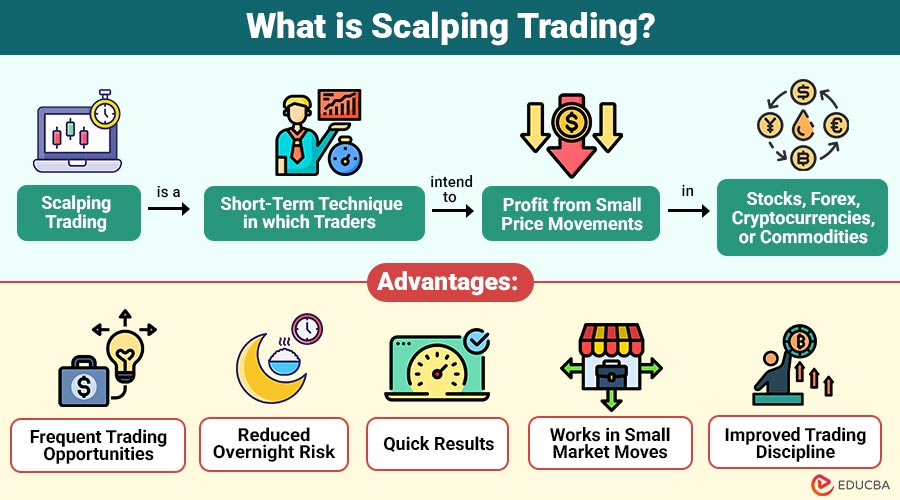
Scalping trading is a short-term technique in which traders intend to profit from small price movements in stocks, forex, cryptocurrencies, or commodities. A scalper usually opens multiple trades during a single trading session and closes them quickly after earning a small profit.
Unlike swing trading or position trading, scalping does not focus on large market moves. Instead, it relies on high trade frequency and quick execution.
For example, a trader may buy a stock at ₹500 and sell it at ₹501 within a few minutes. Though the profit per trade is small, repeating such trades several times can generate meaningful returns.
Table of Contents:
- Meaning
- Working
- Key Features
- Types
- Best Markets
- Common Strategies
- Important Indicators
- Advantages
- Disadvantages
- Tools
- Is Scalping Trading Profitable?
Key Takeaways:
- Scalping trading focuses on earning small profits through multiple rapid trades during active market sessions.
- Successful scalping requires discipline, technical analysis skills, quick execution, and consistently strong risk management strategies.
- Highly liquid markets with tight spreads offer better opportunities for profitable, efficient scalping.
- Scalping involves high stress, frequent monitoring, and fast decision-making in consistently volatile short-term market conditions.
How Does Scalping Trading Work?
Here are the key steps involved in how scalping trading works in fast-moving financial markets.
1. Identifying a Highly Liquid Market
Traders consistently choose highly liquid markets with tight spreads and strong volatility for frequent short-term trading opportunities.
2. Monitoring Short-Term Price Movement
Scalpers closely monitor short-term price fluctuations using charts, indicators, and technical analysis tools continuously during trading sessions.
3. Entering a Trade Quickly
Traders execute trades rapidly whenever favorable market conditions and reliable entry signals appear during active trading periods.
4. Exiting After Reaching Small Profit Targets
Scalpers close trades immediately after hitting small profit targets to minimize risk and secure consistent returns.
5. Repeating the Process Multiple Times
Scalpers repeat trades several times daily to effectively accumulate small profits from continuous short-term price movements.
Key Features of Scalping Trading
Below are the key features of scalping trading:
1. Trade Duration
Scalping trades usually remain open for several seconds or minutes, focusing consistently on rapid market movement opportunities.
2. Profit Target
Rather than waiting for significant price changes, scalpers aim for tiny but frequent profits from individual deals.
3. Number of Trades
Scalping involves placing numerous trades daily to capitalize on continuous short-term market fluctuations throughout the trading session.
4. Risk Exposure
Short holding periods significantly reduce exposure to unexpected market volatility, overnight risks, and sudden unfavorable price movements.
5. Analysis Type
Scalpers consistently rely on technical analysis, price charts, indicators, and market patterns for accurate trading decisions.
6. Market Requirement
Successful scalping requires highly liquid, volatile markets that consistently provide frequent trading opportunities and fast order execution.
Types of Scalping Trading
Below are the major types of scalping trading commonly used by short-term traders in financial markets.
1. Manual Scalping
In manual scalping, traders personally analyze charts and execute trades. This method requires constant monitoring and fast reactions.
2. Automated Scalping
Automated scalping uses trading bots or algorithms to place trades automatically based on predefined rules. It reduces emotional decision-making and improves speed.
3. Momentum Scalping
Momentum scalpers trade during strong market movements caused by news, earnings reports, or sudden volatility.
4. Market-Making Scalping
To profit from bid-ask spread, this approach entails placing buy and sell orders simultaneously.
Best Markets for Scalping Trading
Below are some of the best financial markets commonly preferred by traders for successful scalping trading strategies.
1. Forex Market
The forex market offers high liquidity, tight spreads, and continuous trading hours, making it highly suitable for scalping strategies.
2. Stock Market
Scalpers prefer active stocks with high trading volume, rapid price fluctuations, and strong intraday market movement opportunities daily.
3. Cryptocurrency Market
Cryptocurrency markets experience extreme volatility, allowing scalpers to capture quick profits from frequent short-term price movements efficiently.
4. Futures Market
Futures markets provide leverage, excellent liquidity, and fast execution, attracting experienced traders who regularly use advanced scalping techniques.
Common Scalping Trading Strategies
Below are some widely used scalping trading strategies that help traders identify quick entry and exit opportunities.
1. Moving Average Strategy
Traders use short-term moving averages to identify trends and entry points.
Common combinations include:
- 5 EMA and 20 EMA
- 9 EMA and 21 EMA
When the shorter moving average crosses above longer one, traders may enter a buy position.
2. RSI Scalping Strategy
Relative Strength Index (RSI) helps identify overbought and oversold conditions.
- RSI above 70 may indicate overbought conditions
- RSI below 30 may indicate oversold conditions
Scalpers use these signals for quick trade entries and exits.
3. Breakout Scalping
This strategy focuses on trading price breakouts from support or resistance levels. Scalpers enter trades when the price breaks a key level with strong volume.
4. Bollinger Bands Strategy
Bollinger Bands help measure market volatility.
Traders may:
- Buy near the lower band
- Sell near the upper band
This strategy works best in range-bound markets.
Important Indicators for Scalping Trading
Technical indicators play a major role in scalping decisions.
1. Moving Averages
Moving averages help scalpers quickly identify short-term market trends and potential entry or exit trading opportunities.
2. Relative Strength Index
Relative strength index measures momentum strength and helps traders identify possible reversal zones during volatile short-term market conditions.
3. Moving Average Convergence Divergence
Moving average convergence divergence indicates trend direction, momentum strength, and potential crossover signals for short-term scalping trade decisions effectively.
4. Volume Weighted Average Price
Volume weighted average price helps traders evaluate average trading prices and identify fair intraday market value during active trading sessions.
5. Stochastic Oscillator
Scalpers can more accurately forecast potential short-term price reversals by using a stochastic oscillator to identify overbought and oversold market circumstances.
Advantages of Scalping Trading
Scalping offers several advantages for active traders.
1. Frequent Trading Opportunities
Scalpers execute multiple trades daily, increasing opportunities to earn consistent profits from small market price fluctuations regularly.
2. Reduced Overnight Risk
Trades remain open briefly, reducing exposure to overnight market volatility, unexpected news events, and sudden price gaps.
3. Quick Results
Scalping delivers fast trading outcomes, allowing traders to realize profits or losses within short time periods quickly.
4. Works in Small Market Moves
Scalpers profit from minor price fluctuations without requiring large trends or significant long-term market directional movements consistently.
5. Improved Trading Discipline
Scalping demands strict discipline, quick decision-making, and effective risk management, improving overall trading performance and consistency.
Disadvantages of Scalping Trading
Despite its benefits, scalping also has disadvantages.
1. High Stress Levels
Scalping requires rapid decisions and constant monitoring, which can create significant mental pressure and emotional stress daily.
2. Transaction Costs
Frequent trades increase brokerage commissions, spreads, and other transaction costs, potentially reducing overall trading profitability significantly.
3. Requires Strong Focus
Scalpers must closely monitor charts, indicators, and price movements continuously to identify profitable short-term trading opportunities effectively.
4. Limited Profit per Trade
Each scalping trade produces small profits, requiring consistent accuracy and disciplined execution for meaningful long-term trading success.
5. Risk of Overtrading
Excessive trading activity may trigger emotional decisions, poor risk management, and unnecessary losses during volatile market conditions frequently.
Tools Used in Scalping Trading
Professional scalpers often use advanced tools for faster execution.
1. Trading Platforms
Professional scalpers use advanced platforms like MetaTrader, TradingView, and NinjaTrader for fast trade execution and market analysis.
2. Real-Time Charts
Real-time charts provide instant market updates, helping scalpers identify trends, price movements, and quick trading opportunities accurately.
3. Economic Calendars
Economic calendars track important financial events and news releases that create volatility and profitable short-term scalping opportunities frequently.
4. High-Speed Internet
Reliable high-speed internet ensures accurate order execution, reduced latency, and faster responses during rapid market fluctuations and trades.
Is Scalping Trading Profitable?
Scalping trading can be profitable when combined with:
1. Strong Technical Analysis
Accurate technical analysis helps scalpers identify profitable entry points, market trends, and short-term trading opportunities consistently.
2. Consistent Discipline
Consistent discipline enables traders to follow strategies strictly without emotional decisions affecting trading performance negatively regularly.
3. Effective Risk Management
Proper risk management minimizes potential losses and protects trading capital during volatile and unpredictable market conditions effectively.
4. Fast Trade Execution
Fast trade execution helps scalpers enter and exit positions quickly before market conditions suddenly change unexpectedly.
Final Thoughts
Scalping trading is a fast-paced strategy focused on earning small profits from short-term market movements. It requires discipline, technical analysis, quick execution, and strong risk management. Beginners should practice using demo accounts and simple strategies before live trading. With experience, scalping can offer consistent opportunities across forex, stocks, cryptocurrencies, and futures markets.
Frequently Asked Questions (FAQs)
Q1. Which market is best for scalping?
Answer: Forex and highly liquid stock markets are commonly preferred for scalping due to tight spreads and strong liquidity.
Q2. How much time does scalping require?
Answer: Scalping requires continuous market monitoring during trading hours because trades happen very quickly.
Q3. What indicators are commonly used in scalping?
Answer: Popular indicators include RSI, moving averages, MACD, VWAP, and Bollinger Bands.
Q4. Is scalping risky?
Answer: Yes, scalping involves high risk because of rapid trading, leverage, and market volatility. Proper risk management is essential.
Recommended Articles
We hope that this EDUCBA information on “Scalping Trading” was beneficial to you. You can view EDUCBA’s recommended articles for more information.


