


Local Search Visibility to Rank Higher Locally
To increase your online visibility, your business needs to stand out from the competition. Developing a local search marketing strategy focused on SEO can be challenging, especially when your goal is to attract high-quality traffic ready to purchase. Improving local search visibility enables businesses to capitalize on opportunities, regardless of how crowded their marketplace is. SEO is not about flipping a few switches it is an ongoing, multi-layered process that ensures your content matches what users are searching for. When this alignment happens, your content has a much better chance of being seen.
Search behaviors have evolved. Mobile-initiated voice searches, like “best emergency dentist near me” or “that dentist beginning with H on the High Street,” are becoming more common. This shift gives small businesses a valuable opportunity to boost local search visibility and attract ready-to-buy customers.
Local SEO: What it is and Why You Need it?
Local SEO enhances your online visibility so people in your area can quickly find your business when they search for relevant products or services. Unlike general SEO, it prioritizes search visibility within a specific geographic area. With the rise of mobile searches, Google increasingly considers the user’s proximity to your business as a key ranking factor. AI is also transforming local search, as platforms leverage a deeper understanding of user intent, location signals, and behavior patterns to deliver hyper-local results. This means small businesses must optimize their SEO not only for location but also for how AI interprets and presents information to users.
AI is very useful in SEO, particularly AI brand visibility tracking tools, which help businesses understand how their brand comes across in different digital environments, like ChatGPT or Google AI. Moreover, these tools provide invaluable data on the business’s true market position, as knowing your audience opens the door to the benefits of market segmentation.
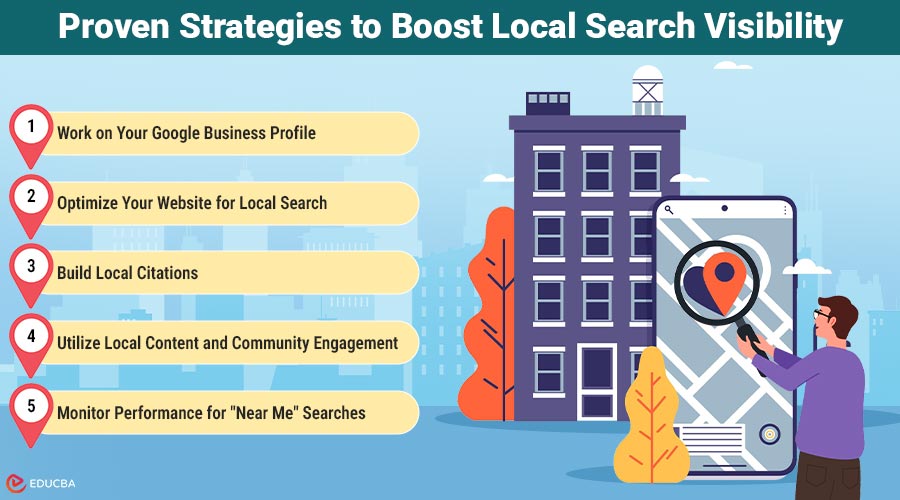
Proven Strategies to Boost Local Search Visibility
Here are key actionable points you can follow to enhance your local presence and attract more nearby customers:
1. Work on Your Google Business Profile
Even with changes in search behavior, your Google Business Profile (GBP) remains the cornerstone of achieving strong local search visibility. It is a free tool, yet when used correctly, it can place your business in three key areas: the local pack, Google Maps, and organic search results. Getting started is straightforward. First, verify your business this step instantly establishes credibility in Google’s eyes. Once verified, complete your business information, including a concise yet informative description. Choosing the correct category is critical; an inaccurate or vague category can limit visibility and mislead potential customers.
High-quality images are essential. They not only make your profile attractive and professional but also indicate to Google that your business is active. Profiles with recent images often perform better in search results. Regularly posting updates whether about special offers, events, or news signals engagement and keeps your audience informed. Enabling features like messaging helps, but responding to both positive and negative reviews has a greater impact by showing responsiveness and reliability.
2. Optimize Your Website for Local Search
Your website and GBP must work together as a unified strategy to enhance local search visibility. Optimizing one without the other can significantly limit your SEO potential. Consistency is key ensure your website communicates the same details about your business as your GBP, including the Name, Address, and Phone Number (NAP). For multi-location businesses, each location should have its own page with unique, location-specific content. Incorporating local terms and points of interest in your content helps users find you faster and improves search rankings.
Technical SEO plays a major role. Ensure that page titles, meta descriptions, and header tags contain relevant local keywords. Implementing LocalBusiness schema markup helps search engines better interpret your business details and display them accurately in search results. Mobile optimization is no longer optional. Since most users browse on mobile devices, your site should load quickly and offer smooth, easy navigation. Features like tappable phone numbers, large buttons, and minimal pop-ups are crucial. A poorly optimized mobile site drives users away, sends negative signals to search engines, and reduces your local search performance.
3. Build Local Citations
Citations, which are mentions of your business on other websites or directories, help strengthen your local presence. This can include listings on platforms such as Yelp, social media profiles, and industry-specific directories. Consistency in your NAP information across all citations is essential, as even minor discrepancies like abbreviating “Street” differently can confuse search engines and negatively impact rankings.
Using citations is a friendly way of developing your small business marketing in ways that will support your local visibility long term. First, review your current online presence to identify all the places your business appears, and ensure every detail is up to date. Focus first on high-traffic platforms like Google, Facebook, and Yelp, and then expand to smaller, niche directories. Including your business in local associations or the chamber of commerce adds credibility and signals that you are an active member of the community. Consistent, well-maintained citations provide a strong foundation for long-term marketing efforts and enhance your business’s visibility in your local area.
4. Utilize Local Content and Community Engagement
Content tailored to your community resonates best with local audiences and helps build trust. Local content can include stories about community events, customer success stories, reviews, testimonials, or even updates about local conditions that affect your business. Relevant content builds connections, establishes authority, and enhances trust in your brand.
Authenticity is key. Your content should clearly reflect that your business is active and engaged within the local community. Posting regularly, using relevant hashtags, geotagging locations, and sharing updates across local social media groups all contribute to greater visibility. In addition to posting, participate in local online forums, respond to inquiries, and partner with nearby businesses to increase your visibility. Engagement strengthens relationships and gives potential customers multiple touchpoints to interact with your brand.
5. Monitor Performance for “Near Me” Searches
High-intent searches, often phrased as “near me,” are increasingly common and can generate immediate customer leads. Optimizing for this type of search may include embedding Google Maps on your site or using location-specific listing services. Tracking performance through tools such as Google Analytics and insights from your GBP helps identify which areas of your marketing strategy are most effective. These tools provide detailed metrics, including website visits, clicks, calls, direction requests, and engagement levels.
Tracking user interactions and top-performing pages helps you make informed adjustments and boost overall site effectiveness. Additionally, analyzing performance across different locations in your service area helps you understand how effectively people are finding your business locally. By combining an optimized Google Business Profile, a user-friendly website, consistent citations, engaging local content, and performance monitoring, businesses can significantly enhance their visibility to nearby customers and create a stronger, more authoritative local presence.
Common Local SEO Mistakes to Avoid
When optimizing for local search visibility, businesses often make mistakes that can negatively impact performance. Here are the key pitfalls to watch out for:
1. Inconsistent NAP Information: Check that your business Name, Address, and Phone number (NAP) are consistent across all platforms. Inconsistencies confuse search engines and users, reducing credibility and harming rankings.
2. Incomplete Google Business Profile (GBP) Setup: Fully set up your GBP with accurate business details, categories, images, and descriptions. Regularly update your profile to maintain strong visibility and engagement.
3. Ignoring Customer Reviews: Responding to all reviews, whether positive or negative, signals that you appreciate and take customer feedback seriously. Ignoring reviews can signal disinterest in the customer experience and damage your reputation.
4. Keyword Stuffing: Overloading content with keywords can make it sound unnatural and negatively affect search rankings. Prioritize content that is useful, informative, and easy for your audience to read.
5. Poor Mobile Optimization: Ensure your website is mobile-friendly, with fast load times, easy navigation, and a responsive design. Mobile issues frustrate users and increase bounce rates, potentially affecting your search rankings.
6. Neglecting Other Platforms: Do not rely solely on Google; expand your presence to social media, local directories, and niche platforms. A multi-channel approach strengthens your local visibility and broadens your reach.
7. Slow Page Load Times or Difficult Navigation: Optimize your website for speed and ease of use. Complex navigation or an unresponsive design can discourage users and reduce engagement.
Final Thoughts
The rapid pace of AI development and its integration into the ecommerce industry requires you to rethink your local search marketing strategy. This requires more than just integrating new tools into your system. This revolution is necessary and satisfies the evolving behaviors of potential clients and the growing capabilities of your competition. To find success and maintain your local visibility, you have to focus on optimization as an iterative process, not just a simple checklist.
Recommended Articles
We hope this guide to improving local search visibility helps your business reach more nearby customers. Check out these recommended articles for additional tips and strategies to boost your online presence.

