

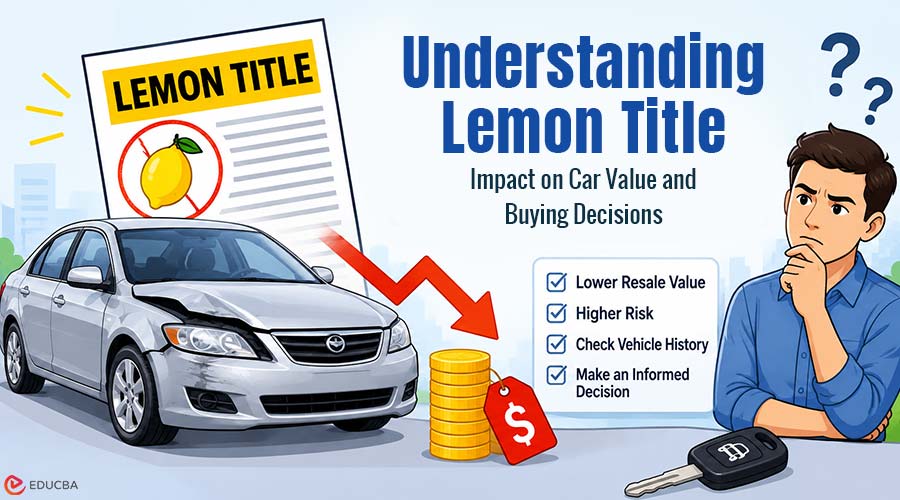
A used car listed thousands below its rivals looks like a win until you spot two words on the paperwork. If the history report shows a lemon title, the manufacturer bought the car back because of a defect that repeated repairs could not fix, and that history follows it for life. The discount is real. So are the costs that come with it, and they do not all show up on the sticker.
This guide treats a lemon title the way you would treat any other financial decision: what you gain, what you give up, and how to run the numbers before you sign.
What is a Lemon Title and How Does it Work?
Every state has a lemon law. Rules differ by state, but the basic principle remains the same. When a new vehicle develops a major warranty-covered problem that the manufacturer fails to resolve despite several repair attempts, the owner may qualify for protection under lemon law and can make the manufacturer buy the car back or replace it.
That is not the end of the car’s life. Manufacturers usually repair buyback vehicles and send them back to auction, where they end up on dealer lots. Before that happens, most states require a branded title so the next buyer knows the history. The label differs by state. You may see “Lemon Law Buyback,” “Manufacturer Repurchase,” or simply “Lemon.” Some states also require a disclosure form that the buyer signs. The brand is usually permanent. Even after a full repair, the title keeps a record.
How Much Value Does a Lemon Title Take Off?
Expect a lemon-titled car to sell for roughly 15% to 40% less than a comparable car with a clean title. There is no official industry figure.
Where a car falls in that range depends on three things:
- The defect itself: A recurring infotainment glitch scares buyers far less than a transmission or electrical fault.
- The brand and model: Cars with strong reliability reputations tend to hold more value, even with a brand on the title.
- The local market: In tight used-car markets, buyers forgive more.
The Math Most Buyers Skip
Here is the part that matters most to your wallet. The discount does not disappear when you buy the car. It goes with the car. Say a clean-title car costs $28,000, and the lemon-titled one is listed at $21,000. That is a 25% discount and $7,000 saved on day one. Now picture selling both cars four years later. If the clean car is worth $16,000 by then, the branded one may bring in only $11,000 or $12,000, because the next buyer will want a discount too.
So your real savings are not $7,000. They are closer to $3,000 or $4,000, and that is before any extra repairs, insurance costs, or a higher loan rate. A lemon title can still be a smart buy. It is just a smaller win than the listing price suggests, and the numbers work best for people who plan to keep the car until it is worn out.
Financing and Insurance: The Hidden Friction
Two costs catch buyers off guard:
Financing: Some lenders will not finance branded-title vehicles at all. Others will, but they may lend less against the car’s value or charge a higher rate, since the car is harder to resell if they ever have to repossess it. Get your financing pre-approved before you fall in love with the car.
Insurance: Most insurers will cover a lemon-titled car for liability. Full coverage can be harder to get, and if the car is totaled, the payout is based on its market value, which is the branded value, not what a clean-title car would be worth. Call your insurer with the VIN before you buy.
When a Lemon Title Can Make Sense?
There are buyers for whom the numbers work:
- The defect was minor or clearly fixed, with documentation to prove it.
- You plan to keep the car for many years, so resale value matters less.
- The manufacturer repaired it and backs it with a warranty, which some do on buyback vehicles.
- You pay cash, so lender rules do not apply.
- If none of those describe you, a clean-title car at a higher price may cost less in the long run.
How to Check for a Lemon Title Before Buying a Car?
Do not rely on the seller. Title brands can slip through the cracks, especially when a car moves between states with different branding rules.
Protect yourself with a few checks:
- Run a vehicle history report using the VIN. Look for words like “buyback,” “repurchase,” or “lemon.”
- Search the National Motor Vehicle Title Information System (NMVTIS), a federal database that tracks title brands across states.
- Ask for the repair records from the original buyback. You want to know what failed and how it was fixed.
- Pay for an independent pre-purchase inspection, and point the mechanic to the original defect.
- Read every disclosure form before signing, and keep copies.
What If You Already Bought One Without Knowing?
Many states require dealers to disclose a manufacturer buyback before the sale. If you find out after the fact that your car has a lemon title and nobody told you, you may have a claim. The same goes if the car you bought new keeps going back to the shop for the same problem. Either way, talk to a lemon law attorney in your state. Many work on contingency, and in many states the manufacturer pays the attorney’s fees when the consumer wins.
Final Thoughts
A lemon title is neither a scam nor a bargain by default. It is a trade. You pay less up front, and you accept lower resale value, possible financing and insurance hurdles, and some repair risk. Run the numbers over the full time you expect to own the car, check the history yourself, and buy with your eyes open. That is how a lemon title stops being a trap and becomes a decision you made on purpose.
Recommended Articles
We hope this comprehensive guide to lemon title helps you understand its impact on car value, resale, financing, and insurance. Check out these recommended articles for more insights and tips to make informed car-buying decisions.