


Why Connected Meetings Lead to Stronger Business Outcomes?
Teams make decisions, set priorities, and shape strategies in meetings. Yet for many companies, meetings are also where productivity disappears. People discuss ideas but never document them, agree on decisions but forget them, and leave absent colleagues struggling to catch up. Over time, this lack of follow-through erodes both momentum and accountability. To reverse this, organizations are rethinking meetings as more than just scheduled conversations—they are treating them as connected workflows. This is why modern project management tools place meetings at the center of collaboration, linking discussions directly to tasks, data, and outcomes. Lark connected meetings embody this approach.
By connecting meetings with scheduling, task management, communication, documentation, and data, Lark ensures that the time teams spend together leads to measurable progress. Instead of meetings ending in ambiguity, they conclude with clarity, alignment, and action.
Key Features That Make Lark Connected Meetings Effective
Unlike traditional meetings, Lark connected meetings transform discussions into connected workflows. Instead of ending in ambiguity, meetings conclude with clarity and actionable next steps. Here is how Lark makes it possible:
1. Lark Meetings: Capturing Decisions as They Happen

Image Source: Lark
Traditional meetings first faced retention challenges. People often wrote decision points as separate notes—or worse, did not write them down at all. Later, when recalling decisions, participants had varying memories, and any absent participants had no visibility. They embed documentation within the meeting itself by simply using Lark Meetings. Special calls are hosted within the platform, scheduled directly with Calendar, and automatically notated by AI.
AI creates notes summarising the conversation and the actions, plus a transcript. Rather than relying on memory for decisions, they can simply navigate back within that shared context. The video recordings are also shareable in Messenger, making decisions visible to any participants who were unable to attend. Meetings transform from fleeting events into lasting assets.
2. Lark Calendar: Aligning Meetings with Priorities

Image Source: Lark
Meetings are meaningless if they do not connect to an organizational priority. Suppose meeting schedules do not align with work process schedules. If meeting schedules do not align with work processes, timing becomes difficult or even impossible to manage. Teams may repeat conversations thoughtlessly or shift them after agreeing on deadlines. Lark Calendar stops this from happening because it builds meetings directly into the work process.
Calendars directly import project deadlines from Tasks and milestones from Base, enabling teams to schedule meetings in relation to their work, rather than just chronologically. Shared visibility surrounds when meetings must occur to engage in critical conversations or critical decision-making to support project milestones. Availability views help streamline all coordination. Meetings do not get planned in isolation through Calendar because meetings become prioritized against work progress. Not only does this make meetings more timely, but it also supports a more productive conversation.
3. Lark Tasks: Ensuring Follow-Ups are Clear and Accountable
A major reason meetings underdeliver is the failure to assign ownership for follow-ups. People share ideas, but unless they turn them into tasks, the ideas disappear into the background. Lark Tasks makes follow-through seamless.
Teams can convert action items from meetings directly into tasks with owners, deadlines, and statuses. These tasks are visible to everyone, reducing the risk of forgotten commitments. Updates happen automatically, so managers do not need to chase reminders. By turning discussion into responsibility, Tasks ensures that the accountability gap after meetings is closed.
4. Lark Messenger: Keeping Meeting Outcomes in the Conversation Flow
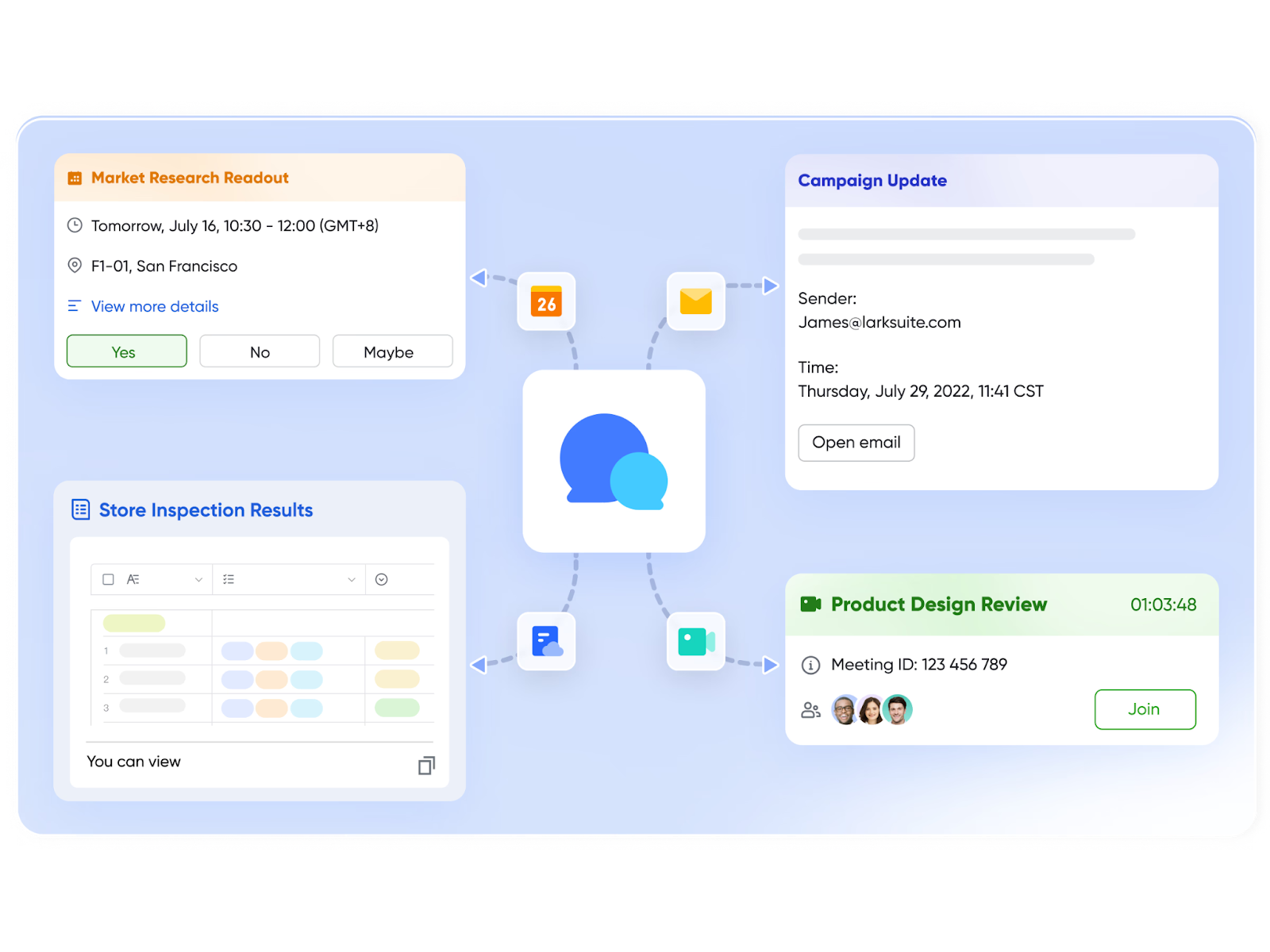
Image Source: Lark
Teams may lose even well-documented decisions if they do not share them in the right place. A worker who missed the meeting may have no idea how to find the notes, and updates can also get buried in email threads. Lark Messenger takes outcomes directly into daily communications.
Meeting notes, recordings, and action items are easily shareable within team chat, pinnable for your teammates to find easily later, or connected to an ongoing thread. This makes meeting outcomes part of the natural flow of collaboration, rather than static files that get hidden away later. Using Lark Messenger ensures that an outcome from a meeting has ongoing influence and involvement among a team long after the call has ended.
5. Lark Docs: Preserving Meeting Insights as Institutional Knowledge

Image Source: Lark
Meetings often surface insights that are valuable beyond a single project. Yet without a structured way to preserve them, these insights fade over time, forcing teams to rediscover the same lessons. Lark Docs provides a space to store and refine meeting outputs into lasting content.
Strategy sessions can become playbooks, brainstorming sessions can become proposals, and recurring discussions can evolve into policies. With Wiki view, these materials can be organized into a searchable knowledge base, making them accessible to new employees or future projects. By capturing knowledge in Docs, organizations ensure that meetings contribute not only to immediate outcomes but also to long-term learning.
6. Lark Base: Connecting Meeting Discussions to Data- Driven Decisions

Image Source: Lark
Strong business outcomes depend on decisions grounded in reliable data. But when meetings rely on conflicting spreadsheets or siloed tools, conversations quickly stall. Participants spend more time debating numbers than deciding what to do next.
Lark Base eliminates this by centralizing data in a single environment. Teams can manage workflows in Kanban boards, tables, or timelines, with updates reflected instantly. This shared source of truth means meetings focus on action, not reconciliation. Moreover, Base reflects the principles of business process management software by ensuring that processes remain visible and consistent. When discussions are grounded in accurate data, decisions yield stronger business outcomes.
Final Thoughts
Disconnected meetings drain energy and delay progress. Without clear notes, aligned schedules, accountable follow-ups, or reliable data, discussions fail to deliver the outcomes businesses need. When teams connect meetings across the workflow, they turn into engines of productivity and alignment. Lark connected meetings make this possible. Meetings document decisions in real-time, calendars align them with priorities, Tasks ensure accountability, the Messenger keeps outcomes within the conversation flow, Documents and Wikis preserve insights, and Base connects discussions to reliable data.
Together, these features ensure that meetings not only consume time but also create measurable progress. To extend this value further, organizations can adopt a CRM app to link internal meeting outcomes with customer relationships. When decisions made in meetings directly influence client interactions, the result is not only stronger business outcomes but also stronger partnerships.
Recommended Articles
We hope this guide to Lark connected meetings helps you transform your meetings into productive outcomes. Check these articles for more insights on enhancing collaboration and business success.

