


Updated July 30, 2026
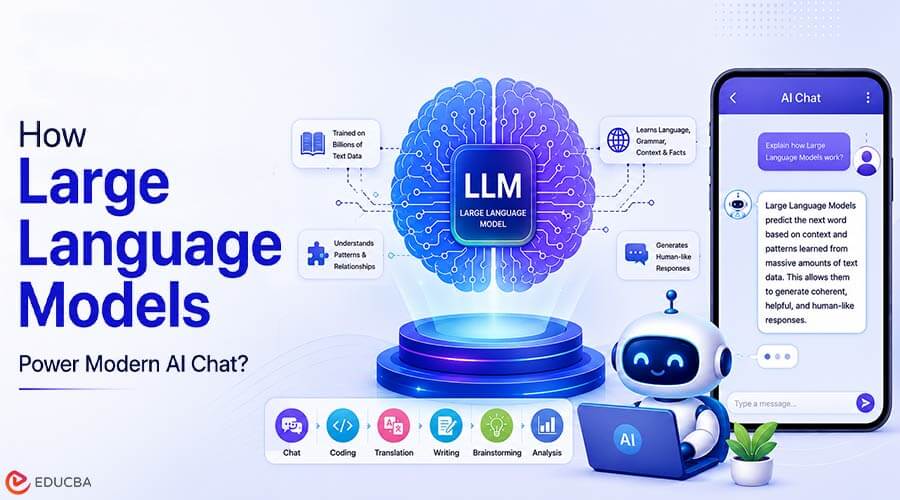
Large Language Models (LLMs) are helping modern AI chat systems feel more alive and become more useful. You can now use these tools for programming, language translation, brainstorming, writing assistance, and much more. It is a tremendous opportunity, and it all stems from the use of Large Language Models, which generate responses dynamically by analyzing language patterns and predicting the most appropriate sequence of words.
What Are Large Language Models (LLMs)?
Large language models (LLMs) are AI systems designed to understand, interpret, and naturally generate human language. During training, the LLM will assess billions of words from public documents, websites, articles, books, and other text sources. But it does not memorize the text. Instead, it learns the statistical relationships among writing styles, concepts, grammar, words, and anything in between. That allows LLMs to perform a multitude of language tasks without requiring separate software, and it’s an important aspect to keep in mind.
How Do Large Language Models Work?
The technology behind Large Language Models is very complex. However, LLMs tend to learn language by predicting the next or missing words during training. As the prediction process continues, the model can develop a strong understanding of vocabulary, grammar, sentence structure, conversational patterns, writing style, common facts, and so on.
Whenever the user enters a prompt, the model is not searching for a memorized answer. Instead, it studies the input and predicts the word sequence that will help create a coherent and useful content piece. Modern LLMs also use attention mechanisms, showing which parts of the conversation are relevant when you generate a new word. Thus, you have a system that allows you to track older messages and maintain consistency, something that’s very powerful.
How Does AI Generate Every Response?
Every answer that’s generated by an AI chatbot follows a specific set of steps, which happens in just a fraction of a second.
User Input
Every interaction with Large Language Models begins when a user submits a prompt. This can be a request, a question, a paragraph, a coding problem, a creative writing prompt, or even a conversation. The AI converts the text into a numerical representation called tokens. These allow the model to process the language mathematically. So even if the user sees sentences and words, the AI is working with their tokenized representation.
Context Analysis
After that, the model studies the existing context. That involves the current prompt, previous messages in the conversation, and the instructions provided to the model. Additionally, you will have relevant relationships between words and ideas, which is a very important aspect of this process. Studying the context is crucial because it makes the conversations appear more natural. It also eliminates awkward situations where the AI should know the previous talks, but there’s no sign of that.
Prediction
Prediction is always at the core of any LLM. The model calculates probabilities for thousands of possible next tokens before selecting one. After the token is selected, the process repeats for the next token until the entire response is generated. The model is also continually studying grammar, context, logical flow, writing style, and user intent, all of which are extremely important.
Response Generation
Once enough tokens have been generated, they are converted back into readable text. Extra systems can also review the response to improve its formatting, instruction-following, clarity, safety, and helpfulness. Once all of those are improved, the text will be presented to the user.
What LLMs Can and Cannot Do?
While Large Language Models are incredibly capable, they are not perfect. They can do a lot, but there are tons they can not do. What they can do is explain complex topics in simpler terms; summarize content; translate between languages; write articles and reports; brainstorm ideas; assist with programming; answer general knowledge questions; edit and improve text; and generate creative stories and dialogue.
However, an LLM can’t think like a human. It has neither emotions nor a conscience. It won’t understand the world via personal experience, and it won’t know every fact with perfect accuracy. Also, it does not automatically verify the generated statement for correctness, which matters quite a bit. The LLM will, however, predict language patterns rather than confirm information. That’s why you do not really want to use it in crucial decision-making situations.
As Large Language Models continue to improve, they are becoming more accurate, more efficient, and better able to handle increasingly complex tasks. Their growing role in AI chat, content creation, software development, and business automation highlights why they have become one of the most important technologies in modern artificial intelligence.
What is Next for Large Language Models?
The world of LLMs is continually evolving, and we see a very bright future. For example, we expect LLMs to have better long-term context, improved reasoning, and more personalized experiences. Additionally, we expect to see multimodal capabilities and greater efficiency, as researchers continue to work on LLMs.
Large Language Models are the foundation of today’s AI chat systems. These Large Language Models enable conversational AI to understand context, generate human-like responses, and support countless applications across industries. They are designed to provide valuable assistance across many AI use cases, and it’s up to us to harness those features and take them to the next level. However, using AI will always have its challenges, which is why you want to implement it wisely. As you do that and focus on putting the best systems in place, the outcome can be great and will help take things to the next level, as long as the LLM systems behind it continue to grow and evolve.
Final Thoughts
Large Language Models have transformed the way AI chat systems understand and generate human language. By analyzing context, predicting the next sequence of words, and continuously improving through advanced training techniques, they power many of the AI tools people use every day. While Large Language Models are highly capable, they still have limitations and should be used alongside human judgment, especially for important decisions. As advancements continue, Large Language Models are expected to become more accurate, efficient, and adaptable, driving the next generation of AI-powered communication and digital experiences.
Recommended Articles
We hope this guide on Large Language Models helps you understand how they power modern AI chat systems and generate human-like responses. Explore these recommended articles to gain deeper insights into artificial intelligence, generative AI, machine learning, and the emerging technologies driving intelligent communication.


