


What is IT Infrastructure?
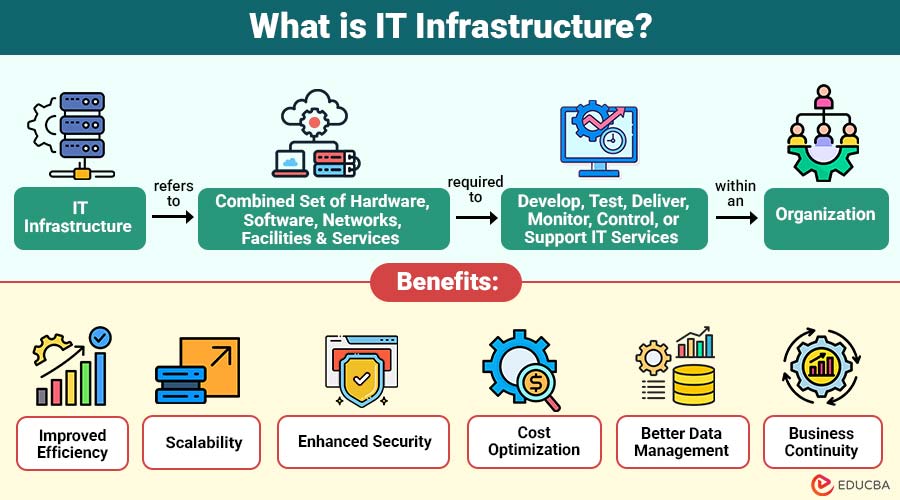
IT infrastructure refers to combined set of hardware, software, networks, facilities, and services required to develop, test, deliver, monitor, control, or support IT services within an organization. It serves as the foundation for all digital operations and applications.
For example, a bank uses computers (hardware), banking software, internet networks, secure servers, and IT support teams to run online banking services. All these together form its IT infrastructure that helps customers check balances, transfer money, and access services securely anytime.
Table of Contents:
Key Takeaways:
- IT infrastructure integrates hardware, software, networks, and services to support efficient, secure digital operations for a business.
- Modern infrastructure emphasizes scalability, flexibility, and cloud adoption to handle dynamic workloads and support growth effectively.
- Strong security, maintenance, and monitoring are essential to protect data and ensure continuous system performance.
- Hybrid and hyperconverged infrastructures simplify management while combining on-premises and cloud environments for better performance.
Key Components of IT Infrastructure
Here are the key components that form the foundation of a robust and efficient IT infrastructure:
- Hardware: Hardware includes physical devices such as servers, computers, routers, and storage systems, which form the foundation for data processing.
- Software: Software includes operating systems, enterprise applications, and management tools that enable organizations to perform tasks efficiently and securely.
- Network: Networking connects devices and systems, enabling communication and data exchange through routers, switches, firewalls, and internet connectivity.
- Data Storage: Data storage includes HDDs, SSDs, and cloud platforms, ensuring the availability, integrity, and security of organizational critical data.
- Data Centers: Data center facilities house servers, storage, and networking equipment, and environments for managing and processing large data volumes.
- IT Services: IT services include system administration, cybersecurity, cloud services, and helpdesk support, ensuring smooth and efficient IT operations.
Types of IT Infrastructure
Here are the main types used by organizations based on their operational and scalability needs:
- Traditional Infrastructure: This setup involves physical servers, storage, and networking components located on-premises. Organizations manage and maintain all resources internally.
- Cloud Infrastructure: Cloud infrastructure uses virtual resources hosted on remote servers. It offers flexibility, scalability, and cost-efficiency, making it highly popular among modern businesses.
- Hyperconverged Infrastructure: HCI streamlines management and boosts performance by integrating networking, compute, and storage into a single system.
- Hybrid Infrastructure: By combining on-premises and cloud environments, hybrid infrastructure enables businesses to take use of both systems’ advantages.
Benefits of IT Infrastructure
Here are the key benefits that provides to organizations for growth and operational efficiency:
- Improved Efficiency: A well-designed system streamlines operations, reduces downtime, improves workflows, and significantly enhances overall productivity across business processes.
- Scalability: Businesses may readily scale resources up or down in response to demand, allowing for flexibility, expansion, and effective management of variations in workload.
- Enhanced Security: To protect critical organizational data, modern systems incorporate sophisticated security features including intrusion detection systems, firewalls, and encryption.
- Cost Optimization: Cloud solutions and virtualization reduce reliance on physical hardware, maintenance, and operational costs while improving resource utilization efficiency.
- Better Data Management: Efficient storage and backup systems ensure data availability, consistency, and quick recovery, supporting informed decision-making and business continuity strategies.
- Business Continuity: Robust systems minimize disruptions, ensure continuous operations, and support effective recovery from failures, disasters, or cybersecurity incidents.
Challenges of IT Infrastructure
Here are some of the key challenges organizations face while managing and maintaining it:
- High Initial Investment: Conventional IT infrastructure increases the initial financial burden by requiring a large upfront investment in networking equipment, hardware, software, and configuration.
- Complexity: Managing diverse systems, technologies, and integrations can be highly complex, requiring skilled professionals to ensure efficient coordination and smooth operations.
- Security Risks: Sensitive data and company continuity are seriously threatened by cyberthreats like ransomware attacks, malware, and data breaches.
- Maintenance and Upgrades: Regular maintenance, updates, and system upgrades are essential to maintain performance, compatibility, and strong security across infrastructure components.
- Downtime Issues: Technical issues or system failures can lead to financial loss, damage reputation, disrupt work, and reduce productivity.
Difference Between IT Infrastructure and Cloud Infrastructure
Here is a clear difference based on key features:
| Feature | IT Infrastructure | Cloud Infrastructure |
| Location | On-premises | Remote servers |
| Cost | High upfront cost | Pay-as-you-go |
| Scalability | Limited | Highly scalable |
| Maintenance | Managed internally | Managed by the provider |
| Flexibility | Less flexible | Highly flexible |
Real-World Examples
Here are some practical examples showing how IT infrastructure is used across different industries:
- Healthcare Industry: Hospitals use IT infrastructure to manage patient records, diagnostic systems, and telemedicine services, improving overall healthcare delivery processes.
- E-commerce Platforms: Online stores depend on robust IT infrastructure for website hosting, secure payment processing, inventory management, and seamless customer experiences.
- Education Sector: Educational institutions use IT infrastructure for e-learning platforms, virtual classrooms, digital resources, and efficient administrative management systems.
- Manufacturing Industry: Manufacturers use IT infrastructure for automation, supply chain management, inventory tracking, and efficient production monitoring.
Future Trends in IT Infrastructure
Here are the emerging trends shaping the future and transforming how organizations operate globally:
- Cloud Computing Growth: As companies use scalable, adaptable, and affordable solutions for computing, storage, and application deployment worldwide, cloud use keeps growing.
- Edge Computing: By processing data closer to devices, edge computing lowers latency, boosts real-time analytics, and improves performance for Internet of Things applications.
- Artificial Intelligence Integration: Artificial intelligence enhances IT infrastructure through predictive maintenance, automation, anomaly detection, and smarter decision-making across systems and operations.
- Green IT Infrastructure: In order to lessen the influence on the environment and carbon footprint, green IT infrastructure places a high priority on energy-efficient technologies, renewable resources, and sustainable practices.
- Software-Defined Infrastructure: Software-defined infrastructure uses software to automatically manage hardware resources, making systems more flexible, easier to expand, and simpler to control from one place.
Final Thoughts
IT infrastructure is critical component of modern business operations, enabling organizations to function efficiently and securely in a digital environment. From traditional setups to advanced cloud-based systems, the evolution of IT infrastructure continues to drive innovation and growth. Businesses may improve performance, guarantee scalability, and maintain competitiveness in a rapidly evolving technology landscape by investing in the appropriate infrastructure and adhering to best practices.
Frequently Asked Questions (FAQs)
Q1. What are the latest trends in IT infrastructure?
Answer: Key trends include cloud computing, edge computing, AI integration, and green IT practices.
Q2. How can companies improve their IT infrastructure?
Answer: Companies can improve their IT infrastructure by adopting cloud solutions, upgrading hardware, strengthening security, automating processes, and monitoring performance regularly.
Q3. What skills are required to manage IT infrastructure?
Answer: Managing IT infrastructure requires skills in networking, system administration, cloud computing, cybersecurity, troubleshooting, and monitoring tools.
Recommended Articles
We hope that this EDUCBA information on “IT Infrastructure” was beneficial to you. You can view EDUCBA’s recommended articles for more information.

