


Updated October 28, 2025
What is Intelligent Process Automation (IPA)?
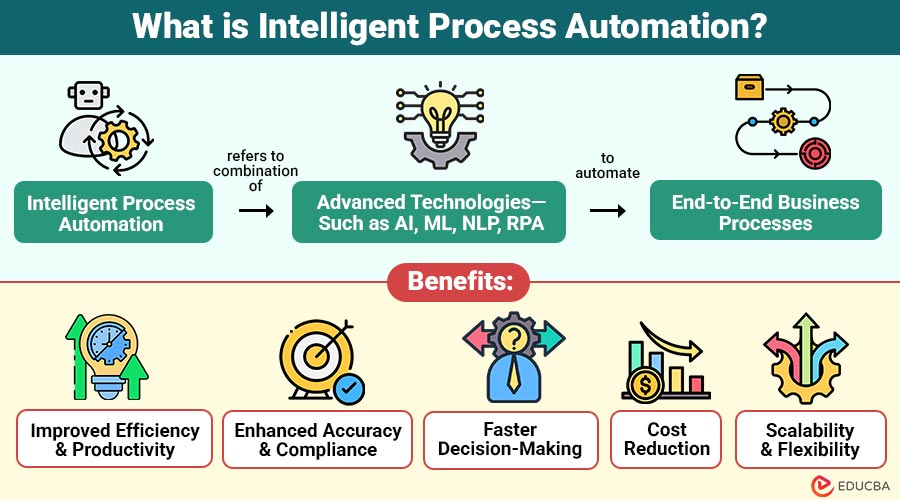
Intelligent Process Automation refers to combination of advanced technologies—such as Artificial Intelligence, machine learning, natural language processing, and robotic process automation —to automate end-to-end business processes. Unlike traditional automation, which focuses on repetitive, rule-based tasks, IPA can analyze data, make context-aware decisions, and learn over time, making it suitable for complex, dynamic business environments.
For example, in the banking sector, IPA can automate loan processing by extracting data from documents, verifying customer information using AI models, and routing applications through approval workflows—all without human intervention.
Table of Contents:
Key Takeaways:
- Intelligent Process Automation integrates AI, ML, NLP, and RPA to automate complex end-to-end business processes efficiently.
- IPA enhances productivity, accuracy, and decision-making by combining intelligent data analysis with automated workflows.
- Businesses across industries—like banking, healthcare, and logistics—use IPA to streamline operations and reduce costs.
- Successful IPA implementation requires quality data, skilled talent, strong governance, and effective change management strategies.
How Intelligent Process Automation Works?
The IPA process can be summarized in several key steps:
1. Process Identification
Analyze business workflows to identify repetitive, rule-based, or data-intensive tasks that can be automated for improved efficiency and accuracy.
2. Process Mapping
Document and map existing workflows to identify gaps, dependencies, and opportunities for intelligent automation to reduce manual intervention.
3. Automation Deployment
Implement RPA bots combined with AI and ML models to automatically execute, learn, and optimize complex processes across different business systems.
4. Monitoring and Optimization
Continuously track automated process performance, gather insights through analytics, and refine automation strategies using real-time machine learning feedback.
Key Components of Intelligent Process Automation
IPA operates by integrating several intelligent technologies that work together to optimize workflows. The major components include:
1. Robotic Process Automation
RPA automates repetitive, rule-based tasks such as data entry, invoice processing, and report generation. It serves as the foundation of IPA by mimicking human actions across systems.
2. Artificial Intelligence
AI brings cognitive abilities —such as reasoning, perception, and problem-solving — to automation. It enables systems to make smart decisions and adapt to changes in input or environment.
3. Machine Learning
Without explicit programming, machines can learn from past data and get better over time. It helps predict outcomes, detect anomalies, and refine the accuracy of automated processes.
4. Natural Language Processing
NLP enables computers to comprehend and analyze human language, enabling intelligent user interaction through chatbots, virtual assistants, and sentiment analysis tools.
5. Computer Vision
This component helps systems interpret and process visual information, such as scanned documents or images, enabling tasks like image recognition and document verification.
6. Process Mining
Process mining tools analyze event logs from enterprise systems to identify inefficiencies, bottlenecks, and opportunities for automation improvement.
Key Differences: Intelligent Process Automation vs Traditional Robotic Process Automation
Here are the key differences between Intelligent Process Automation (IPA) and Traditional Robotic Process Automation (RPA):
| Feature | Intelligent Process Automation | Traditional Robotic Procss Automation |
| Data Handling | Structured and unstructured data | Structured data only |
| Decision-Making | Context-aware and AI-driven | Rule-based |
| Learning Capability | Uses ML to self-improve | None |
| Complexity of Tasks | Handles dynamic, complex processes | Handles repetitive, simple tasks |
| Human Intervention | Minimal | Frequent |
| Scalability | High, adaptive | Limited |
Benefits of Intelligent Process Automation
The adoption of IPA offers numerous benefits across industries. Here are some of the most impactful benefits:
1. Improved Efficiency and Productivity
IPA eliminates repetitive manual work, allowing employees to focus on strategic and creative tasks, which boosts overall productivity.
2. Enhanced Accuracy and Compliance
By automating data-driven processes, IPA reduces the chances of human errors and ensures compliance with industry standards and regulations.
3. Faster Decision-Making
AI-driven analytics enable quick and accurate decision-making by processing large volumes of data in real time.
4. Cost Reduction
Automation minimizes labor costs, streamlines operations, and improves resource utilization, resulting in substantial cost savings.
5. Scalability and Flexibility
IPA systems can be easily scaled up or down according to business needs without major infrastructure changes.
Challenges in Implementing Intelligent Process Automation
While IPA offers immense potential, organizations may encounter challenges such as:
1. High Initial Investment
Implementing Intelligent Process Automation requires substantial upfront costs for AI, RPA tools, infrastructure setup, and employee training programs.
2. Data Quality Issues
Inaccurate, inconsistent, or incomplete data can hinder intelligent systems’ learning, affecting automation accuracy and overall process efficiency.
3. Skill Gaps
IPA implementation demands skilled professionals with AI, RPA, and analytics expertise, often creating workforce challenges and training requirements.
4. Change Management
Employee resistance, lack of understanding, and inadequate communication can delay IPA adoption and reduce the effectiveness of organizational transformation.
5. Security and Compliance Risks
To prevent breaches and legal repercussions, automated procedures must adhere to stringent cybersecurity protocols and data protection rules.
Real-World Use Cases
Here are some real-world use cases showcasing how Intelligent Process Automation (IPA) is transforming different industries:
1. Banking and Financial Services
IPA automates customer onboarding, credit scoring, and fraud detection using AI-powered algorithms. For instance, banks use IPA to automatically process loan applications, analyze risk, and verify documents.
2. Healthcare
In healthcare, IPA supports patient data management, billing, and diagnostic reporting. It helps hospitals reduce administrative workloads and focus on patient care.
3. Supply Chain and Logistics
IPA enhances logistics efficiency by predicting demand, optimizing routes, and managing inventory levels through real-time analytics.
4. Human Resources
Automation assists HR departments with onboarding employees, payroll management, and resume screening using AI and NLP.
5. Insurance
IPA can automatically process claims, detect fraud, and provide customer support, reducing the time required to settle claims and enhancing customer trust.
6. Manufacturing
In manufacturing, IPA streamlines operations by integrating with IoT devices to monitor equipment, predict failures, and maintain quality standards.
Final Thoughts
Intelligent Process Automation represents significant leap forward from traditional automation methods. By combining RPA with AI, ML, and NLP, organizations can automate not only repetitive tasks but also complex decision-driven processes. With advantages such as improved precision, effectiveness, and customer satisfaction, IPA has emerged as a strategic imperative for businesses looking to maintain competitiveness in the digital age. Businesses that embrace IPA today are setting the foundation for tomorrow’s intelligent enterprise.
Frequently Asked Questions (FAQs)
Q1. What industries use Intelligent Process Automation?
Answer: Industries like banking, healthcare, insurance, logistics, and manufacturing actively use IPA to enhance efficiency and reduce costs.
Q2. Is Intelligent Process Automation expensive to implement?
Answer: While initial costs can be high, the long-term benefits in productivity, accuracy, and cost savings often outweigh the investment.
Q3. What is the future of Intelligent Process Automation?
Answer: The future lies in hyperautomation, where organizations use AI, ML, and analytics to automate end-to-end processes across all departments seamlessly.
Recommended Articles
We hope that this EDUCBA information on “Intelligent Process Automation” was beneficial to you. You can view EDUCBA’s recommended articles for more information.


