
What is Infrastructure Automation?
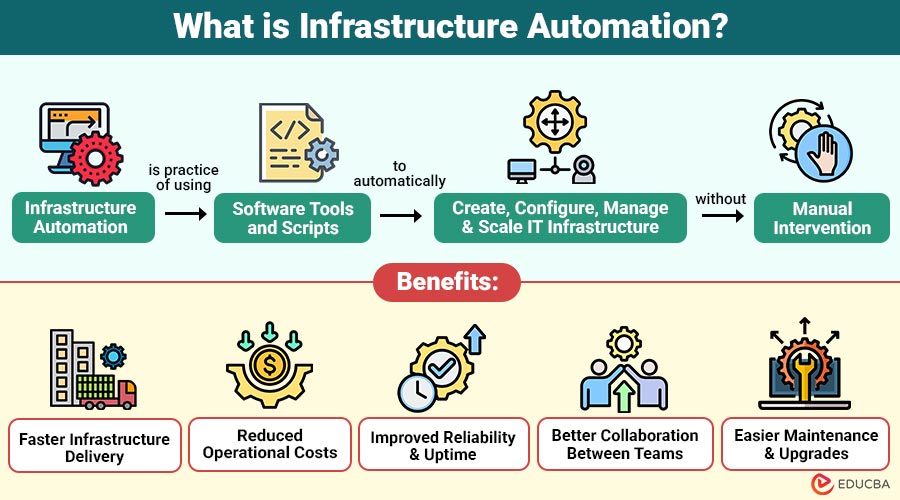
Infrastructure automation is practice of using software tools and scripts to automatically create, configure, manage, and scale IT infrastructure without manual intervention.
Instead of manually setting up servers, installing software, or configuring networks, teams define infrastructure requirements as code. Automation tools then execute these definitions to provision infrastructure reliably across environments such as development, testing, staging, and production.
Table of Contents:
- Meaning
- Importance
- Key Components
- Popular Tools
- Benefits
- Use Cases
- Challenges
- Real-World Example
- Best Practices
Key Takeaways:
- Infrastructure automation replaces manual infrastructure tasks with code-driven workflows, ensuring speed, consistency, scalability, and reliability.
- Infrastructure as Code enables repeatable, version-controlled infrastructure creation across cloud, on-premises, and hybrid environments.
- Automation reduces operational costs, human errors, and downtime while improving collaboration between development, operations, and security teams.
- Adopting infrastructure automation is essential for modern DevOps practices, continuous delivery, resilience, and long-term business competitiveness.
Why is Infrastructure Automation Important?
Here are the key reasons why infrastructure automation is essential for modern, scalable, and reliable IT operations:
1. Speed
Infrastructure automation provisions servers in minutes instead of days or weeks, accelerating development, testing, and production deployments.
2. Consistency
Automation makes sure every environment is set up the same way, preventing errors, mismatches, and problems when deploying software.
3. Reliability
Automated infrastructure processes minimize manual intervention, significantly reducing human errors, failures, outages, and overall operational instability risks.
4. Scalability
Automation enables systems to scale automatically based on demand, handling traffic spikes efficiently without manual intervention.
5. Cost Optimization
Automated infrastructure adds or removes resources as needed, saving money, reducing waste, and making systems work more efficiently.
Key Components of Infrastructure Automation
The core components of infrastructure automation are outlined below, each playing a crucial role in building reliable, scalable systems.
1. Infrastructure as Code
Infrastructure as Code defines servers, networks, and resources using code files, enabling automated setup, version control, consistency, repeatability, and easy rollback across environments.
2. Configuration Management
Configuration management keeps systems correct by automatically installing software, updating, enforcing settings, and fixing changes without manual work.
3. Provisioning and Orchestration
Provisioning sets up the infrastructure, while orchestration makes sure all tasks run in the right order so applications and services work together smoothly
4. Monitoring and Auto-Remediation
Monitoring and auto-remediation detect infrastructure issues in real time and automatically fix problems, ensuring system availability, performance stability, and self-healing operations.
Popular Infrastructure Automation Tools
Some commonly used tools in infrastructure automation include:
1. Terraform
Provision cloud and on-premises infrastructure consistently using declarative configuration files across multiple providers.
2. Ansible
It automatically sets up systems, installs applications, and runs tasks using simple, easy-to-read instructions written in YAML.
3. Chef & Puppet
Manage system configurations and enforce compliance through code-based policies and continuous configuration enforcement.
4. AWS CloudFormation
Automates AWS infrastructure creation and management using JSON or YAML templates.
5. Azure ARM / Bicep
Define, deploy, and manage Azure resources using declarative templates and simplified domain-specific language.
6. Kubernetes
Orchestrates containerized applications, managing deployment, scaling, networking, and infrastructure abstraction automatically.
Benefits of Infrastructure Automation
Here are the key benefits of infrastructure automation, highlighting how organizations improve speed, reliability, security, and cost efficiency.
1. Faster Infrastructure Delivery
Automation enables rapid infrastructure provisioning, reducing setup time from weeks to minutes.
2. Reduced Operational Costs
By minimizing manual tasks and resource wastage, automation significantly lowers operational and infrastructure management costs.
3. Improved Reliability and Uptime
Standardized automated processes reduce human errors, ensuring stable environments and higher system availability.
4. Better Collaboration Between Teams
Shared infrastructure code improves visibility, alignment, and collaboration between development, operations, and security teams.
5. Easier Maintenance and Upgrades
Automated updates simplify maintenance tasks, ensuring smooth upgrades with minimal service disruption.
Use Cases of Infrastructure Automation
Here are the key use cases of infrastructure automation that demonstrate how organizations streamline operations, improve reliability, and scale efficiently.
1. Cloud Provisioning
Organizations automatically provision cloud environments on demand for development, testing, and production, eliminating delays, approvals, and errors.
2. DevOps and CI/CD Pipelines
Automation creates test environments, deploys applications consistently, and destroys temporary infrastructure, enabling faster, reliable, continuous software releases.
3. Disaster Recovery
Automated infrastructure lets you quickly rebuild systems after problems, reducing downtime and keeping the business running.
4. Compliance and Security
Automation keeps security settings consistent, follows compliance rules automatically, and makes audits easier by using repeatable, version-controlled setups.
5. Scaling Application
Infrastructure automatically scales resources based on traffic and workloads, maintaining performance during peak demand without manual intervention.
Challenges of Infrastructure Automation
Here are the main challenges organizations face when implementing infrastructure automation effectively.
1. Initial Learning Curve
Teams face steep initial learning curves in understanding automation concepts, tools, scripting languages, and best practices effectively organization-wide.
2. Tool Selection Complexity
Choosing appropriate automation tools is complex due to overlapping features, integrations, varying scalability needs, and an ever-evolving ecosystem.
3. Error Propagation Risk
4. Cultural Shift Requirement
Infrastructure automation requires cultural shifts toward DevOps practices, collaboration, shared ownership, and continuous improvement across teams organization-wide.
Real-World Example
Here is a real-world example showing how organizations achieve efficiency, reliability, and agility through infrastructure automation.
A global e-commerce company migrated from manual server provisioning to infrastructure automation using Infrastructure as Code and cloud orchestration.
Results achieved:
- Infrastructure setup time reduced from days to minutes
- Deployment failures decreased by over 40%
- Improved system availability during high-traffic events
- Faster onboarding of new development teams
This demonstrates how infrastructure automation directly impacts business agility and reliability.
Best Practices for Infrastructure Automation
Here are some recommended best practices to ensure effective, secure, and reliable infrastructure automation.
1. Use Version Control
Store all infrastructure code in version control systems to track changes, enable collaboration, and support safe rollbacks.
2. Modular and Reusable Scripts
Design automation scripts to be modular and reusable, simplifying maintenance, scalability, and long-term infrastructure evolution.
3. Pre-Production Testing
Test infrastructure changes in staging environments before production deployment to prevent outages and unexpected failures.
4. Least-Privilege Security
Apply least-privilege access principles to automation tools, limiting permissions and reducing security risks effectively.
5. Continuous Monitoring
Continuously monitor automated systems to proactively detect failures, performance issues, and configuration drift.
6. Clear Documentation
Write down document automation steps clearly so teams can understand, learn, fix issues, and use them consistently.
Future of Infrastructure Automation
The future of infrastructure automation includes:
1. AI-driven Automation and Predictive Scaling
AI analyzes usage patterns to automatically scale infrastructure resources before performance issues or traffic spikes occur.
2. Increased Adoption of GitOps
Infrastructure and deployments are managed through Git repositories, enabling version control, automation, consistency, and easy rollbacks.
3. Policy-as-Code for Security and Governance
Security, compliance, and governance rules are defined as code and automatically enforced across infrastructure environments.
4. Serverless and Platform-based Abstractions
Developers focus on applications, while platforms automatically manage servers, scaling, availability, and underlying infrastructure.
Final Thoughts
Infrastructure automation is a foundational capability for modern IT and DevOps-driven organizations. Automation takes the place of slow and mistake-prone manual work with dependable, repeatable processes. Using automation helps businesses deliver faster, stay more secure, run efficiently, and handle problems better. As systems get more complex, automating infrastructure is key to staying innovative and competitive.
Frequently Asked Questions (FAQs)
Q1. Is Infrastructure Automation only for cloud environments?
Answer: No. It can be used for on-premises, hybrid, and cloud infrastructure.
Q2. Does Infrastructure Automation replace operations teams?
Answer: No. It empowers operations teams to work more efficiently and focus on higher-value tasks.
Q3. Is Infrastructure Automation secure?
Answer: Yes, when implemented correctly with access controls, encryption, and compliance policies.
Q4. Do small teams need Infrastructure Automation?
Answer: Yes. Automation helps small teams scale faster with fewer resources.
Recommended Articles
We hope that this EDUCBA information on “Infrastructure Automation” was beneficial to you. You can view EDUCBA’s recommended articles for more information.


