
What is Incremental Testing?
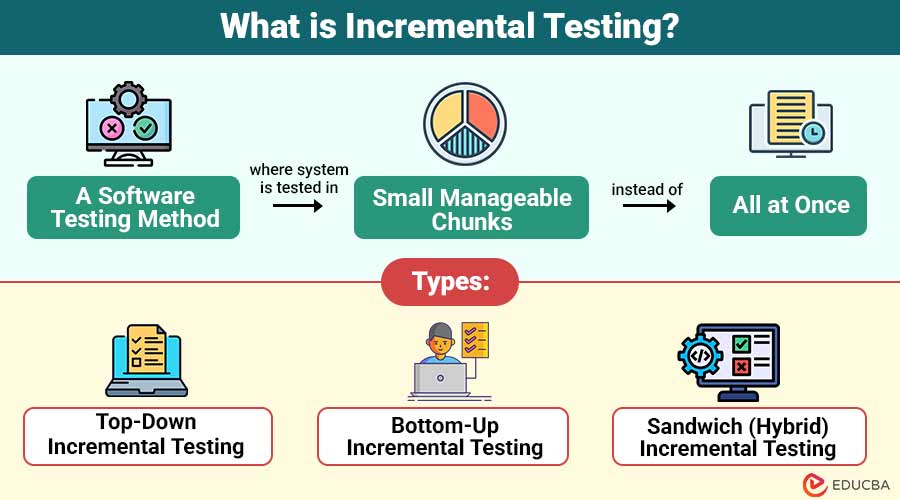
Incremental testing is a software testing method where the system is tested in small manageable chunks instead of all at once. Developers or testers add and test one module or function at a time, making it easier to detect issues early and ensure each part works correctly with the others.
For example, imagine you are building a calculator app. Instead of testing the entire app after development is complete, you first test the addition module, then the subtraction module, and then test how they work together. This is incremental testing in action.
Table of Contents:
- Meaning
- Why Use Incremental Testing?
- Types
- When Should You Use?
- Real World Example
- Pros and Cons
- Tools
- Best Practices
Key Takeaways:
- Incremental testing detects bugs early by verifying modules individually and their integration step-by-step.
- It supports Agile and DevOps by enabling continuous testing, faster feedback, and smooth integration.
- Modular design and automated tools are essential for efficient and scalable incremental testing.
- Though initial setup is effortful, it improves long-term quality, saves time, and reduces testing risks.
Why Use Incremental Testing?
Incremental testing is popular among development teams for many reasons:
1. Early Bug Detection
The development team identifies issues early in the cycle, making them quicker, easier, and less costly to locate and fix.
2. Faster Development
Developers minimize integration issues later by testing modules as they are developed, efficiently accelerating the overall software development and deployment process.
3. Modular Approach
By testing in small units, large and complex systems become easier to manage, debug, and maintain throughout the development cycle.
4. Improved Confidence
Incremental testing ensures each component works properly, increasing team confidence before integrating new features or expanding system functionality.
Types of Incremental Testing
There are three main types based on the direction of integration:
1. Top-Down Incremental Testing
- Modules are integrated and tested from the top (main module) down to the lower-level modules.
- Stubs (dummy programs) are used to simulate the lower modules.
- Suitable when high-level logic and user flows are ready early.
2. Bottom-Up Incremental Testing
- Testing starts from the lower-level modules and moves upward.
- Drivers (test programs) are used to call the lower modules.
- It is best when utility functions or core logic components are developed first.
3. Sandwich (Hybrid) Incremental Testing
- Combines top-down and bottom-up approaches.
- Testing is done simultaneously from both ends and converges in the middle.
- Efficient for large and complex systems.
When Should You Use Incremental Testing?
Use incremental testing when:
1. Large or Complex System
Ideal when developing large or complex systems to manage integration risks and detect issues in smaller parts.
2. Agile, Scrum, or DevOps Teams
Agile, Scrum, and DevOps practices benefit from incremental testing by supporting continuous integration, early feedback, and faster release cycles.
3. Independent Module Development
When system components can be developed separately, testing helps verify each module individually before integrating it with others confidently.
4. Avoid Full Retesting on Changes
It is beneficial when you want to avoid retesting the entire system after every minor code update or modular enhancement.
Real World Example
Here is a practical scenario showing how incremental testing is applied during the development of a food delivery app.
Scenario: Building a Food Delivery App
- Step 1: Test the login module
- Step 2: Test restaurant search
- Step 3: Integrate and test the cart system
- Step 4: Test payment processing
- Step 5: Integrate everything incrementally and test connections
At each step, developers run tests only on the newly added module and its interactions, not the entire app. This saves time, reduces risk, and improves the reliability of the software.
Pros and Cons of Incremental Testing
Here are the pros and cons of using incremental testing during the software development lifecycle.
Pros:
- Helps quickly identify and isolate bugs in specific modules, reducing debugging time and improving overall software reliability.
- Saves testing time by avoiding full-system retests, allowing efficient validation of only the newly integrated or updated modules.
- Perfectly aligns with Agile development by enabling continuous integration, iterative improvements, and frequent feedback throughout the development lifecycle.
- Adding and testing each module gradually enhances test coverage, ensuring broader validation of the complete system.
Cons:
- Detailed planning and well-defined module boundaries ensure smooth testing flow and proper handling of dependencies.
- Requires creating stubs and drivers for simulating unbuilt modules, increasing the initial effort and complexity of testing.
- Developers may encounter integration issues or dependency errors if they do not combine modules in a proper and compatible sequence.
- Testing becomes difficult and error-prone if modules are tightly coupled or lack a clear separation of functionality and responsibilities.
Tools That Support Incremental Testing
Some tools that can help automate or assist include:
1. JUnit
A popular Java testing framework called JUnit facilitates progressive unit testing by allowing for test automation, execution, and modular component verification.
2. TestNG
TestNG is a Java testing framework that facilitates incremental testing through powerful grouping, sequencing, and parallel execution features, making continuous integration efficient and scalable.
3. PyTest
PyTest is a Python testing tool that supports incremental testing by allowing modular test structures, fixtures, and plugins for efficient test automation in agile environments.
4. Google Test
Google Test is a C++ framework that enables incremental testing by allowing developers to write modular unit tests and integrate them with build systems for automation.
5. CI/CD Tools like Jenkins or GitHub Actions
CI/CD tools automate incremental builds and tests by triggering test workflows after code changes, ensuring early detection of defects during development and integration phases.
Best Practices
Here are the essential best practices to follow for successful and efficient incremental testing throughout the software development lifecycle:
1. Modular Design
Break your software into small, independent, and clearly defined modules to enable focused testing, simplify debugging, and support better code maintainability and scalability.
2. Version Control
Utilize Git or similar version control tools to track code changes and trigger incremental tests only for updated components, improving test efficiency and speed.
3. Automated Testing
Implement automated test frameworks that continuously execute incremental tests after each change, ensuring quick feedback, higher accuracy, and reduced manual intervention in the testing cycle.
4. Mock Dependencies
Use stubs, drivers, and mocks to simulate the behavior of unbuilt or external modules, enabling testing in isolation and supporting early-stage incremental test execution.
5. Test Documentation
Maintain detailed records of tests performed at each increment, including results and coverage, to ensure traceability, auditability, and consistent understanding of testing progress.
Final Thoughts
Incremental testing is more than just a technique — it is a philosophy that supports better software development through smart planning, early error detection, and step-by-step confidence building. Whether you are a startup building your first app or an enterprise managing large systems, this method keeps testing lean, focused, and efficient.
Frequently Asked Questions (FAQs)
Q1. Is incremental testing the same as unit testing?
Answer: No. Incremental testing tests modules together as they are integrated, whereas unit testing checks individual functions or methods in isolation.
Q2. Can incremental testing be automated?
Answer: Yes. Most modern CI/CD pipelines automatically run incremental tests whenever they detect a change in a specific module or file.
Q3. What industries benefit from incremental testing?
Answer: Almost all, especially finance, healthcare, e-commerce, and telecommunications, where reliability and quick iteration matter.
Q4. Does incremental testing require extra effort?
Answer: Initially, yes. You need to plan the testing sequence and possibly write stubs and drivers. But in the long run, it saves time and improves test quality.
Recommended Articles
We hope that this EDUCBA information on “Incremental Testing” was beneficial to you. You can view EDUCBA’s recommended articles for more information.

